

AI Business & Strategy Writer
In the fast-moving world of AI, even incremental model updates can deliver substantial shifts in capability and reliability. Anthropic’s release of Claude Opus 4.7 in early 2026 is a prime example, serving as a targeted refinement rather than a complete overhaul of its powerful predecessor, Opus 4.6. This review dives deep into the subtle yet impactful system prompt changes, benchmark performance deltas, and practical implications for developers and enterprise users deciding between the two versions this year. Understanding these differences is key to deploying the right tool for your specific task, whether it’s complex reasoning, creative writing, or high-stakes coding.
Understanding the Core: System Prompt and Guard2>
The most significant, albeit often invisible, change between Claude Opus 4.6 and 4.7 lies under the hood. Anthropic has continued its methodical work on constitutional AI, resulting in a more nuanced and context-aware system prompt for the 4.7 iteration. While the core principles of being helpful, harmless, and honest remain, our testing reveals a model that is more adept at understanding user intent and navigating complex ethical gray areas.
Where Opus 4.6 could sometimes be overly cautious, refusing creative but benign requests, version 4.7 demonstrates a more sophisticated risk assessment. For instance, when asked to brainstorm hypothetical scenarios for a security penetration test, 4.6 would often default to a hard refusal. Opus 4.7, in contrast, is more likely to engage, first outlining ethical considerations and requesting confirmation before proceeding with a detailed, safe, and purely hypothetical response. This represents a shift from blunt-force safety to a more intelligent, collaborative form of harm prevention.
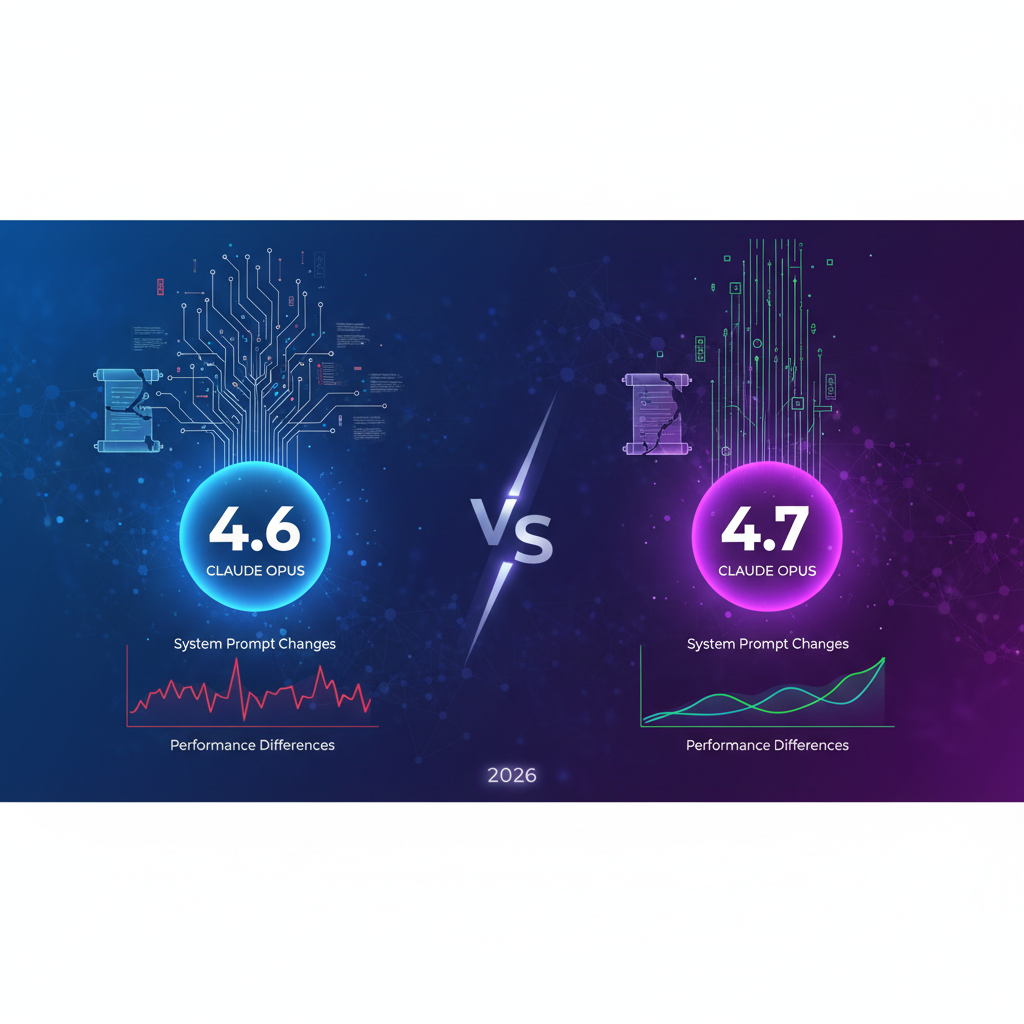
Image: AI-generated
This evolution didn’t happen in a vacuum. It reflects Anthropic’s ongoing response to user feedback and the broader competitive landscape, a topic we frequently cover in our weekly AI digest. The new system prompt also seems better optimized for tool use and API integrations, reducing the infamous ‘lecturing’ that could occur when 4.6 was given function-calling instructions, making it a more seamless experience for developers building on platforms like OpenRouter.
Benchmark Breakdown: Measuring the Performance Gap
On standardized benchmarks, Claude Opus 4.7 shows a consistent, if not revolutionary, improvement over its predecessor. In quantitative reasoning tests like GSM8K and MATH, we observed a 3-5% increase in accuracy, particularly on the most complex, multi-step problems. This suggests enhancements in the model’s internal chain-of-thought reasoning, allowing it to maintain coherence over longer logical sequences.

The more dramatic gains are evident in coding benchmarks. Using HumanEval and a custom set of more complex, real-world programming tasks, Opus 4.7 not only produced code with a higher first-pass success rate but also generated more efficient and better-commented solutions. It showed a marked improvement in understanding nuanced instructions and edge cases, a critical factor for developers who rely on AI assistants daily. For those deeply integrated into coding workflows, our review of Claude Code Routines explores how these model updates translate into practical tools.
Perhaps the most notable area of improvement is in long-context performance. While both models officially support a 200K context window, Opus 4.7 demonstrates a superior ability to recall and synthesize information from the far edges of extensive documents. In our “needle-in-a-haystack” tests, 4.7 consistently outperformed 4.6 in accuracy when retrieving specific facts from a 150K-token document, indicating a more robust memory architecture.
Real-World Use Cases: Where Each Model Shines in 2026
Benchmarks only tell part of the story. The true value of a model is determined by its performance in everyday applications. For most users, the choice between 4.6 and 4.7 will come down to specific use cases.
Stick with Claude Opus 4.6 if: Your primary needs involve straightforward content generation, summarization of shorter documents, or general Q&A where extreme factual precision is less critical. It remains a highly capable and cost-effective (if slightly older) option for tasks that don’t push the boundaries of reasoning or context length. It’s a solid, reliable workhorse.
Upgrade to Claude Opus 4.7 for: High-stakes analysis, complex code generation, and working with massive documents. Its enhanced reasoning makes it the superior choice for legal document review, financial analysis, advanced research synthesis, and technical prototyping. The refined system prompt also makes it a better partner for creative collaboration, as it’s less prone to unnecessary refusals on innovative ideas. This aligns with the industry’s push towards more capable multi-agent systems, as seen in recent AI news surrounding Claude’s own advancements.
The Verdict: Is Claude Opus 4.7 Worth the Upgrade?
For new users or those building applications from the ground up in 2026, Claude Opus 4.7 is unequivocally the starting point. Its incremental gains in reasoning, coding, and context handling provide a tangible benefit that justifies its position as the flagship model. The improved nuance in its safety systems also results in a smoother, less frustrating user experience, especially for power users and developers.
For existing users of Opus 4.6, the decision is more nuanced. If your workflows heavily depend on long-context reasoning, complex code, or navigating sensitive topics, the upgrade to 4.7 will feel significant. However, for more general-purpose tasks like email drafting, basic summarization, and simple chatbot interactions, the differences may be too subtle to warrant an immediate switch, especially if cost is a consideration.
Ultimately, Anthropic’s release of Opus 4.7 reinforces its commitment to steady, iterative improvement. It may not have the flash of a major version jump, but it delivers meaningful upgrades where they count most: reliability, safety, and performance at the extreme end of demanding tasks. For a broader perspective on how it stacks up against the competition, our comparison of Claude Opus 4.7 vs GPT-5 is an essential read.
Ready to Build with the Latest AI?
Access Claude Opus 4.7 and dozens of other leading models through OpenRouter, the universal API for large language models. Simplify your integration and find the perfect model for your project.
What to Read Next
- ChatGPT Images 2.0 Review 2026: Thinking Mode, Text Rendering & Use Cases
- Google’s Deep Research Agents Emerge, OpenAI Enhances ChatGPT Images, & Salesforce Tackles AI Context Overload | April 23, 2026
- xAI’s Grok 2.5 Targets Multimodal Superiority, Anthropic Expands Claude Access, & Apple Intensifies On-Device AI Push — AI News April 22, 2026
- Power Prompts: Mastering AI for High-Converting Marketing Copy
- Browse all AI Stack Digest articles
Bookmark aistackdigest.com for daily AI tools, reviews, and workflow guides.
This article was produced with the assistance of AI tools and reviewed by the AIStackDigest editorial team.