In one of the most dramatic reversals in tech corporate history, Nvidia’s board voted unanimously on Monday to reinstate Jensen Huang as President, Chief Executive Officer, and Board Director — less than two weeks after his shock resignation amid a swirling scandal involving a suspected Chinese spy and a workplace affair. The move sent Nvidia shares surging nearly 27% in premarket trading and drew an immediate endorsement from President Trump, who called Huang a “Great Patriot and National Treasure.”
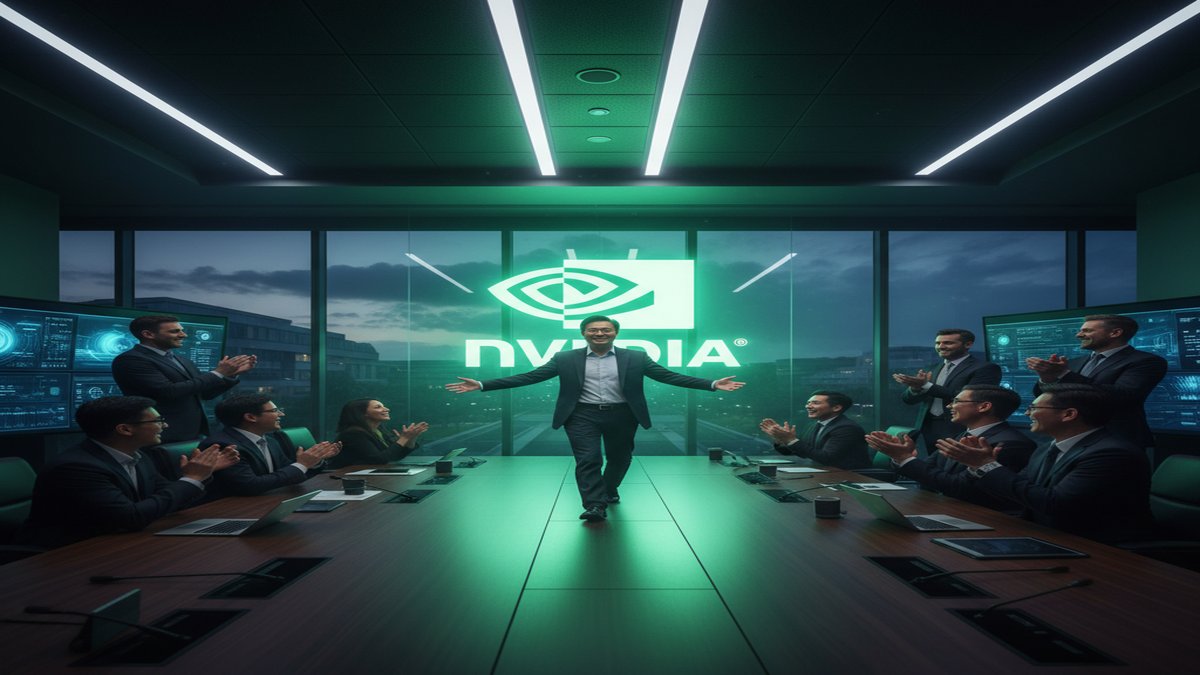
Image: AI Stack Digest (Generated)
What Happened
Nvidia’s Board of Directors announced on November 23, 2026 that Jensen Huang has been reinstated effective immediately as President, CEO, and Board Director following a unanimous vote. The board stated it reached its decision after a series of discussions and meetings with Huang, and critically, after receiving input from senior levels of the United States government confirming that his return poses no national security risk.
Board Chair Harvey C. Jones stated: “The Board believes Jensen is the right person to lead NVIDIA, and that his reinstatement is in the best interests of our stockholders, employees, partners and customers. We have every confidence in Jensen and look forward to working with him as he resumes his leadership of the Company.”
Huang himself responded with a statement underscoring the gravity of the moment: “I am honored to return to NVIDIA and lead one of the most consequential technology companies in the world at the beginning of a new industrial revolution. I take this responsibility with the greatest humility and renewed commitment. I can’t wait to get back to work.”
Colette Kress, who had been serving as interim CEO while continuing her duties as CFO, will return to her role as Chief Financial Officer. Jones will remain as Board Chair. The board also reiterated that the previously announced independent investigation into reports that Huang had been targeted by a foreign intelligence operation would continue to its conclusion — with Huang’s full cooperation.
The reinstatement comes after a stunning fall from grace. Huang had resigned less than two weeks prior following a cascade of revelations: a romantic affair with Alice Huang, a Chinese businesswoman with suspected intelligence ties, and a separate relationship with Kimberly Powell, Nvidia’s Vice President of Healthcare, who reported directly to him. The dual scandals had rocked one of the most valuable companies on the planet and triggered a corporate governance crisis of the first order.
The Chinese Spy Affair: What We Know
The core of the security controversy centers on Alice Huang — no relation to Jensen — a Chinese businesswoman with whom the Nvidia founder had an affair between spring 2025 and fall 2026. According to a New York Times report, US intelligence agencies determined that Alice Huang maintained contact with an official from China’s Ministry of State Security (MSS) throughout a period that overlapped with her relationship with Huang. American intelligence also uncovered evidence that her business partner, Kang Wei, whom she reportedly introduced as her husband, worked with the same Chinese intelligence agency — raising suspicions that Jensen Huang had been deliberately targeted in a foreign espionage operation.
The pair have also come under scrutiny over their alleged involvement in a network of Southeast Asian companies, including Singapore-based Megaspeed, which is suspected of diverting advanced Nvidia chips to China in violation of US export restrictions. Megaspeed has denied wrongdoing, and Beijing has dismissed the espionage allegations as unfounded.
Critically for Monday’s reinstatement decision, Trump wrote on Truth Social that “The Attorney General of the United States has confirmed that the US Government does not possess evidence that he has engaged in any unlawful conduct.” The administration’s position — along with the input provided to Nvidia’s board — appears to have been decisive in clearing the path for Huang’s return. Trump had been briefed about Alice Huang’s suspected intelligence ties as early as June 2025 but has repeatedly questioned whether she was actually a spy, and urged Nvidia multiple times to bring Jensen back.
The separate workplace scandal involving Kimberly Powell, Nvidia’s VP of Healthcare who answered directly to Huang, added a second dimension to the crisis. Axios reported that Huang’s security team allegedly offered a nondisclosure agreement to a bystander who had recorded an interaction between the two executives during Nvidia’s annual developer conference in San Jose in March 2026.
Why Nvidia Had No Real Choice
The speed of Monday’s reversal — and the board’s unanimous support — reflects a stark commercial reality that Wall Street analysts had been telegraphing since the moment Huang resigned. Nvidia is not just a chip company: it is an AI infrastructure monopoly built substantially around one man’s relationships, vision, and credibility. Replacing him was never going to be a clean governance exercise.
Wall Street analyst Dan Ives of Yorkville Ives put the calculus bluntly in a Monday research note: Nvidia with Jensen Huang at the helm could be worth $300 per share. Without him, the target drops to $225. “At the end of the day despite this Jensen saga the Board knew it had no choice but to bring him back,” Ives wrote, citing Huang’s critical relationships with suppliers, major AI customers, and technology partners. Despite the bullish underlying view, Ives maintained his official $225 price target and “Outperform” rating, noting that the internal investigation, government inquiries, and unresolved export control questions remain significant overhangs.
The logic is straightforward: Nvidia’s H100, H200, and next-generation Blackwell GPU architectures are the backbone of virtually every major AI training cluster on the planet. The company’s dominance in CUDA-based compute is the product of a decade-long ecosystem play that Huang personally engineered. Colette Kress, a highly capable CFO, was widely regarded as a capable steward but not a visionary capable of holding together Nvidia’s supplier relationships with TSMC, its hyperscaler partnerships with Microsoft, Google, and Amazon, and its positioning against AMD and Intel. The board clearly agreed.
What Changes Under Huang’s Return
Huang does not return to an unchanged Nvidia. The board has announced a series of structural reforms that will accompany his reinstatement, designed to address the governance failures that allowed the scandal to escalate unchecked.
First, Nvidia is forming a National Security and Export Control Committee comprised solely of independent directors. The committee will oversee trade compliance and national security risks, and is engaging counsel with expertise in national security matters, who will in turn retain advisors with deep intelligence and export control backgrounds.
Second, the company is commencing a search for a newly created Chief Compliance Officer position. This individual will oversee compliance across Nvidia and report directly to the Nominating and Corporate Governance Committee — a structure that creates a compliance function independent of the CEO’s office.
Third, the independent investigation into reports that Huang was targeted by a foreign intelligence operation will continue to its conclusion. Nvidia stated explicitly that this investigation, run by independent counsel retained by a committee of independent directors, will proceed regardless of the reinstatement. Huang has committed to full cooperation.
Finally, Nvidia will continue to cooperate with ongoing government investigations and inquiries — including, implicitly, the Megaspeed chip diversion probe. Trump’s Truth Social post explicitly urged Nvidia to “continue investigating its compliance with US export controls,” signaling that the administration views compliance reform as a condition, not a suggestion.
Market and Industry Reaction
Markets reacted immediately and emphatically. Nvidia shares surged approximately 27% in premarket trading on Monday, a staggering gain for a company already valued in the trillions. The move validated the view that Huang’s departure had been a governance discount on an otherwise structurally dominant business — and that his return removes that discount instantly.
Trump’s public endorsement was effusive and unusually direct for a sitting president commenting on a corporate governance matter. “NVIDIA needs Jensen’s leadership in order to ensure the Success and Prosperity of not only the Company, but the American Economy,” Trump wrote on Truth Social, adding that his administration had concluded Huang posed no national security threat. The involvement of the US government at the senior levels cited in Nvidia’s press release — and Trump’s claim to have discussed the matter with Chinese President Xi — underscores just how geopolitically charged the situation had become.
For the broader AI industry, the resolution is stabilizing. Nvidia’s GPU supply is the critical bottleneck for every major AI lab and hyperscaler. Uncertainty over Nvidia’s leadership direction had introduced a risk premium into AI infrastructure planning cycles. With Huang reinstated and the government’s blessing secured, that uncertainty recedes — though it does not disappear entirely while investigations remain open.
What to Watch Next
Several threads remain unresolved and will define the story over coming months. The independent investigation into whether Huang was deliberately targeted by Chinese intelligence will be the most consequential. Its findings — expected to eventually become public — will either fully rehabilitate Huang or introduce new complications, regardless of the current clean bill of health from the Attorney General.
The Megaspeed chip diversion probe is a separate but related concern. If advanced Nvidia GPUs were systematically routed to China through Singapore-based intermediaries in violation of export controls, the resulting fines, restrictions, or reputational damage could be significant. The Trump administration’s directive to Nvidia to continue that investigation suggests it has not been quietly dropped.
The Kimberly Powell situation also remains unresolved. A workplace relationship between a CEO and a direct report — allegedly accompanied by an NDA offer to a witness — raises corporate governance questions that the board has not yet publicly addressed. Watch for any announcements regarding Powell’s status or Nvidia’s internal HR policy reforms.
Finally, Nvidia has a packed product calendar. The Blackwell GPU ramp, next-generation networking products, and Huang’s relationships with hyperscaler customers will all require his hands-on attention. His return statement — “I can’t wait to get back to work” — signals he intends to move quickly past the scandal and refocus on execution.
The Bottom Line
Jensen Huang is back at Nvidia, and markets have delivered their verdict with a 27% premarket rally. The board’s unanimous reinstatement — backed by US government clearance and a presidential endorsement — reflects the uncomfortable reality that Nvidia’s commercial dominance is inseparable from its founder’s leadership. The investigations continue, the compliance reforms are real, and the geopolitical questions around chip export controls are unresolved. But for the AI industry that runs on Nvidia’s silicon, the most disruptive leadership vacuum in recent memory has closed — for now.
This article was produced with the assistance of AI tools and reviewed by the AIStackDigest editorial team.