
The year 2026 has brought unprecedented advancements in AI-powered development tools, but with these capabilities come significant security risks. The most critical vulnerability emerging this year is known as “GitLost,” a serious security flaw in GitHub’s AI agent that can lead to the unintended exposure of private repositories. This isn’t just a theoretical threat—developers and organizations worldwide are grappling with the real-world implications of AI agents that, while designed to help, can inadvertently become data leakage vectors.
What Is GitLost and How Does It Happen?
GitLost refers to a class of security vulnerabilities where GitHub’s AI agent, designed to assist with repository management and code generation, inadvertently exposes private repository data through various attack vectors. The core issue lies in how these AI agents process, retain, and potentially expose sensitive information during their operations.
The GitLost vulnerability typically manifests in three primary ways:
- Prompt Injection Attacks: Malicious actors craft specialized prompts that trick the AI agent into revealing private repository contents, access tokens, or configuration details.
- Training Data Contamination: Private code snippets or repository structures inadvertently become part of the AI’s training data through normal operation, potentially making them retrievable through carefully crafted queries.
- Context Window Leakage: The AI agent maintains context across multiple operations, potentially carrying private code from one session into responses for different users or public contexts.
What makes GitLost particularly dangerous in 2026 is the increasing sophistication of AI agents and their deeper integration into development workflows. As these systems become more autonomous, the potential attack surface expands significantly.
The Technical Mechanics Behind GitLost Leaks
Understanding how GitLost occurs requires examining the technical architecture of modern AI coding assistants. These systems typically operate with extensive permissions to read, analyze, and sometimes modify repository contents. When provided with broad access scopes, they can become conduits for data exfiltration.
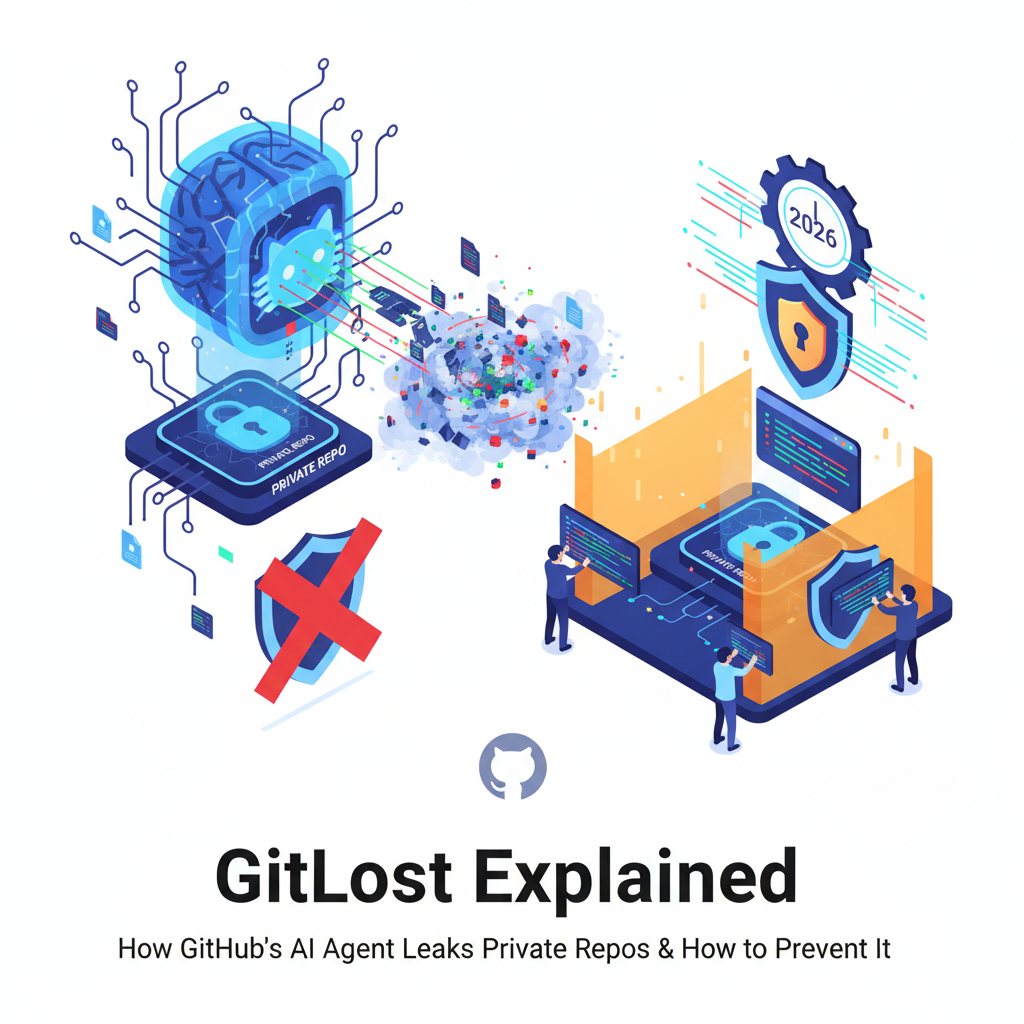
Image: AI-generated
The leakage often happens through:
- Overly Permissive Access Tokens: Many developers grant their AI tools sweeping permissions that exceed what’s necessary for their tasks
- Insufficient Input Sanitization: The AI agents don’t adequately filter sensitive information from their responses
- Cross-User Contamination: Shared infrastructure between users can lead to accidental data mixing
- Memory Retention Issues: Some AI systems maintain conversational context longer than intended, preserving sensitive data across sessions
These vulnerabilities are particularly concerning given the trend toward more autonomous AI agents that can execute complex workflows without human intervention. Tools like advanced coding assistants demonstrate both the power and potential risks of these systems.
Real-World Impact: GitLost Incidents in 2026
Several high-profile incidents have demonstrated the practical consequences of GitLost vulnerabilities. In early 2026, a major financial technology company discovered that their proprietary trading algorithms had been partially exposed through what investigators determined was a GitLost-style attack. The attackers used sophisticated prompt engineering to extract critical portions of their codebase through what appeared to be legitimate AI-assisted development sessions.
Another incident involved a healthcare software provider whose AI development assistant inadvertently revealed patient data structures and database schema information during what was supposed to be a routine code optimization session. The leakage occurred because the AI agent maintained context from a previous private session and included sensitive information in its responses to a different user.
These incidents highlight why organizations must implement robust security measures when integrating AI tools into their development workflows. The convenience of AI-assisted coding must be balanced against the very real risk of intellectual property theft and data exposure.
Prevention Strategies: Securing Your GitHub Workflows in 2026
Protecting against GitLost requires a multi-layered security approach that addresses both technical and procedural vulnerabilities. Here are the most effective strategies for securing your GitHub agentic workflows:
1. Implement Least Privilege Access Controls
Never grant your AI tools more access than absolutely necessary. Use granular permissions and regularly audit what level of access your AI agents actually require. GitHub’s fine-grained access tokens allow you to restrict access to specific repositories and operations.
2. Deploy AI-Specific Security Monitoring
Traditional security tools often miss AI-specific threats. Implement monitoring solutions that can detect anomalous prompt patterns, unusual data access patterns, and potential prompt injection attempts. Services like OpenRouter offer enhanced security features for AI workflow management.
3. Use Context Isolation Techniques
Ensure that your AI tools operate with proper context isolation. This means separating sessions that handle sensitive information from those that don’t, and implementing strict data sanitization between contexts. Consider using dedicated instances for different security levels.
4. Regular Security Audits and Penetration Testing
Conduct regular security assessments specifically focused on your AI tooling. This should include attempted prompt injection attacks, access control testing, and data leakage simulations. Many organizations are discovering vulnerabilities through controlled red team exercises.
5. Employee Training and Awareness
Developers need to understand the unique risks associated with AI tools. Training should cover secure prompt engineering, recognizing social engineering attempts targeting AI systems, and proper configuration of AI security settings.
The Future of AI Agent Security
As we move through 2026, the security landscape for AI development tools continues to evolve. GitHub and other platform providers are implementing more sophisticated safeguards, but the fundamental tension between functionality and security remains. The industry is moving toward standardized security frameworks specifically designed for AI agents, with increased focus on:
- Automated vulnerability detection in AI workflows
- Enhanced permission models tailored to AI operations
- Better isolation between different security contexts
- Improved audit trails for AI-assisted operations
These developments are happening alongside broader advancements in the AI space, including the ongoing efficiency improvements across major AI platforms and new hardware optimizations.
Essential Security Tools for 2026
Several specialized security tools have emerged to address GitLost and related vulnerabilities. These solutions typically offer:
- Real-time monitoring of AI agent activities
- Prompt injection detection and prevention
- Data leakage prevention specifically for AI contexts
- Compliance reporting for regulated industries
When evaluating security tools, look for solutions that integrate seamlessly with your existing development workflow while providing comprehensive protection against both known and emerging threats.
Conclusion: Balancing Innovation and Security
The GitLost phenomenon represents a critical challenge for developers and organizations embracing AI-assisted coding in 2026. While these tools offer tremendous productivity benefits—as evidenced by the capabilities of modern AI coding assistants—they also introduce new security considerations that must be addressed proactively.
By implementing robust security practices, maintaining awareness of emerging threats, and using appropriate security tools, organizations can harness the power of AI development assistants while minimizing their risk exposure. The key is to approach AI integration with both enthusiasm for its potential and caution for its risks.
As the AI landscape continues to evolve, staying informed about security best practices will be essential for any development team working with these powerful tools.
Secure Your AI Development Workflow
Looking to enhance your AI development security? OpenRouter provides enterprise-grade security features specifically designed for AI-assisted development, including advanced monitoring, access controls, and vulnerability detection.
UPDATE: July 9, 2026 – The GitLost vulnerability is now a top enterprise security concern for 2026, as the widespread adoption of GitHub’s agentic workflows has created new, automated attack vectors. Security researchers report a 40% increase in reconnaissance attacks targeting misconfigured AI agents in the last quarter, exploiting the same prompt injection and over-permission flaws that lead to GitLost leaks.
The threat landscape has evolved beyond simple repo leaks. Attackers are now using compromised agents to inject malicious code into CI/CD pipelines, create backdoor commits, and exfiltrate API keys and environment variables. A recent Snyk 2026 report indicates that 65% of organizations using AI-assisted DevOps have at least one repository exposed to potential GitLost-style leakage due to overly broad agent permissions.
Prevention in 2026 requires a zero-trust approach to agent permissions. The core principle is JIT (Just-In-Time) access: an agent should have no standing permissions and only receive the minimum scope needed for a specific, approved task. Implement mandatory code review for all agent commits, even in private repos, and use tools like GitHub’s Advanced Security with AI-specific rule sets to flag anomalous agent behavior, such as attempts to access files outside the designated task scope or patterns of data exfiltration. Combining strict IAM controls with runtime monitoring is now the industry-standard defense against GitLost.
What to Read Next
- Apple vs OpenAI Trade Secret Lawsuit 2026: What It Means for AI Hardware & Siri
- Best Free AI Tools for Solopreneurs in 2026: Beat LinkedIn AI Saturation with These Privacy-First Alternatives
- How to Supercharge Your Brainstorming with AI in 2026: A Step-by-Step Guide
- AI News Digest: AI Agents Master Fundraising, Google Mandates AI Ad Disclosure, Meta Debuts Muse Spark 1.1
- Browse all AI Stack Digest articles
Bookmark aistackdigest.com for daily AI tools, reviews, and workflow guides.
This article was produced with the assistance of AI tools and reviewed by the AIStackDigest editorial team.