The year 2026 has solidified the dominance of large language models in the commercial sphere, but choosing the right one for your business is more critical than ever. At the pinnacle of this technological arms race stand two formidable opponents: Anthropic’s Claude Fable 5.2 and OpenAI’s GPT-6.1 Terra Pro. Both represent the bleeding edge of AI capability, yet they embody distinctly different philosophies in performance, safety, and commercial application. This comparison cuts through the hype to deliver a clear-eyed analysis of which flagship model might be the right investment for your enterprise needs.
The Philosophical Divide: Constitutional AI vs. Scalable Superintelligence
Understanding the core design principles of each model is key to predicting its behavior. Claude Fable 5.2 is the latest evolution of Anthropic’s Constitutional AI framework. This approach hardwires a set of principles into the model’s core, aiming for robust, predictable, and helpful behavior that aligns with human intent. The result is an AI often praised for its thoughtful, measured, and ethically conscious outputs, making it a favorite in industries where risk mitigation is paramount.
In contrast, OpenAI’s GPT-6.1 Terra Pro continues down the path of scaling towards broader, more generalized superintelligence. Its strength lies in its raw creative power, immense knowledge breadth, and ability to tackle an incredibly diverse range of tasks with high proficiency. The “Terra” designation signifies its focus on being a foundational, all-terrain model for enterprise deployment, offering immense power that requires careful steering to ensure optimal and safe outcomes.
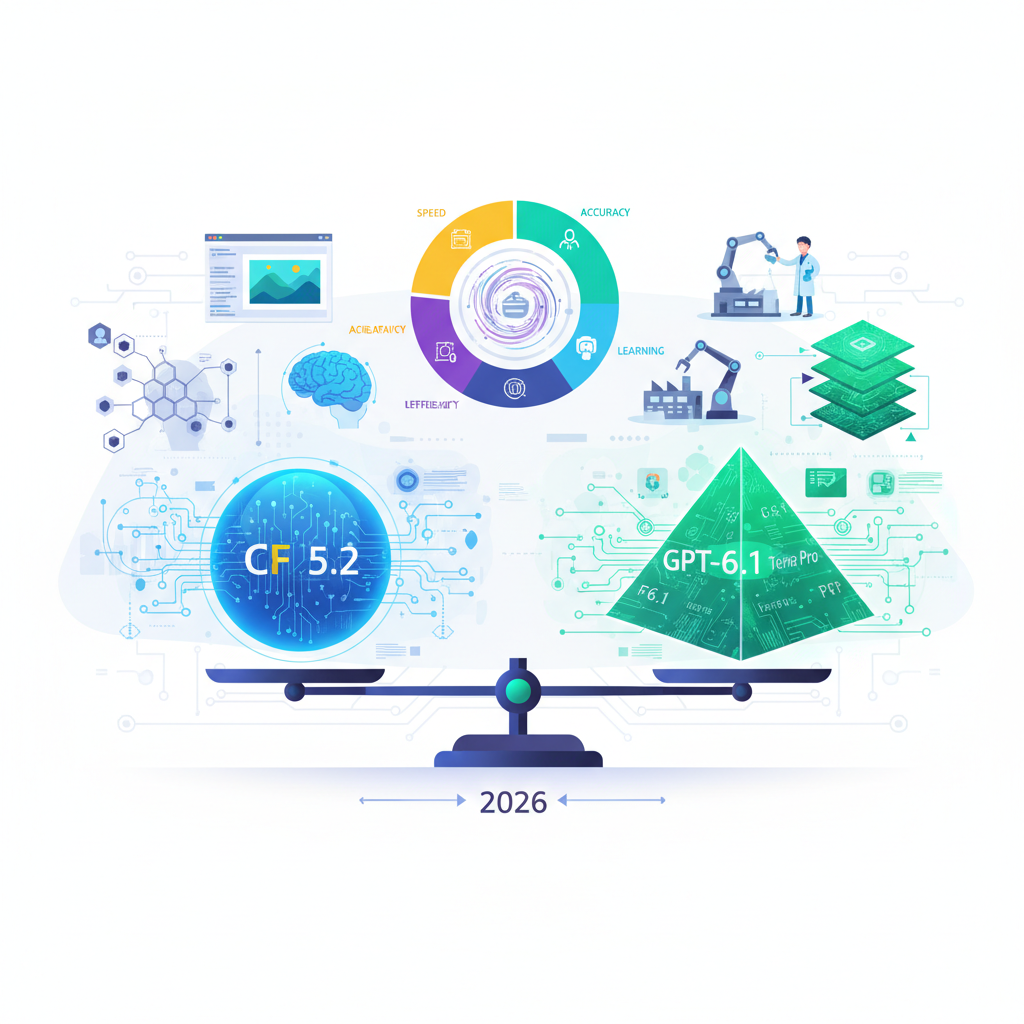
Image: AI-generated
Head-to-Head: Performance and Capabilities
While specific benchmark scores are closely guarded secrets, consistent user reports and enterprise feedback paint a clear picture of relative strengths.
Reasoning and Complex Analysis
For deep, multi-step reasoning and nuanced analysis, Claude Fable 5.2 often demonstrates a slight edge. Its ability to break down complex problems, consider multiple angles, and provide well-reasoned chain-of-thought explanations makes it exceptionally strong for legal document review, technical research synthesis, and strategic planning. GPT-6.1 Terra Pro is by no means a slouch in this department and can generate answers faster, but its responses can sometimes prioritize fluency over depth of reasoning in highly complex scenarios.
Creativity and Content Generation
When it comes to pure creative ideation, marketing copy generation, and narrative storytelling, GPT-6.1 Terra Pro frequently takes the lead. Its outputs are often more vibrant, engaging, and varied. It excels at brainstorming a wide array of ideas and adapting its tone and style on the fly. Fable 5.2 produces highly coherent and well-structured creative content, but it can sometimes be perceived as more conservative or less flamboyant in its stylistic choices.
Coding and Technical Tasks
This is a highly contested area. GPT-6.1 Terra Pro boasts extensive support for a vast number of programming languages and frameworks, often generating code that is innovative and concise. However, Claude Fable 5.2 has developed a strong reputation for generating exceptionally robust, secure, and well-documented code. Its explanations for code functionality are often more thorough, making it a powerful tool for both development and educational purposes. For developers looking to streamline their workflow, tools like Cursor, which can integrate with these models, are becoming indispensable.
Context Window and Long-Form Processing
Anthropic has consistently pushed the boundaries of context length, and Fable 5.2 continues this tradition. Its massive context window allows it to process and analyze entire codebases, lengthy reports, or multiple documents simultaneously with high accuracy. GPT-6.1 Terra Pro also features a significantly expanded context window compared to its predecessors, but some users report that Claude maintains better coherence and recall across the furthest extremes of its context limit, a critical factor for large-scale document analysis.
Commercial Considerations: Pricing, Privacy, and Deployment
For businesses, technical prowess is only half the equation. Commercial terms are a major differentiator.
OpenAI’s GPT-6.1 Terra Pro operates on a well-established consumption-based pricing model, charging per token for both input and output. This can be cost-effective for a high volume of small tasks but can become expensive for long-running conversations or processing large documents.
Anthropic has adopted a more nuanced approach with Claude Fable 5.2. While also offering a pay-per-use API, it is known to provide more flexible enterprise licensing options, including tiered subscriptions that can offer better value for heavy users. Both companies offer robust data privacy policies, assuring customers that their API data is not used for model training. However, Anthropic’s Constitutional AI framework provides an additional layer of transparency that some compliance officers find reassuring, a point underscored by recent industry scrutiny as seen in our coverage of increased regulatory investigations.
Deployment options are also critical. Both models are primarily cloud-based via API. For businesses requiring full data isolation, exploring on-premise or virtual private server (VPS) solutions for other parts of their AI stack can be beneficial. Guides on hosting a Telegram bot on a VPS illustrate the principles of affordable, controlled deployment that can complement these flagship APIs.
Security, Safety, and Alignment: The Enterprise Imperative
In 2026, AI safety is not a luxury; it’s a requirement. This is perhaps the most significant differentiator. Claude Fable 5.2 is engineered from the ground up to be “helpful, harmless, and honest.” It is notoriously difficult to jailbreak or prompt into generating harmful, biased, or unsafe content. This built-in resilience drastically reduces moderation overhead and mitigates brand and operational risk.
GPT-6.1 Terra Pro incorporates advanced safety mitigations and is highly capable in its own right. However, its immense power and flexibility mean that with deliberately malicious or poorly constructed prompts, it can potentially be guided to produce unwanted outputs more easily than Claude. This necessitates stronger guardrails and monitoring on the client side, a lesson some enterprises have learned the hard way, as discussed in our analysis of Goldman Sachs pulling Claude Code.
Conclusion: Which Flagship Model is Right for You?
The choice between Claude Fable 5.2 and GPT-6.1 Terra Pro isn’t about which model is objectively “better,” but which is better for your specific context.
Choose Claude Fable 5.2 if: Your priorities are security, reliability, and deep reasoning. It is the ideal choice for regulated industries like finance, healthcare, and legal, for applications involving sensitive data analysis, and for businesses that want to minimize AI-related risk above all else. Its long-context prowess is unmatched for research and synthesis tasks.
Choose GPT-6.1 Terra Pro if: You need maximum creative firepower, broad general knowledge, and speed. It excels in marketing, advertising, content creation, and rapid prototyping. Its versatility makes it a strong choice for businesses that want a single, powerful model for a wide variety of tasks and have the internal governance to steer it effectively.
Ultimately, the best strategy for many large enterprises in 2026 is not to choose one, but to maintain access to both through a unified platform. Aggregators like OpenRouter allow teams to leverage the unique strengths of each model for different tasks, ensuring the right tool is always used for the right job. This multi-model approach, combined with robust internal risk management, is the true winning strategy for harnessing the power of flagship AI in 2026.
When evaluating different AI models on platforms like OpenRouter, developers should consider several factors beyond raw benchmark performance. Model selection often depends on specific use cases, cost considerations, and integration requirements. The availability of multiple high-performance models through API marketplaces provides developers with greater flexibility to choose the right tool for each task, whether for coding assistance, content creation, or data analysis.
What to Read Next
- Gemini 4 Hydrogen vs Gemini 4 Carbon: What Developers Need to Know in 2026
- Gemini Robotics 2.5: AI-Powered Robots Achieve Near-Industrial Reliability in Real Factory Environments
- Nvidia Names Colette Kress Interim CEO After Jensen Huang Ouster: What It Means for AI’s Most Critical Company
- How to Fine-Tune Mistral 7B on Your Own Data With LoRA: A Complete Guide for Local AI
- Browse all AI Stack Digest articles
Bookmark aistackdigest.com for daily AI tools, reviews, and workflow guides.
This article was produced with the assistance of AI tools and reviewed by the AIStackDigest editorial team.