
As we move deeper into 2026, the landscape of large language models continues to evolve, offering developers a more nuanced choice than ever before. Google’s Gemini 4 series stands at the forefront of this evolution, presenting two distinct tiers: Gemini 4 Hydrogen and Gemini 4 Carbon. For developers building the next generation of AI applications, understanding the critical differences between these two models is not just an academic exercise—it’s a fundamental architectural decision that impacts cost, performance, and scalability.
The Gemini 4 series represents a significant leap in multimodal reasoning and complex task handling. While both Hydrogen and Carbon share the core Gemini 4 architecture, they are optimized for very different use cases and resource constraints. This comparison will break down the key factors every developer should consider when choosing between these two powerful models.
Core Architecture and Shared Capabilities
Before diving into their differences, it’s important to recognize what unites Gemini 4 Hydrogen and Carbon. Both models are built on the same foundational transformer architecture and training methodology. They share core capabilities in multimodal understanding, processing text, images, and code with a high degree of sophistication. Both versions excel at complex reasoning tasks, following intricate instructions, and generating coherent, contextually appropriate responses.
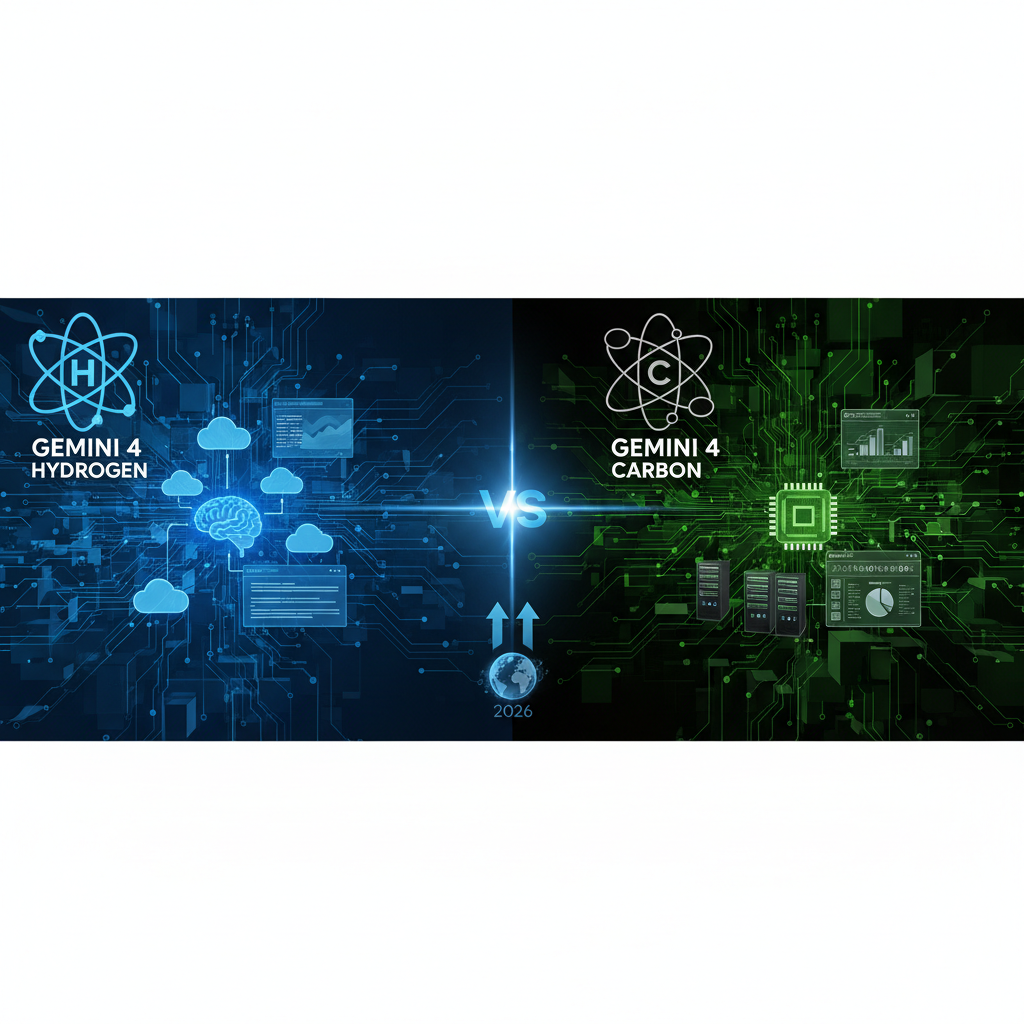
Image: AI-generated
This shared foundation means that, for many basic tasks, the output quality between Hydrogen and Carbon might be indistinguishable. However, as tasks grow in complexity, length, or require deeper contextual reasoning, the differences begin to emerge in significant ways.
Parameter Scale and Model Size
The most fundamental difference between Gemini 4 Hydrogen and Gemini 4 Carbon lies in their scale. While Google has not released exact parameter counts, industry analysis suggests Carbon represents the full, uncompromised version of the Gemini 4 architecture, likely comprising significantly more parameters than its Hydrogen counterpart.
Hydrogen is engineered to be a more compact, efficient version of the model—what some in the industry might call a “distilled” version. This doesn’t mean it’s inferior; rather, it’s optimized for different constraints. The smaller parameter count of Hydrogen translates to faster inference times and lower computational requirements, making it accessible for applications where resources are limited or cost is a primary concern.
Performance Characteristics: Speed vs. Depth
For developers, the performance trade-offs between these two models will likely be the deciding factor. Gemini 4 Hydrogen is designed for speed and efficiency. It delivers remarkably fast response times, making it ideal for real-time applications such as chat interfaces, quick information retrieval, and tasks where latency is critical.
Gemini 4 Carbon, by contrast, is built for depth and complexity. It handles longer context windows more effectively, excels at tasks requiring deep chain-of-thought reasoning, and demonstrates stronger performance on benchmarks measuring sophisticated problem-solving abilities. If your application involves complex document analysis, advanced code generation, or multi-step reasoning tasks, Carbon’s additional capacity provides tangible benefits.
This performance difference isn’t just about raw power—it’s about specialization. Hydrogen might complete a simple coding task faster, while Carbon would likely outperform on a complex, multi-file refactoring challenge.
Context Window and Memory Handling
Another critical differentiator is how each model handles context. Gemini 4 Carbon is understood to support a substantially larger context window compared to Hydrogen. This enables Carbon to process and reason over extensive documents, maintain coherence across longer conversations, and integrate more information into its responses.
For developers building applications that need to reference large knowledge bases, analyze lengthy documents, or maintain extended conversational context, Carbon’s enhanced memory capabilities are a significant advantage. Hydrogen, while capable, may require more frequent context management or summarization strategies when working with large amounts of information.
Cost and Accessibility Considerations
Perhaps the most practical consideration for developers is cost. Gemini 4 Hydrogen is positioned as the more affordable option, with lower per-token pricing that makes it accessible for high-volume applications or projects with constrained budgets. This cost efficiency makes Hydrogen an excellent choice for applications where many users generate numerous requests, or where the tasks don’t require Carbon’s full capabilities.
Gemini 4 Carbon commands a premium price, reflecting its greater computational requirements and advanced capabilities. This investment is justified for applications where performance quality directly impacts business value—such as premium AI assistants, complex analytical tools, or mission-critical enterprise applications.
Many development teams are adopting a hybrid approach, using Hydrogen for more routine tasks and reserving Carbon for situations that demand its advanced capabilities. This cost-aware strategy can optimize both performance and budget allocation.
Deployment Options and Integration
Both Gemini 4 Hydrogen and Carbon are available through Google’s Cloud AI platform and API services, but they may differ in their deployment flexibility. Hydrogen’s smaller footprint makes it more suitable for edge deployment scenarios or environments with limited connectivity. Some developers have found success running Hydrogen in constrained environments where Carbon would be impractical.
Carbon, while more resource-intensive, offers more robust options for fine-tuning and customization for enterprise applications. Its additional capacity provides more “headroom” for adaptation to specific domains or use cases.
Use Case Scenarios: Choosing the Right Tool
Understanding when to use each model is crucial for developers. Gemini 4 Hydrogen excels in:
- High-volume customer service chatbots
- Real-time translation services
- Content moderation and filtering
- Basic code completion and suggestion
- Mobile applications with limited resources
Gemini 4 Carbon shines in:
- Advanced research and analysis tools
- Complex software engineering assistants
- Sophisticated creative writing and content generation
- Enterprise knowledge management systems
- Applications requiring deep, multi-step reasoning
For teams working on AI-assisted coding projects, the choice between Hydrogen and Carbon might depend on the complexity of the codebase and the nature of the tasks.
The Developer Experience
From an API perspective, both models offer similar interfaces, making it relatively straightforward to switch between them or conduct A/B testing. Many developers start with Hydrogen for prototyping and initial development, then upgrade to Carbon for production deployment if the application demands it.
The developer experience also extends to tools and ecosystems. Platforms like OpenRouter provide access to both models alongside other leading AI systems, allowing developers to compare performance and cost across multiple providers. This can be particularly valuable for teams building applications that might benefit from model routing or fallback strategies.
Future-Proofing Your AI Strategy
As we look toward the rest of 2026 and beyond, the distinction between model tiers like Hydrogen and Carbon is likely to become more common across AI providers. This trend reflects the industry’s maturation and recognition that one-size-fits-all solutions are increasingly inadequate for diverse application requirements.
Developers should consider their choice between Hydrogen and Carbon not as a permanent decision, but as part of an evolving strategy. Building applications that can adapt to different model capabilities—or even switch between them dynamically based on task requirements—represents a sophisticated approach to AI integration.
The emergence of specialized models continues to reshape the landscape, as seen in developments like Gemini Robotics 2.5’s specialized capabilities for physical world interactions.
Conclusion: Making the Informed Choice
The choice between Gemini 4 Hydrogen and Gemini 4 Carbon ultimately comes down to your specific application requirements, performance needs, and budget constraints. Hydrogen offers an exceptional balance of capability and efficiency, while Carbon provides the fullest expression of the Gemini 4 architecture’s potential.
For most development teams, the optimal approach involves thoughtful experimentation with both models. Test your most critical workflows with each option, measure the performance differences against your specific metrics, and calculate the cost implications. This data-driven approach will ensure you select the right model for your needs without overpaying for capabilities you don’t require or underestimating the power your application truly needs.
As the AI landscape continues to evolve throughout 2026, this nuanced understanding of model capabilities will become increasingly important for developers building competitive, effective AI-powered applications.
Ready to Build with Gemini?
Access both Gemini 4 Hydrogen and Carbon through OpenRouter, which provides unified access to leading AI models with consistent API endpoints, making it easy to compare performance and switch between options.
As AI models continue to evolve, understanding the differences between specialized versions becomes increasingly important for developers making architectural decisions. The choice between different model variants can significantly impact application performance, cost efficiency, and scalability. Developers should carefully consider their specific use cases, performance requirements, and budget constraints when evaluating these options.
What to Read Next
Explore more AI insights and developer resources on our homepage. For deeper technical comparisons, check out our analysis of other leading AI models in 2026. Subscribe to our newsletter to stay updated on the latest developments in AI infrastructure and development tools.
This article was produced with the assistance of AI tools and reviewed by the AIStackDigest editorial team.