As AI becomes more deeply integrated into the fabric of software development and business operations, understanding the terms of service for the APIs we rely on is no longer a mere formality—it’s a critical business necessity. In 2026, Anthropic’s API training policy stands as a key example of this shift, with clear and strictly enforced rules against using its services for large-scale model training. For developers and companies building on Claude, ignorance of these rules is not bliss; it’s a direct path to account suspension and disrupted workflows. This article demystifies the Anthropic API training policy for 2026, explaining why certain activities are prohibited and providing a clear roadmap for staying compliant.
What Exactly is Prohibited? Defining “Large-Model Training”
Anthropic’s Acceptable Use Policy explicitly prohibits using its API outputs to train, fine-tune, or create other machine learning models. This restriction is often summarized as a ban on “large-model training,” but its scope is intentionally broad. It is designed to prevent any activity where the outputs from Claude are used as a dataset to improve a competing or derivative AI model. This includes:
- Systematically querying the API to generate massive volumes of text for the purpose of creating a training dataset.
- Using Claude’s responses to fine-tune an open-source model like Llama or Mistral.
- Attempting to create a smaller, distilled model that mimics Claude’s capabilities based on its outputs.
- Using API outputs to augment existing datasets for model training projects.
The policy is not aimed at legitimate use cases like generating content for a website, powering a customer service chatbot, or assisting with code generation. Instead, it targets the extraction of the core intellectual property—the model’s knowledge and reasoning patterns—that Anthropic has invested billions of dollars in developing.
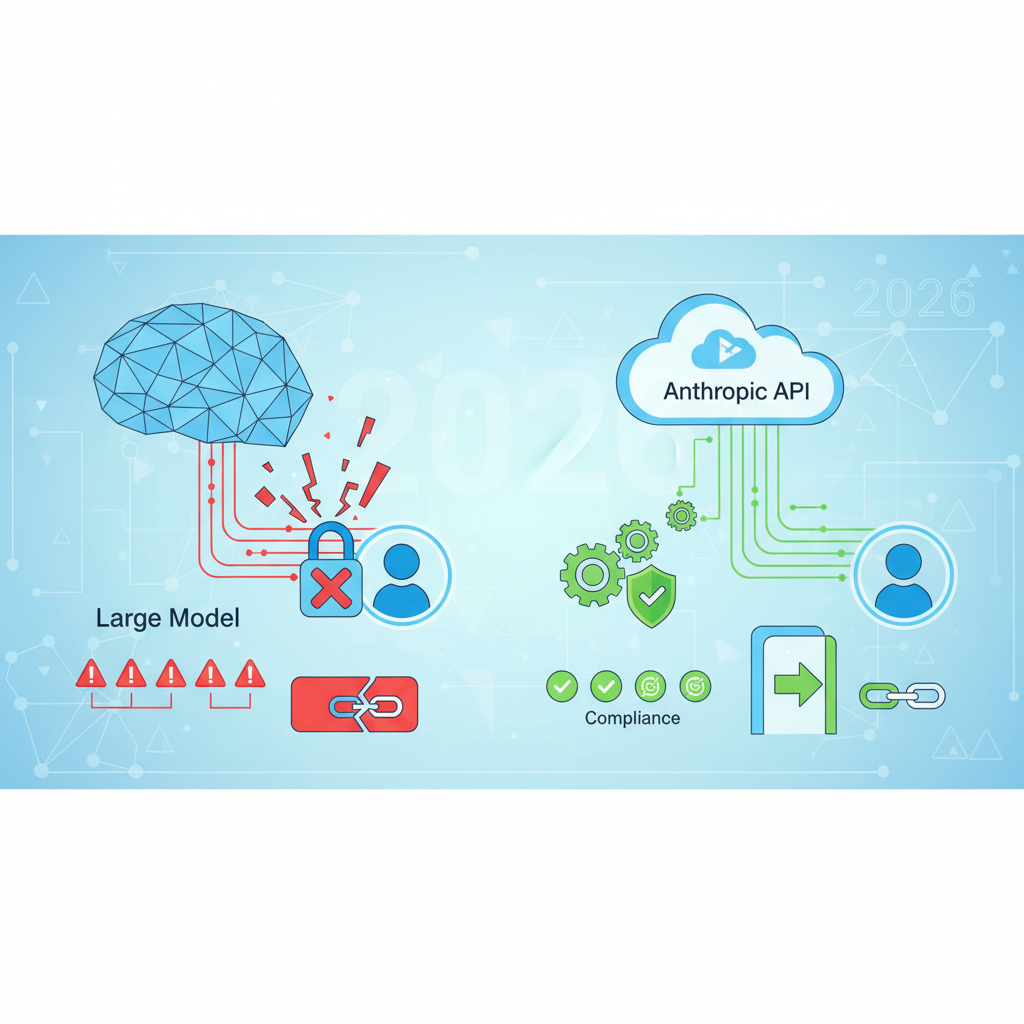
Image: AI-generated
The Why: Protecting IP, Infrastructure, and Business Models
The reasoning behind this strict policy is multifaceted, touching on intellectual property, infrastructure costs, and long-term business viability.
First and foremost, it is an issue of intellectual property protection. Models like Claude represent one of the most significant R&D investments in modern technology. Allowing their outputs to be freely used to create competing models would effectively undermine the economic incentive for companies like Anthropic to continue pushing the boundaries of AI research. The value is in the model’s weights and architecture, and the API policy acts as a necessary shield for this valuable IP.

Image: AI-generated
Secondly, it’s a matter of infrastructure and cost. Training a model on API outputs would require making an astronomical number of API calls. This kind of usage would place an enormous, unsustainable load on Anthropic’s servers, driving up operational costs and potentially degrading service quality for all other users. The policy ensures that computational resources are allocated to delivering value to end-users, not to being scraped for model replication. This infrastructure challenge is a central theme in the wider AI industry, as discussed in our analysis of the growing energy demands of AI data centers.
Finally, it protects Anthropic’s business model. The company offers access to its state-of-the-art AI through a paid API. If users could simply use that API to build a functionally equivalent model, it would cannibalize their own revenue stream and threaten their ability to operate and innovate. This concern over liability and sustainable business models is a recurring topic, even extending to issues explored in Anthropic’s own financial disclosures, such as the AI agent liability paradox.
How Anthropic Detects Violations and Enforces the Policy
While the exact detection methods are proprietary, it is understood that Anthropic employs a combination of automated monitoring and analysis to identify accounts that violate its training policy. Key indicators likely include:
- Abnormal Usage Patterns: Accounts that make a high volume of rapid, repetitive queries, especially with varied prompts designed to probe the model’s knowledge base, are a primary red flag.
- Content and Output Analysis: The nature of the prompts themselves can be a giveaway. A high frequency of prompts that are instructional or designed to generate training data (e.g., “generate a thousand examples of X”) will attract scrutiny.
- Behavioral Fingerprinting: Techniques may be used to analyze how outputs are consumed and whether they align with typical application use versus data collection.
When a violation is detected, the consequence is typically immediate and severe: account suspension. This can bring a project or business that relies on the API to a sudden halt, resulting in significant operational disruption and potential financial loss.
Best Practices for Staying Compliant in 2026
For developers and businesses, adherence to the policy is straightforward if you follow these guidelines:
- Use the API for Its Intended Purpose: Leverage Claude for real-time assistance, content generation, summarization, code help, and analysis within your applications. The key is that the value is realized in the moment of the API call, not in the subsequent use of the output as data.
- Avoid Systematic Data Generation: Do not design workflows or scripts whose primary function is to call the API repeatedly to build a corpus of text or code.
- Review Your Application’s Data Flow: Ensure that the outputs from the API are being presented to an end-user or used directly in your application’s logic, not piped into a separate data storage system for future model training.
- Choose the Right Tool for Model Training: If your goal is to train a model, use dedicated platforms and datasets designed for that purpose. For cost-effective access to a wide range of models for experimentation, consider using a aggregator like OpenRouter, which provides transparent access to many models under their respective terms.
- Automate Compliant Workflows: If you are building complex automations that involve the Anthropic API, use reputable platforms like n8n to design and manage your workflows, ensuring they are structured to comply with usage policies from the ground up.
What to Do If Your Account Is Flagged
If you find your account access revoked, your first step should be to carefully review Anthropic’s terms of service and acceptable use policy to understand what behavior may have triggered the suspension. If you believe it was a mistake, you can appeal through Anthropic’s official support channels. Be prepared to explain your use case in detail and demonstrate how your application consumes API outputs without violating the policy. However, prevention is vastly preferable to appealing a suspension.
Conclusion: Compliance as a Foundation for Innovation
Anthropic’s API training policy for 2026 is not an arbitrary restriction but a necessary measure to protect its technology, ensure fair access for all users, and maintain a sustainable business that can continue to innovate. For developers, respecting this policy is a fundamental part of building reliable and ethical AI-powered applications. By understanding the rules and designing your systems with compliance in mind, you can harness the power of Claude without risking the stability of your projects. The future of AI development depends on a healthy ecosystem where providers can protect their work and users can build with confidence.
Understanding API training policies remains crucial for developers and organizations working with large language models. Compliance with usage terms helps maintain service access while supporting the sustainable development of AI technologies. Developers should regularly review platform documentation and implement monitoring systems to ensure their usage patterns align with current policies.
What to Read Next
- Claude Code Password Leak 2026: How to Secure Your GitHub Repos After the “Don’t Ask Again” Exposure
- Optimizing Developer Workflows with AI in 2026: A Guide to Beyond-Copilot Efficiency
- Claude Code Email Privacy: How to Stop Websites from Tracking Your Address in 2026
- How to Build a Modern AI Agentic Workflow in 2026: Architectures, Tools, and Best Practices
- Browse all AI Stack Digest articles
Bookmark aistackdigest.com for daily AI tools, reviews, and workflow guides.
This article was produced with the assistance of AI tools and reviewed by the AIStackDigest editorial team.