
AI Agent Specialist
Unveiling the Horizon NPU: The Dawn of Truly Local AI in Consumer Devices
The landscape of artificial intelligence is undergoing a profound transformation, moving beyond the confines of distant data centers and into the very devices we interact with daily. At the forefront of this revolution are Neural Processing Units (NPUs), specialized silicon designed to bring sophisticated AI capabilities directly to your laptop, mini PC, and edge devices. Today, we delve into the emergence of the hypothetical but representative Horizon NPU, a conceptual breakthrough illustrating how dedicated AI hardware is redefining what’s possible for local, on-device artificial intelligence.
For years, running powerful AI models demanded immense computational resources, typically found only in cloud servers or high-end workstations equipped with expensive Graphics Processing Units (GPUs). While GPUs remain indispensable for training massive foundational models, their architecture, primarily optimized for parallel graphics rendering, isn’t always the most efficient solution for the specific, recurring inference tasks required by everyday AI applications on consumer hardware. This is where NPUs step in, promising a future where AI is not just pervasive but deeply integrated, private, and instantaneously responsive.
What is a Neural Processing Unit (NPU)?
An NPU is a class of microprocessor designed specifically to accelerate artificial intelligence and machine learning workloads. Unlike a traditional Central Processing Unit (CPU) which excels at general-purpose computing, or a GPU which handles highly parallelizable tasks like graphics and large-scale model training, an NPU is purpose-built for the mathematical operations fundamental to neural networks – primarily matrix multiplications and convolutions. This specialization allows NPUs to perform these operations with unparalleled energy efficiency and speed, making them ideal for sustained AI inference on battery-powered devices.

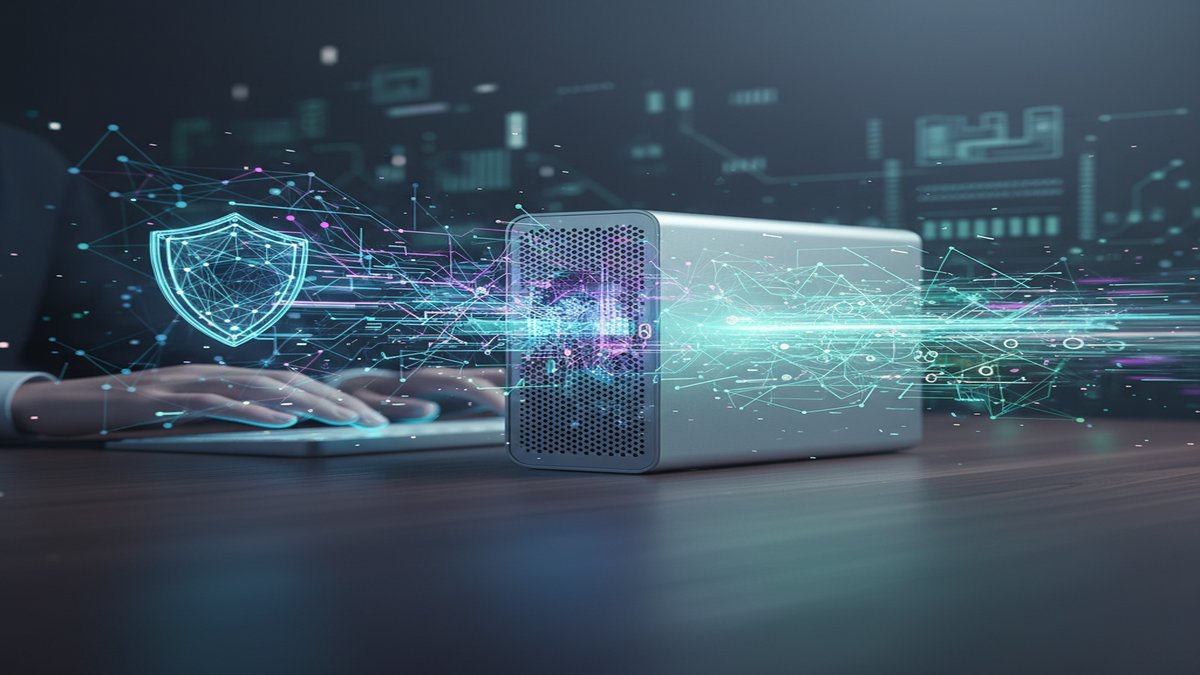
Image: AI Generated (Conceptual)
The Horizon NPU, in our conceptual framework, epitomizes this design philosophy. It integrates tightly with the CPU and GPU within a System-on-a-Chip (SoC) architecture, creating a heterogeneous compute environment. This allows the system to intelligently offload AI tasks to the most suitable processing unit: complex graphics to the GPU, general computing to the CPU, and dedicated AI inference to the NPU. This intelligent distribution of workload is crucial for optimizing performance, power consumption, and thermal management in compact devices.
The Rise of the AI PC: More Than Just a Marketing Term
The term “AI PC” has rapidly gained traction, but it represents a genuine shift in personal computing. An AI PC is fundamentally a computer that integrates a dedicated NPU capable of handling significant AI workloads directly on the device. Microsoft, for instance, has set a benchmark for its Copilot+ PCs, requiring a minimum of 40 Trillion Operations per Second (TOPS) from their NPUs. The Horizon NPU, hypothetically, would exceed this, pushing the boundaries of what local AI can achieve.
This push towards AI PCs is driven by several factors. Firstly, the sheer volume of data processed by AI applications is growing exponentially, making cloud-only solutions less sustainable for real-time, personalized experiences. Secondly, privacy concerns are paramount. Processing sensitive data locally, rather than sending it to remote servers, offers a significant boost in user privacy and data security. Thirdly, local AI ensures functionality even without an internet connection, crucial for mobile and edge computing scenarios.
Consider the practical applications. With a robust NPU like the Horizon, your device could run sophisticated Small Language Models (SLMs) and even moderately sized Large Language Models (LLMs) entirely offline. This means instant code suggestions, advanced document summarization, real-time language translation, and intelligent content creation tools without relying on a constant cloud connection or incurring API costs. Productivity software, creative suites, and communication platforms are all set to become vastly more intelligent and personalized.
The NPU’s ability to handle AI tasks with superior power efficiency also translates into tangible benefits for the user experience. Features like enhanced video conferencing (background blur, gaze correction, noise suppression), intelligent photo and video editing, and proactive system optimization can run continuously in the background with minimal impact on battery life. The Horizon NPU would ensure that these “always-on AI” experiences are seamless, responsive, and truly helpful, not a drain on your device’s resources.
Deep Dive into Horizon NPU Capabilities (Conceptual)
Let’s imagine the Horizon NPU boasting a theoretical performance of 70+ TOPS, offering significant headroom for future AI models. This level of performance would allow it to efficiently run:
- 7B-parameter models for natural language processing, enabling advanced conversational AI, text generation, and summarization directly on device.
- Advanced computer vision tasks such as real-time object detection, image segmentation, and intelligent video analysis for security or creative applications.
- Generative AI models for tasks like image generation from text prompts, style transfer, and even short video clip creation, opening new avenues for creativity without cloud dependency.

Image: AI Generated (Conceptual)
The architecture of such an NPU would likely include:
- Dedicated AI Accelerators: Optimized for tensor operations crucial for deep learning.
- On-chip Memory: High-bandwidth, low-latency memory to feed data to the AI cores without bottlenecks.
- Advanced Power Management: Granular control over power states to maximize efficiency during inference tasks.
- Integrated Software Stack: Seamless integration with operating systems and developer tools to simplify deployment of AI applications.
This integration is vital for the developer ecosystem. Companies like Microsoft, Intel, AMD, and Qualcomm are investing heavily in creating robust software development kits (SDKs) and frameworks that allow developers to harness the power of NPUs with relative ease. This means more AI-powered applications will become available that can leverage the Horizon NPU’s capabilities, leading to a richer and more intelligent user experience across the board.
The Impact on Developers and Everyday Users
For developers, the proliferation of powerful NPUs like the Horizon NPU means an expanded canvas for innovation. They can now design and deploy AI applications that are:
- Faster: Instantaneous responses for AI features without network latency.
- More Private: User data stays on device, enhancing security and trust.
- More Reliable: AI capabilities are available even in areas with poor or no internet connectivity.
- More Efficient: Lower power consumption for AI tasks, leading to longer battery life for users.
This shift also presents new opportunities for those looking to explore the cutting edge of AI development and deployment. As local AI becomes more prevalent, the need for robust, flexible platforms to experiment with and deploy models is growing. Platforms like OpenRouter are becoming increasingly important, offering a unified API for a wide range of models, both cloud-based and those optimized for local inference. This democratizes access to advanced AI capabilities and fosters innovation.
For everyday users, the benefits are even more profound, albeit often subtle. Imagine a personal assistant that understands your context better because it’s analyzing your local data without sending it to the cloud. Or creative tools that generate unique content in seconds, adapting to your personal style. Education, healthcare, entertainment – every sector stands to gain from more intelligent, personalized, and efficient on-device AI.
Challenges and the Road Ahead
While the promise of NPUs is immense, challenges remain. The rapid pace of hardware innovation means that developers need to constantly adapt their models for different NPU architectures. Standardization efforts are crucial to ensure broad compatibility and ease of deployment. Furthermore, while NPUs excel at inference, training large-scale models will likely remain the domain of powerful cloud-based GPUs for the foreseeable future. The synergy between cloud and edge AI will be key.
The Horizon NPU represents a conceptual leap towards a future where AI is not just a feature but an intrinsic part of our personal computing experience. As these specialized processors become more powerful and ubiquitous, we can expect a new wave of innovative applications that are faster, more private, and deeply integrated into our daily lives. The era of truly local AI is not just on the horizon; it’s already here, reshaping how we interact with technology and unlocking unprecedented potential.
The journey has just begun, and the coming years will undoubtedly bring even more exciting developments in the realm of local AI hardware.
This article was produced with the assistance of AI tools and reviewed by the AIStackDigest editorial team.