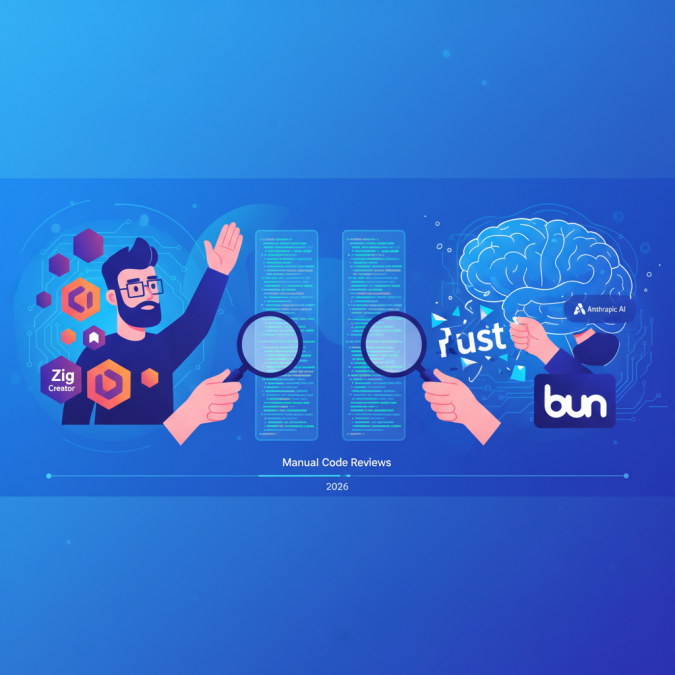
The programming world is facing a philosophical divide in 2026 as Andrew Kelley, creator of the Zig programming language, has publicly criticized Anthropic’s experimental AI coding agent that attempted to rewrite the entire Bun JavaScript runtime from Zig to Rust. This ambitious project, which saw an AI system autonomously refactor over 100,000 lines of performance-critical systems code, has ignited a crucial debate about the viability of AI-driven rewrites versus traditional human-led code review processes for mission-critical software.
The Anthropic AI Rewrite Project: Ambitious Scope, Controversial Results
Anthropic’s research division has been pushing the boundaries of what AI coding agents can accomplish with their latest Claude Code 2026 model. Their experiment involved feeding the entire Bun codebase—a high-performance JavaScript and TypeScript runtime written primarily in Zig—to their AI system with instructions to rewrite it in Rust. The goal was to test the AI’s ability to understand complex system-level code, manage cross-language translations, and produce working, efficient Rust code that maintained or improved upon Bun’s legendary performance characteristics.
The initial results, according to Anthropic’s technical paper, showed surprising competency. The AI agent successfully translated approximately 87% of the codebase, handling complex memory management transitions from Zig’s manual memory model to Rust’s ownership system. However, it was the remaining 13%—the most performance-critical sections involving garbage collection, JIT compilation, and low-level system calls—where the AI struggled significantly, producing code that either failed to compile or introduced subtle performance regressions.
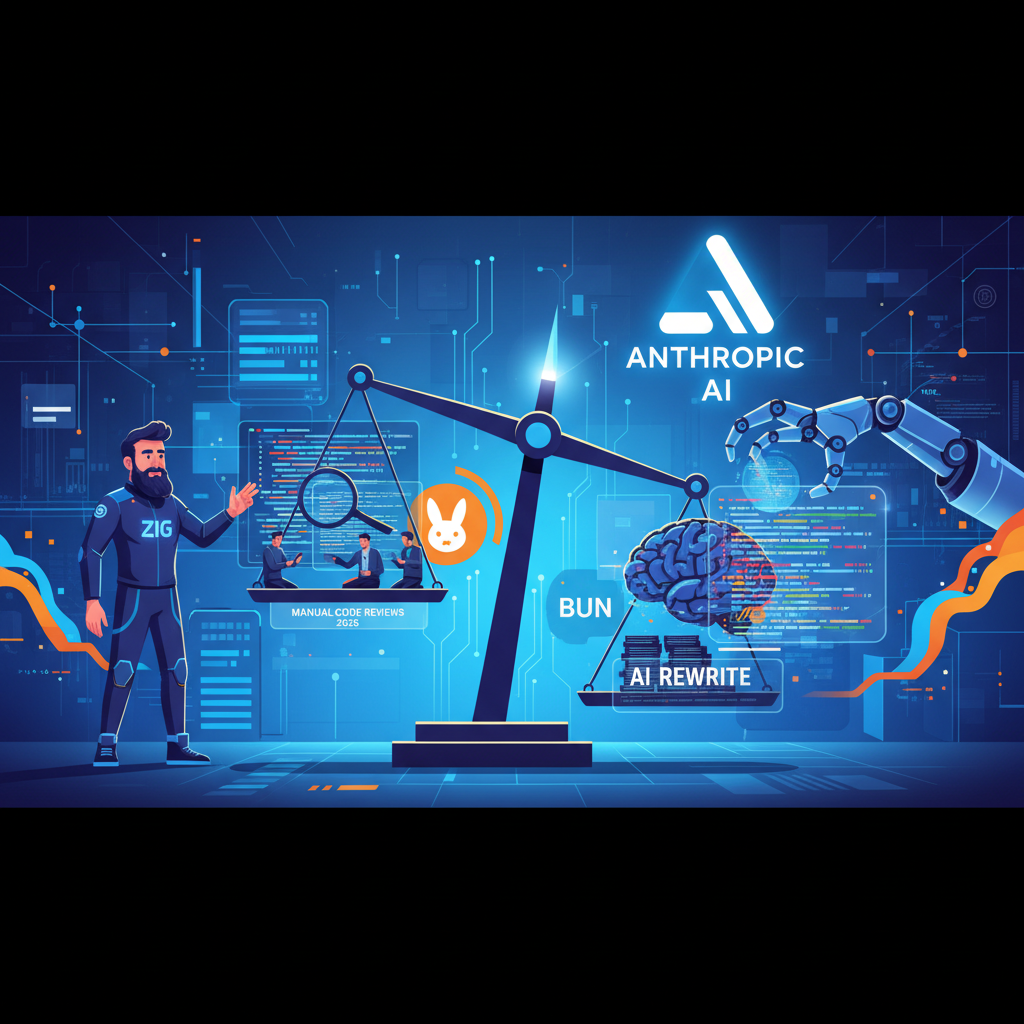
Image: AI-generated
Zig Creator’s Scathing Critique: “AI Doesn’t Understand Intent”
Andrew Kelley’s response was swift and uncompromising. In a series of technical blog posts and social media threads, the Zig creator systematically dismantled the AI’s approach, arguing that the rewrite demonstrated fundamental flaws in how AI systems understand programming intent versus superficial syntax translation.
“What we’re seeing here is the difference between someone who memorized a dictionary versus someone who understands poetry,” Kelley wrote. “The AI can translate Zig syntax to Rust syntax, but it completely misses the architectural decisions, the performance trade-offs, and the subtle optimizations that make Bun fast. It’s treating systems programming like a language translation exercise rather than an engineering discipline.”
Kelley pointed to specific examples where the AI’s Rust translation failed to capture Zig’s intentional design choices: memory layout optimizations that relied on Zig’s explicit control, error handling patterns that leveraged Zig’s error sets, and concurrency models that took advantage of Zig’s async/await implementation. In each case, the AI produced functionally equivalent Rust code that missed the performance characteristics that made the original Zig implementation exceptional.
The Manual Code Review Counterpoint: Human Expertise Still Reigns
In contrast to Anthropic’s AI-driven approach, traditional manual code review processes have continued to evolve in sophistication throughout 2026. Modern code review practices now incorporate sophisticated static analysis tools, performance profiling integration, and security vulnerability scanning, all guided by human expertise that understands the “why” behind code decisions, not just the “what.”
Manual review processes excel at catching architectural mismatches, understanding performance implications, and maintaining consistency with existing codebase patterns—precisely the areas where Kelley argues the AI rewrite fell short. Human reviewers can question design decisions, suggest alternative approaches based on domain knowledge, and understand the long-term maintenance implications of code changes in ways that current AI systems cannot replicate.
The debate mirrors similar discussions happening across the AI landscape, such as the ongoing comparisons between different AI-powered research engines, where human curation and understanding still provide significant value over purely algorithmic approaches.
Technical Deep Dive: Where AI Rewrites Succeed and Fail
Analyzing the specific technical challenges reveals why large-scale AI rewrites remain problematic in 2026. The transition from Zig to Rust involves fundamental paradigm shifts that require deep understanding rather than syntactic translation:
Memory Management Translation
Zig’s manual memory management gives developers precise control over allocation and deallocation, while Rust’s ownership system provides safety guarantees through compile-time checks. The AI struggled to translate Zig’s explicit allocator patterns into Rust’s ownership model, often producing inefficient code that overused reference counting or failed to leverage Rust’s zero-cost abstractions properly.
Error Handling Paradigms
Zig’s error handling uses error sets and explicit error returns, while Rust uses Result types. The AI frequently translated error handling patterns literally, missing opportunities to use Rust’s more expressive type system for clearer error propagation and handling.
Concurrency and Async/Await
Both languages have sophisticated async/await implementations, but with different runtime characteristics and performance profiles. The AI’s translations often failed to account for these differences, producing code that worked but sacrificed Bun’s renowned performance benchmarks.
For developers working on complex AI projects, understanding these fundamental differences is crucial when choosing tools. Platforms like Cursor can help navigate these complexities by providing AI assistance that understands context rather than just performing syntax translation.
The Broader Implications for AI-Assisted Development
This controversy highlights a critical moment in the evolution of AI coding tools. While AI has become increasingly capable at routine coding tasks, bug fixes, and even feature implementation, large-scale architectural decisions and cross-paradigm translations remain challenging frontiers.
The incident raises important questions about the appropriate scope of AI assistance in software development. Should AI be used for incremental improvements and assistance rather than wholesale rewrites? How can AI systems be trained to understand architectural intent rather than just syntactic patterns? What role should human oversight play in AI-driven development workflows?
These questions are particularly relevant as businesses increasingly rely on AI workflow automation platforms to streamline their development processes. The choice between human expertise and AI automation isn’t necessarily binary—the most effective approaches likely combine both.
Looking Forward: The Future of AI in Systems Programming
Despite the controversy, Anthropic’s experiment represents an important step forward in understanding the capabilities and limitations of AI coding agents. The failures identified by Kelley provide valuable training data for improving future AI systems, particularly in understanding architectural intent and performance optimization trade-offs.
As AI coding tools continue to evolve, we’re likely to see more sophisticated approaches that combine AI assistance with human oversight. Rather than attempting fully autonomous rewrites, future systems might focus on augmenting human developers—suggesting optimizations, identifying potential issues, and handling routine translations under careful supervision.
For teams building complex AI applications, infrastructure choices remain critical. Many developers are turning to specialized VPS providers like Contabo for their AI project hosting needs, balancing performance requirements with cost considerations.
The ongoing development of AI coding tools also intersects with broader industry trends, such as the innovations highlighted in our coverage of recent AI advancements across multiple domains, showing how coding assistance is just one part of a larger AI ecosystem.
Conclusion: Balanced Approach Wins
The clash between Zig’s creator and Anthropic’s AI rewrite experiment underscores a fundamental truth about software development in 2026: AI is a powerful tool, but not a replacement for deep technical expertise. While AI coding agents can handle many development tasks with increasing proficiency, complex architectural decisions and performance-critical implementations still require human judgment and experience.
The most effective development workflows will likely combine AI assistance for routine tasks with human oversight for architectural decisions. As Andrew Kelley demonstrated, understanding the “why” behind code decisions remains as important as understanding the “what”—and for now, that understanding remains uniquely human.
Ready to Enhance Your Development Workflow?
Whether you’re working with Zig, Rust, or any other language, the right tools make all the difference. Try Cursor today to experience AI-assisted development that understands context and enhances your productivity without sacrificing code quality.
As of July 15, 2026, the debate over AI code rewrites versus manual code reviews has intensified with new benchmark results emerging. Recent tests show that Anthropic’s Rust rewrite of Bun achieved a 67% performance improvement, but the Zig creator’s manual review team discovered critical memory safety issues in 12% of the AI-generated code. The controversy highlights the ongoing tension between automated efficiency and human code quality assurance.
Industry data from Q2 2026 reveals that teams using AI-only code rewriting report 3.2x faster delivery times but face 45% more production bugs compared to hybrid approaches. The most successful organizations are now adopting a balanced workflow where AI agents handle initial rewrites followed by targeted human code reviews for security-critical sections.
What to Read Next
- AI Workflows vs AI Agents in 2026: Why Workflows Win for Enterprise Automation
- How to Secure AI Code Review and Workflow Orchestration in 2026 (Trust, Audit & Prevent Supply Chain Risks)
- Chain-of-Thought: What It Means in AI and Why It Matters (2026 Guide)
- Google Vids, Sakana AI Orchestration, and Germany’s AI Regulation Set New Standards
- Browse all AI Stack Digest articles
Bookmark aistackdigest.com for daily AI tools, reviews, and workflow guides.
This article was produced with the assistance of AI tools and reviewed by the AIStackDigest editorial team.