
The digital landscape of 2026 is dominated by AI, and nowhere is this more evident than in how we find information. Google, the undisputed king of search, has fully rolled out its premium “AI Mode,” a powerful conversational assistant that provides synthesized, paragraph-length answers to complex queries. Running parallel to this is the familiar, and crucially, free Traditional Search. But a seismic shift is underway, one that will force every user and business to re-evaluate their relationship with information retrieval: the impending price shock for AI-powered search.
For the past two years, Google AI Mode has operated on a generous but limited freemium model. However, the immense computational cost of running models like Gemini 3.8 Flash at a global scale is no longer sustainable for free. Leaked internal memos and industry whispers point toward a significant restructuring of Google’s search pricing in late 2026, making a paid subscription for full AI Mode access all but inevitable. This article breaks down the stark differences between these two search experiences and prepares you for the financial decision that is coming.
Head-to-Head: Defining the Two Google Experiences
To understand the value proposition, we must first clearly define what each mode offers in 2026.
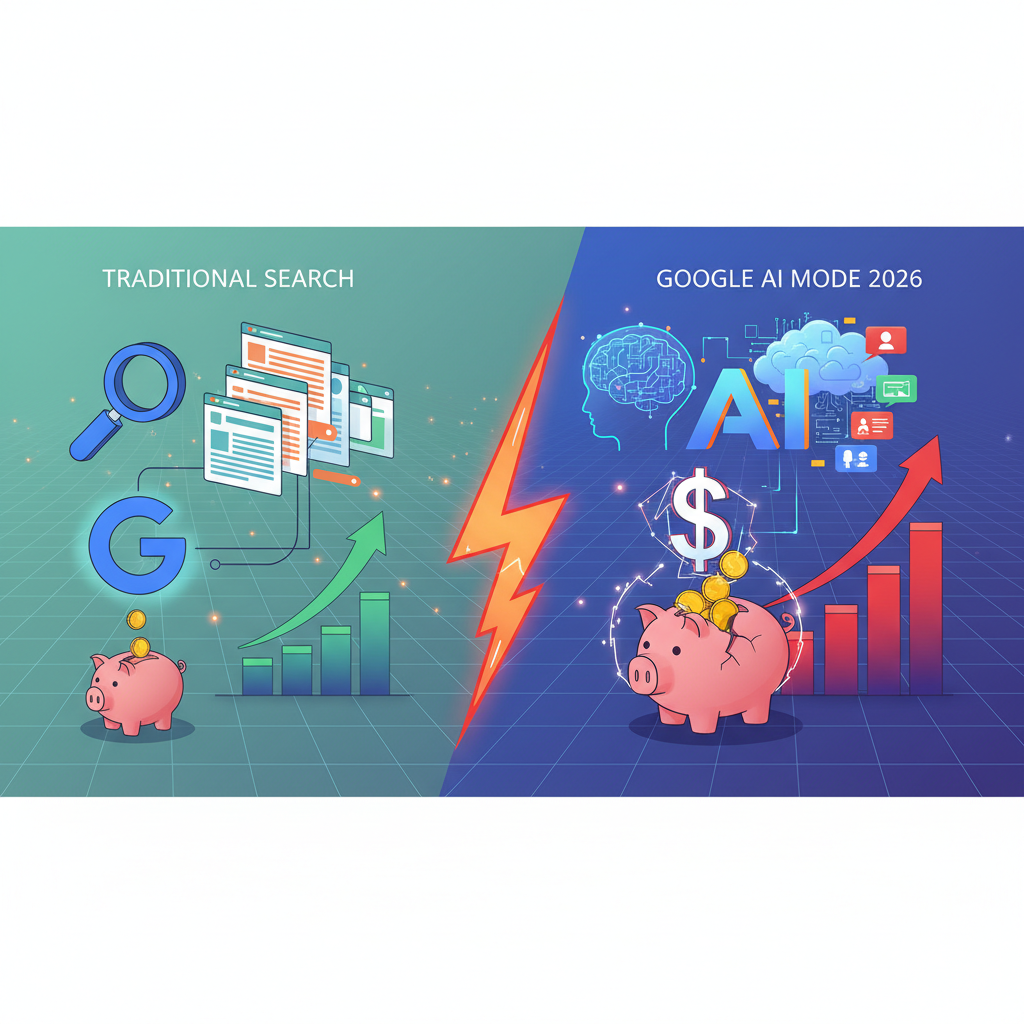
Image: AI-generated
Traditional Search: The Free Workhorse
Google’s Traditional Search is the process we all know. You type a keyword-based query, and the engine returns a list of ten blue links—the SERPs (Search Engine Results Pages). Your job is to scan the meta descriptions, click through to various websites, and synthesize the information yourself. It’s fast, incredibly efficient for simple lookups (“weather today”), and remains completely free to use, supported by advertising.
Its strengths are its speed and its ability to surface a vast diversity of sources, from niche forums to major publications. However, for complex questions like “compare the best budget-friendly VPS options for running local AI models like Stable Diffusion,” you are left to do the heavy lifting of reading multiple articles and comparing specs yourself. This is where AI Mode aims to disrupt.

Image: AI-generated
AI Mode: The Conversational Analyst
Google AI Mode is a fundamentally different product. Instead of links, you get a single, cohesive answer generated on the fly by Google’s AI. It understands context and nuance, allowing for follow-up questions in a conversational thread. For that complex VPS query, AI Mode would digest the entire web and present you with a structured comparison of providers, pricing tiers, and key specs relevant to AI workloads.
The trade-off? This convenience comes at a massive computational cost. Each AI response consumes significantly more energy and processing power than serving a traditional SERP. This cost is the core reason behind the looming subscription fee. Early beta pricing suggests a tiered system, with a limited number of free AI queries per month before a paywall appears, pushing users toward a monthly subscription for heavy usage.
The 2026 Price Shock: Why Google Must Monetize AI Search
The move to a paid model isn’t purely profit-driven; it’s a matter of infrastructure economics. Training and inferencing with large language models require immense resources. As discussed in our coverage of the AI investment boom, the capital required to build and maintain these systems is staggering. Google simply cannot offer an unlimited, high-cost service for free without jeopardizing its bottom line or inflating its ad rates to unsustainable levels.
This creates a new digital divide: those who can pay for the convenience of synthesized information and those who revert to the manual labor of traditional search. For knowledge workers, researchers, and businesses, the subscription may become a necessary cost of doing business, much like a software license. For the casual user, it may mean returning to the familiar territory of blue links.
Who Should Pay? A Decision Framework for 2026
Your choice between AI Mode and Traditional Search will now be a conscious financial decision. Here’s who will benefit most from each.
Stick with Traditional Search (Free) If:
- You primarily perform simple, factual queries (“what time does Starbucks open?”).
- You enjoy the process of researching and comparing sources yourself.
- You are highly cost-sensitive and unwilling to add another monthly subscription.
- Your search needs are occasional and not tied to professional output.
Upgrade to AI Mode (Paid) If:
- You are a researcher, student, or content creator who needs to synthesize information quickly. Tools like advanced prompt techniques can maximize your ROI from AI Mode.
- You are a developer or tech professional comparing complex products or APIs. For instance, if you’re evaluating AI models beyond search, a platform like OpenRouter provides a unified interface to compare multiple options efficiently.
- You value time above all else. The time saved by getting instant, coherent answers can easily justify a modest monthly fee for power users.
Preparing for the Future of Search
The era of free, unlimited AI is ending. As Google leads this charge, other players will likely follow. For users, this means becoming more intentional about search. Use AI Mode for what it’s best at: complex analysis and synthesis. Use Traditional Search for quick facts and to directly support publishers by clicking on their links.
For businesses and content creators, the shift reinforces the need to create truly high-value content that AI can confidently cite and that humans will want to visit. As AI becomes the summarizer, being the original source becomes more critical than ever.
The landscape is changing rapidly, as seen in other areas like AI video generation. The 2026 Google search price shock is not just a change in pricing; it’s the definitive arrival of AI as a paid utility, reshaping our relationship with information itself.
What to Read Next
- OpenRouter Batch API 2026: How to Run Cheaper Multi-Model AI Workflows
- Top 5 Free AI Tools You Should Be Using Right Now (September 2026)
- Is Claude Pro Worth It in 2026? Honest Review After 3 Months
- Best AI Coding Tools in 2026: Cursor vs Copilot vs Supermaven and More
- Browse all AI Stack Digest articles
Bookmark aistackdigest.com for daily AI tools, reviews, and workflow guides.
This article was produced with the assistance of AI tools and reviewed by the AIStackDigest editorial team.