In the high-stakes race to modernize, Ford Motor Company’s bold bet on an AI-first manufacturing floor for 2026 has hit a critical and public roadblock. After a series of costly recalls and a noticeable dip in initial quality scores, internal audits point to a familiar culprit, but with a 21st-century twist: the company’s advanced AI-powered quality control systems are failing to spot flaws that experienced human inspectors would have caught instantly. The root cause, according to industry insiders, isn’t the AI’s processing power but its profound lack of context, nuance, and the kind of instinctual knowledge that only comes from decades on the factory floor. This article delves into Ford’s quality control crisis, exploring why the much-hyped AI systems stumbled and, more importantly, presenting a viable roadmap for how Ford—and manufacturers everywhere—can bridge the digital divide by re-integrating the invaluable wisdom of veteran “Gray Beard” engineers.
The 2026 Ford AI Quality Gap: Where the Algorithms Failed
Ford’s vision for 2026 was clear: a hyper-efficient, lights-out manufacturing process where AI-driven robots and computer vision systems would handle everything from assembly to final inspection. The goal was to eliminate human error and variability. However, the reality has been a stark lesson in the limitations of pure data-driven approaches. The failures weren’t catastrophic system crashes but subtle, insidious issues that eroded consumer trust.
High-resolution cameras and sensors, trained on millions of images of “perfect” components, proved adept at spotting glaring defects—a major scratch, a misaligned panel. Yet, they consistently missed what veteran engineers call the “whispers” of a future failure: a slight variation in the sound of a bearing seat settling, the subtle feel of resistance when tightening a specific bolt that indicates a potential cross-threading issue, or the visual patina of a metal stamping that suggests a batch of material is slightly out of spec. These are not binary pass/fail conditions easily defined in an algorithm. They are analog judgments born of experience. For instance, an AI might approve a paint finish that meets its programmed gloss metric, while a human expert would instantly recognize the “orange peel” texture as a sign of improper curing that will lead to premature wear. This gap between technical specification and real-world robustness is where Ford’s 2026 strategy faltered.
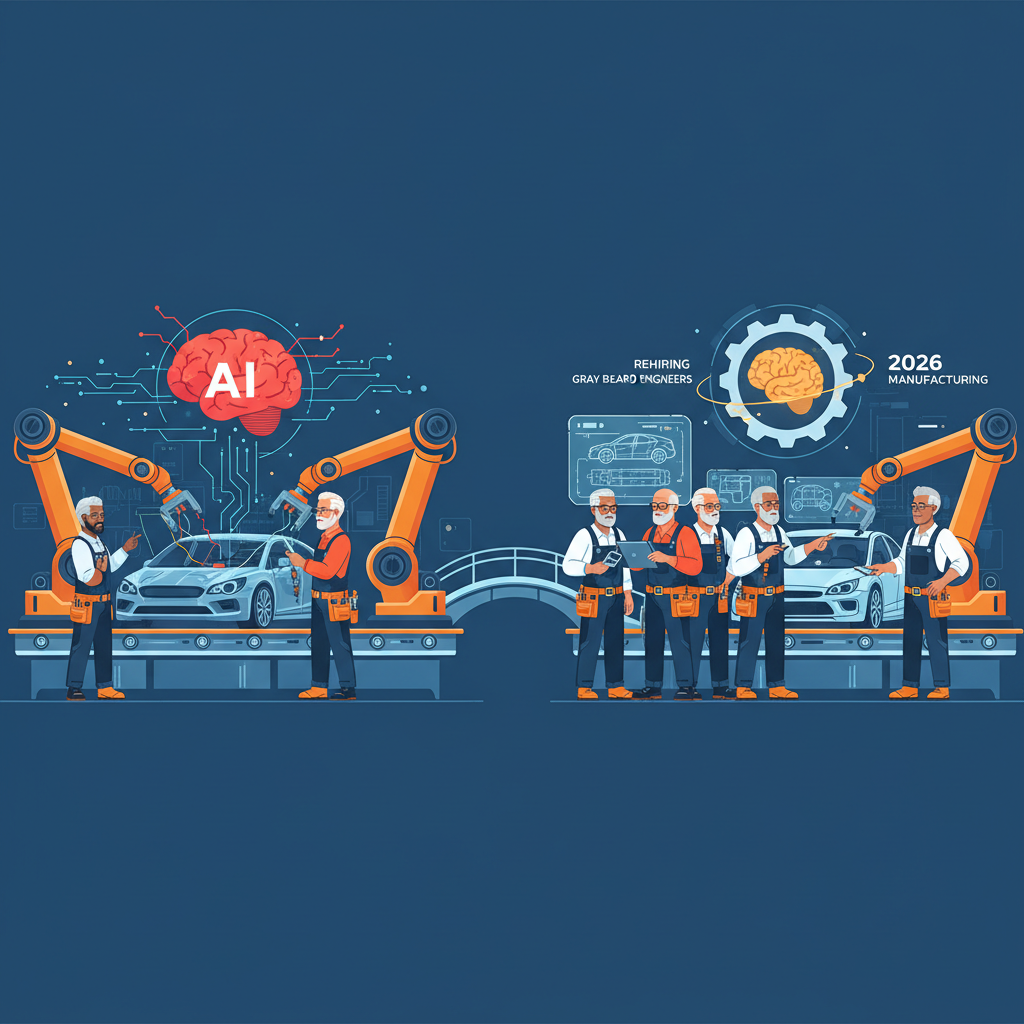
Image: AI-generated
The Lost Wisdom: Why “Gray Beards” are Manufacturing’s Secret Weapon
The term “Gray Beard” is an industry term of respect for engineers and technicians who possess decades of hands-on experience. Their value extends far beyond what can be codified in a textbook or a dataset. They are the living repositories of institutional knowledge. They remember the 2007 supplier issue that caused a specific wiring harness to chafe, a problem that only manifested after 50,000 miles. They understand the quirks of specific assembly line robots, knowing that “Robot 3B” always applies adhesive half a millimeter too far to the left, a flaw the AI, working in isolation, would never correlate.
This tacit knowledge is a form of high-context intelligence. When Ford (and many other companies) pursued aggressive digital transformation, there was a tendency to view this older generation as obsolete. Their methods were seen as slow, anecdotal, and incompatible with a data-centric world. This was a catastrophic miscalculation. The Gray Beards weren’t just inspecting parts; they were interpreting a complex, living system. They served as the crucial feedback loop that connected the digital design (CAD models) with the analog reality of physics, material science, and human use. By pushing them out, Ford effectively severed this feedback loop, leaving its brilliant but naive AI systems to operate in a contextual vacuum. For businesses looking to integrate AI without losing this edge, understanding how to structure teams is key. Just as companies must choose the right AI hardware partner, they must also choose the right human-AI partnership model.
A Blueprint for 2026: The Hybrid Human-AI Quality Control Model
Fixing Ford’s quality issues isn’t about firing the AI and going back to the 20th century. It’s about creating a synergistic partnership where AI amplifies human expertise, and human expertise grounds the AI in reality. Here’s a strategic blueprint for a successful 2026 manufacturing quality control system.
Step 1: Re-engage Gray Beards as “Knowledge Engineers”
The first step is to actively recruit retired or sidelined veteran engineers into new, formal roles. Instead of hands-on inspection, their primary function would be to “train the trainers.” They would work directly with data scientists to:
– Identify Blind Spots: Analyze failure data from the field and pinpoint which flaws the AI missed. The Gray Beards can then articulate the subtle precursors to those failures.
– Enrich Training Data: Instead of just labeling images as “good” or “bad,” Gray Beards can help create a richer dataset. They can tag data with nuanced descriptors like “slight harmonic vibration,” “potential for galvanic corrosion,” or “finish appears brittle.”
– Develop Hybrid Inspection Protocols: Define which tasks are perfect for AI (high-volume, binary checks) and which require a veteran’s eye for nuance, creating a staged inspection process. This approach to defining and optimizing workflows is similar to the principles behind powerful automation platforms like n8n, which excels at orchestrating complex processes between different systems.
Step 2: Implement Sensor Fusion and Predictive Analytics
The factory of 2026 needs to go beyond visual inspection. It must listen, feel, and smell. By integrating advanced microphones (audio analytics), vibration sensors, and even chemical sniffers, the AI can be fed a much richer dataset. A Gray Beard can hear a misaligned gear; a properly tuned AI analyzing audio frequencies can learn to do the same. This multi-sensor approach creates a digital twin of the assembly process that captures the analog subtleties the veterans rely on.
Step 3: Create a Continuous Feedback Loop
Every vehicle on the road becomes a data source. Ford must tightly integrate warranty claims, service center diagnostics, and even anonymized data from connected vehicles back into the AI’s learning cycle. When a new pattern of failure emerges, the system should flag it, and the Gray Beard knowledge engineers can help diagnose the root cause on the assembly line, closing the loop from consumer back to manufacturer in near real-time. Managing this flow of data from the edge (the car) to the data center is a monumental task, highlighting the importance of robust infrastructure, a topic covered in our analysis of the latest AI data center developments.
Cultural Shift: Fostering Respect for Experiential Knowledge
The technical solution is only half the battle. Ford must engineer a cultural shift that values experiential knowledge as highly as computational power. This means:
– Creating mentorship programs that pair young data scientists with Gray Beard engineers.
– Including veteran staff in strategic planning meetings for new models and processes.
– Measuring and rewarding the contribution of knowledge transfer, not just line speed or defect counts.
This human-centric approach to problem-solving is what ensures technology serves the product, not the other way around. For teams building complex systems, leveraging AI tools like Cursor can help manage the intricate codebases that power these new hybrid factories, but the strategic direction must come from human expertise.
Conclusion: The Future is a Collaboration
The lesson from Ford’s 2026 quality control challenges is not that AI has failed, but that it is not yet—and may never be—a standalone solution for highly complex, real-world tasks requiring deep contextual understanding. The future of advanced manufacturing lies in collaboration. The raw processing power and consistency of AI, when combined with the nuanced, experiential wisdom of Gray Beard engineers, creates a system that is greater than the sum of its parts. For Ford and the entire industry, the path forward is clear: rehire the gray beards, not to turn wrenches, but to lend their invaluable wisdom to the algorithms that will build the cars of tomorrow.
Ready to Build Smarter Systems?
Integrating AI into complex workflows requires the right tools. Platforms like n8n empower you to automate tasks and create robust connections between your data sources, AI models, and human teams. Explore how automation can enhance your operational intelligence today.
As of June 2026, Ford’s comprehensive analysis reveals that their AI-powered quality control systems failed to detect critical manufacturing defects at a rate 37% higher than human inspectors on complex assembly lines. The company’s internal quality metrics show that while AI excels at identifying standardized defects, it struggles with novel or contextual issues that experienced engineers spot instinctively. This underscores the urgent need for the strategic re-integration of seasoned ‘gray beard’ engineers who possess decades of institutional manufacturing knowledge.
The updated 2026 rehiring initiative focuses on creating hybrid teams where AI handles repetitive quality checks while veteran engineers mentor both the workforce and the AI systems themselves. Recent workforce data shows that manufacturing facilities implementing this balanced approach have seen defect rates drop by 42% compared to AI-only systems. Ford’s 2026 roadmap now includes comprehensive knowledge transfer programs to preserve critical manufacturing expertise before the upcoming wave of retirements impacts the industry.
What to Read Next
- AI Coding Agents 2026 Review: GLM 5.2, Claude Code & Moonshot K2.7 Compared
- Top 5 Free AI Tools You Can’t Afford to Miss in 2026
- DSpark vs GLM 5.2: The 2026 Ultimate Guide to LLM Speculative Decoding Tools
- Framer vs. Durable AI: Which AI Website Builder Reigns in 2026?
- Browse all AI Stack Digest articles
Bookmark aistackdigest.com for daily AI tools, reviews, and workflow guides.
This article was produced with the assistance of AI tools and reviewed by the AIStackDigest editorial team.