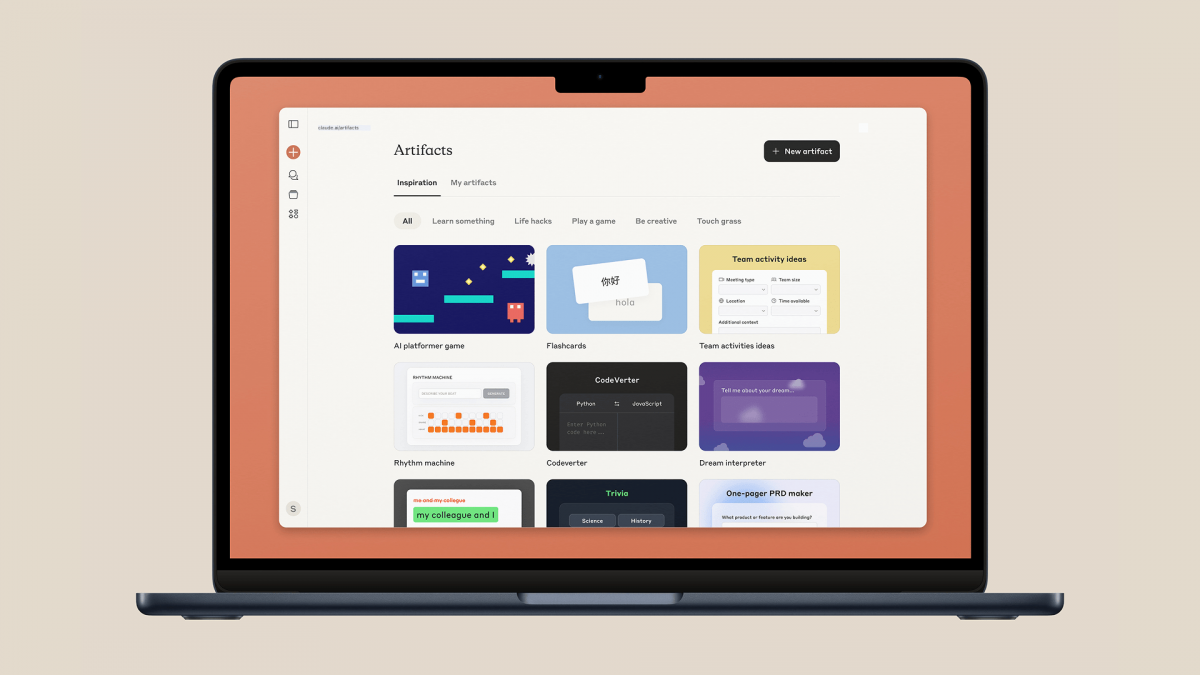
Anthropic, a leading AI research company, has announced a significant update to its Claude AI chatbot: the ability to “Install as app” on Mac and PC for its innovative mini-app Artifacts. This move allows users to transform their Claude-generated mini-applications into native desktop experiences, deepening the integration of AI tools directly into daily workflows for developers and power users alike. It represents a strategic step by Anthropic to make its advanced AI capabilities more accessible and embedded in the computing environment, moving beyond browser-dependent interactions and fostering a new era of AI-powered desktop productivity.

Image: The Verge
What Happened
Anthropic has officially rolled out a new capability for its Claude AI chatbot, enabling users to “Install as app” for mini-applications created using its Artifacts feature. This update is currently in beta and extends Claude’s functionality beyond its web interface, allowing these AI-powered tools to run as standalone desktop applications on both Mac and Windows operating systems. The Artifacts feature, introduced by Anthropic last year, allows users to generate and interact with various outputs—such as code, documents, or UI elements—directly within the Claude environment. With this latest development, these artifacts can now be packaged and installed like traditional software, complete with their own toolbar icons and customizable permissions. Users can grant these mini-apps default browser-like permissions, enhanced app permissions for notifications and shortcuts, or even full computer access, depending on their needs and security preferences. This move aims to streamline workflows for developers and power users, offering a more integrated and persistent experience for AI-assisted tasks. Early adopters are reportedly leveraging this feature to build diverse tools, including AI-powered games, learning aids, data analysis applications, writing assistants, and complex agent workflows that orchestrate multiple Claude calls for sophisticated tasks. The new installation option is available across Anthropic’s Free, Pro, and Max subscription tiers, emphasizing broad access to this enhanced functionality.
Why This Matters
This development from Anthropic is a significant stride towards making AI agents more integral to everyday computing, moving beyond the conversational interface to persistent, actionable applications. For AI practitioners and developers, it signifies a new paradigm in tool creation and deployment. Instead of relying on complex IDEs or deploying to web servers for simple utilities, they can now “vibe code” directly within Claude, generating functional mini-apps that run locally. This greatly reduces the friction associated with prototyping and deploying small, specialized AI tools, fostering rapid experimentation and iteration. The ability to grant granular permissions means that these AI applications can be deeply integrated with the operating system, interacting with local files, sending notifications, and intercepting shortcuts, blurring the lines between traditional software and AI-driven agents. This is particularly impactful for automating repetitive tasks, creating personalized assistants, or building bespoke analytics tools that can operate without constant browser interaction. Furthermore, Anthropic’s encouragement for sharing these artifacts, with API usage counting against the *consumer’s* subscription, could spur a vibrant ecosystem of community-driven AI mini-apps, much like how app stores catalyzed mobile development. This could lead to an explosion of niche, highly effective AI tools tailored to specific professional and personal needs, ultimately accelerating the adoption and utility of advanced AI in practical applications.
The Bigger Picture
Anthropic’s “Install as app” feature for Claude Artifacts is not an isolated development but rather a pivotal piece within a broader, accelerating industry trend: the democratization of AI development and the pervasive integration of AI agents into our daily computing environments. We are unequivocally witnessing a profound paradigm shift, transitioning from a model where AI was primarily perceived as a monolithic, often abstract, cloud-based service to one where AI is becoming an embedded, highly customizable, and deeply personal component of our digital lives. Major tech giants like Google, with its ongoing enhancements to the Gemini app experience, and Microsoft, with its ambitious Copilot initiatives, are also aggressively pursuing deeper operating system integration and more profoundly personalized AI experiences. However, Anthropic’s distinctive approach with Artifacts carves out a unique niche by genuinely empowering users to *build* and customize these mini-apps directly within the very AI environment, a stark contrast to merely consuming pre-built, static functionalities. This strategic move reflects a burgeoning understanding that the true, transformative power of artificial intelligence resides not solely in its raw computational intelligence, but critically in its inherent ability to adapt, evolve, and be extended by its end-users, fostering a symbiotic relationship between human creativity and machine capability. It furthermore strongly hints at an imminent future where the very nature of software development becomes intrinsically collaborative with AI, with advanced generative models increasingly playing a central, indispensable role in both initial code generation and comprehensive application scaffolding. The significant emphasis on robust desktop integration also serves as a potent acknowledgement of the enduring and often overlooked importance of native applications, which inherently offer superior performance, robust offline capabilities, and unparalleled deep system access – critical areas where purely web-based solutions can, at times, inherently fall short. As cutting-edge AI models continue to mature, becoming exponentially more capable, efficient, and versatile, the ability to seamlessly run them, or at the very least their sophisticated interfaces, locally as dedicated, high-performance applications will undeniably emerge as a crucial, perhaps even decisive, differentiator within the fiercely competitive AI landscape. This is particularly salient for privacy-sensitive tasks, highly specialized professional workflows, or operational environments with inherently limited or unreliable internet connectivity. This entire trajectory is a clear, unmistakable indicator that the ongoing battle for AI supremacy is rapidly evolving, shifting its primary focus from raw model capability and benchmark scores to the far more impactful dimensions of seamless integration, unparalleled user experience, and profound user-driven extensibility within the complete computing stack. This foundational shift is set to redefine how we interact with technology and unlock unprecedented levels of digital efficiency and innovation.
What to Watch Next
The immediate next steps will be to closely monitor the adoption and evolution of Claude’s Artifacts and their desktop application counterparts, particularly as they mature beyond the beta phase. We should intently watch for the types of mini-apps that gain significant traction within the community – whether they are niche productivity tools streamlining specific professional tasks, innovative creative assistants pushing the boundaries of digital art and design, or highly specialized developer utilities that fundamentally alter coding workflows. The security implications of granting “full computer access” to AI-generated mini-apps will undoubtedly remain a paramount area of focus. Anthropic will face the ongoing challenge of ensuring robust sandboxing mechanisms and crystal-clear user controls to prevent any potential for malicious or buggy AI to cause unintended system-level issues or data vulnerabilities. The industry will also be keenly observing competitive responses from other major AI players like OpenAI and Google. Will they introduce similar “AI app builder” functionalities that integrate seamlessly with desktop environments, or will they diverge towards different paradigms of AI deployment, perhaps emphasizing cloud-native solutions or more restricted embeddable components? We can confidently anticipate an accelerating race to simplify AI application development and deployment, with a strong and growing emphasis on low-code or even no-code interfaces for creating custom AI agents, making these powerful tools accessible to a much broader user base beyond traditional programmers. The performance characteristics and resource consumption of these native Claude mini-apps will also be absolutely crucial; efficient operation and minimal system overhead will be essential for widespread, long-term adoption, especially on consumer-grade hardware. Lastly, it will be fascinating to observe how developers begin to leverage the API interaction capabilities of these artifacts. This could potentially lead to the emergence of far more complex, interconnected agent workflows that could automate entire business processes, from data analysis and report generation to sophisticated customer service interactions. This is undoubtedly an exciting and rapidly evolving frontier, and the early success and widespread adoption of these desktop-integrated AI mini-apps could fundamentally reshape the future of human-computer interaction and redefine the very concept of AI-powered productivity.
The Bottom Line
Anthropic’s “Install as app” feature for Claude Artifacts marks a pivotal moment in the evolution of AI tools. By transforming AI-generated mini-apps into native desktop applications, Anthropic is not just enhancing user convenience; it’s empowering a new class of AI-assisted creativity and productivity. This move signals a future where AI agents are seamlessly woven into the fabric of our operating systems, offering personalized, powerful, and persistent assistance without the confines of a browser tab. The implications for developers, businesses, and individual users are profound, promising a more integrated, efficient, and user-extensible AI ecosystem. The ability to quickly prototype, deploy, and share custom AI applications locally could ignite a new wave of innovation, making advanced AI capabilities accessible to a much broader audience and truly embedding artificial intelligence into our daily digital lives.
This article was produced with the assistance of AI tools and reviewed by the AIStackDigest editorial team.