As we move through 2026, the AI landscape continues to evolve at a breathtaking pace, with powerful models becoming increasingly accessible. For developers, startups, and hobbyists, the cost of accessing top-tier AI can be a significant barrier. This is where platforms like OpenRouter shine, aggregating a vast array of models into a single, unified API. Navigating the best free options available can be daunting, but three names consistently rise to the top: Qwen, Gemini, and ERNIE. This commercial investigation breaks down the key strengths, ideal use cases, and commercial considerations for these leading free models on OpenRouter in 2026.
OpenRouter: The Gateway to AI Democratization
Before diving into the models, it’s crucial to understand the platform that makes this comparison possible. OpenRouter acts as a universal API, connecting users to a wide range of large language models from various providers. Instead of managing multiple API keys and endpoints, developers can use OpenRouter’s single interface to query the best model for their specific task and budget. This is particularly valuable for accessing free tiers, as OpenRouter simplifies the process of discovering and switching between cost-effective options. For anyone looking to experiment or build applications without initial investment, starting your journey at OpenRouter is a strategic first step.
Qwen: The Open-Source Powerhouse
Hailing from Alibaba’s Tongyi Qianwen project, the Qwen series has cemented its reputation as one of the most capable open-weight model families available. In 2026, its free offerings on OpenRouter are a go-to for developers who value transparency and customization. The models are known for their strong performance in reasoning, coding, and multilingual tasks, often rivaling or even surpassing similar-sized proprietary models.
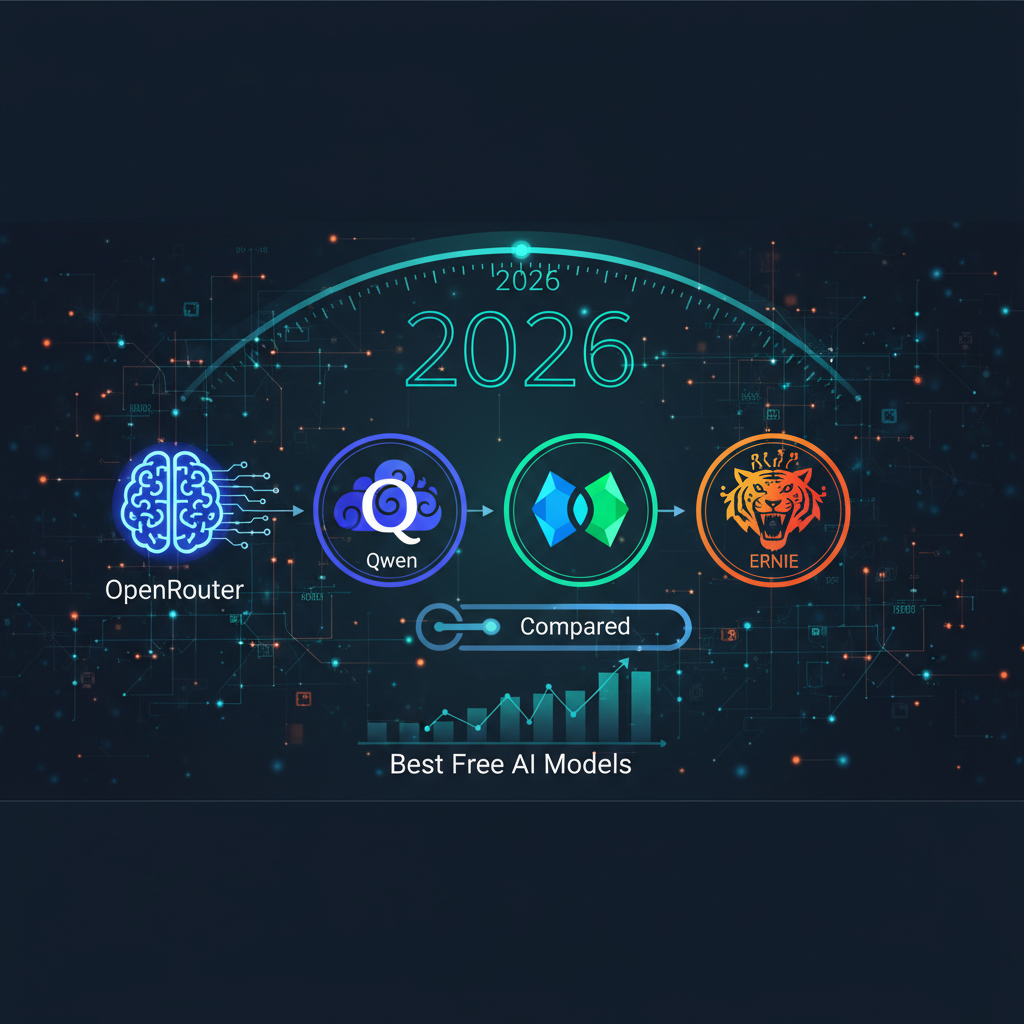
Image: AI-generated
One of Qwen’s standout features is its generous context window, allowing it to process and reason over large documents—a critical capability for tasks like legal document review, codebase analysis, or long-form content creation. Its performance in coding tasks is particularly notable, making it a favorite among developers looking for a free assistant to help with everything from debugging to generating boilerplate code. For those interested in taking model customization further, techniques like fine-tuning with LoRA can be applied to Qwen’s open weights, though this requires moving beyond the OpenRouter API.
Gemini: Google’s Multimodal Contender
Google’s Gemini family represents the tech giant’s flagship AI effort. While its most advanced versions are paid, a robust free tier of Gemini models remains accessible through OpenRouter. Gemini’s key differentiator is its inherently multimodal nature. Even in its free iterations, it is designed from the ground up to understand and process not just text, but also images, audio, and video within a single model architecture.
This makes the free Gemini models on OpenRouter an excellent choice for applications that require any level of multimodal understanding. Whether you’re building an app that needs to analyze a graph in a PDF, describe the contents of an uploaded image, or handle a user query that mixes text and visual references, Gemini’s free tier offers a glimpse into this advanced capability. Its integration with the broader Google AI ecosystem also means it often benefits from the latest infrastructural improvements deployed by the company. For developers looking to build more complex, multimodal workflows, understanding the capabilities of models like Gemini is a foundational step, much like leveraging an advanced orchestrator.
ERNIE: Baidu’s Specialized Expert
Baidu’s ERNIE (Enhanced Representation through kNowledge IntEgration) has carved out a distinct niche, particularly for users with a focus on Asian languages and markets. By 2026, ERNIE has deepened its integration of massive knowledge graphs, making it exceptionally strong at understanding real-world entities, facts, and their relationships.
For commercial applications targeting Chinese-speaking audiences or requiring nuanced understanding of context within Asian business environments, the free ERNIE model on OpenRouter can be an unmatched resource. Its performance in tasks like sentiment analysis on Chinese social media, summarizing Mandarin business reports, or generating culturally appropriate marketing copy often exceeds that of its general-purpose competitors. This specialized knowledge base, combined with its strong natural language understanding capabilities, makes ERNIE a strategic tool for businesses operating in or expanding into these markets.
Head-to-Head Comparison: Choosing the Right Tool
Choosing between Qwen, Gemini, and ERNIE isn’t about finding the “best” model in absolute terms, but rather identifying the best tool for your specific job.
For Coding and Technical Tasks: Qwen often takes the lead due to its open-source heritage and strong performance on technical benchmarks. Developers appreciate its ability to reason through complex code problems and its long-context capability for analyzing entire code files.
For Multimodal and Creative Tasks: Gemini’s architecture gives it a natural advantage. If your project involves any amount of image description, chart analysis, or creative brainstorming that blends visual and textual ideas, Gemini’s free tier is the most capable starting point.
For Asian Markets and Knowledge-Intensive Queries: ERNIE is the specialist. Its deep integration with knowledge graphs provides more accurate and context-aware responses for queries related to businesses, geography, and culture within its area of specialization.
It’s also vital to consider the commercial implications of using these free tiers. While incredibly powerful, free models may have rate limits, slower response times during peak usage, or less consistent uptime compared to paid plans. For a mission-critical application, a paid plan or a hybrid approach might be necessary. Always have a strategy for managing your API usage efficiently to avoid unexpected bottlenecks.
Beyond the Model: Integrating AI into Your Workflow
Selecting a model is just the first step. The real value is unlocked when you seamlessly integrate it into your development and business workflows. Tools like n8n or Make.com can be invaluable here, allowing you to create automated pipelines that take the output from your OpenRouter API calls and trigger actions in other apps—like sending emails, updating databases, or posting to social media. This turns a simple AI query into a powerful, automated business process.
Furthermore, as you build with AI, it’s important to consider the broader ecosystem. The question of how to handle AI-generated code and its licensing is more relevant than ever in 2026, especially when using open-weight models like Qwen that encourage modification and redistribution.
Conclusion and Next Steps
The availability of powerful free models like Qwen, Gemini, and ERNIE on OpenRouter in 2026 has dramatically lowered the barrier to entry for AI innovation. Each model brings a unique set of strengths to the table: Qwen for its open flexibility and coding prowess, Gemini for its multimodal vision, and ERNIE for its deep knowledge and regional specialization. The best approach is to experiment with all three using OpenRouter’s unified API to see which one aligns best with your specific data and use case.
Remember that the AI field moves quickly. The performance and features of these free tiers are subject to change as the companies behind them continue to innovate. The most successful developers will be those who stay agile, continuously evaluate their tools, and integrate them into robust, automated systems.
When evaluating free AI models through OpenRouter, developers should consider not just immediate cost savings but also long-term reliability and performance consistency. The availability of free models continues to evolve as providers balance accessibility with sustainable service delivery. Understanding the trade-offs between different free offerings helps developers make informed decisions about which models best suit their specific use cases and requirements.
What to Read Next
We hope this comparison helps you choose the right free AI model for your 2026 projects. To continue your learning, explore more articles on AI Stack Digest. You might find our guide on how to verify AI-written content particularly useful as you generate more material. For the latest news and in-depth reviews, be sure to bookmark our site and subscribe to our newsletter!
This article was produced with the assistance of AI tools and reviewed by the AIStackDigest editorial team.