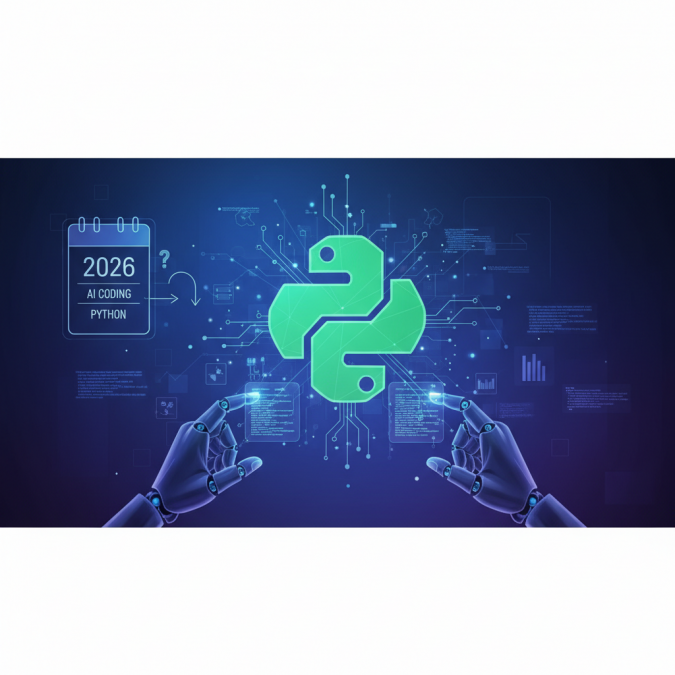
The developer workflow in 2026 is unmistakably different. You no longer start with a blank page and a blinking cursor. Instead, you open a chat interface and describe the feature you need. Within seconds, a sophisticated AI, perhaps one you’ve selected from our guide on the Best OpenRouter Models, generates functional code, complete with comments. So, in a world where machines can draft logic, why does Python—a language that debuted over three decades ago—remain the undisputed king of data science, AI research, and backend development? The answer lies not in the code itself, but in everything that surrounds it: the ecosystem, the community, and the uniquely human-centric design that makes Python the perfect partner for AI, not its victim.
The Co-Pilot, Not the Pilot: AI as a Python Force Multiplier
The fundamental misunderstanding in the “AI vs. Python” debate is framing it as a replacement. In 2026, AI coding assistants are best viewed as force multipliers for skilled developers. They excel at generating boilerplate, implementing well-known algorithms, writing unit tests, and debugging syntax errors. However, they operate within the constraints and paradigms of the languages they are trained on. Python, due to its sheer volume of high-quality public code, extensive documentation, and clear syntax, is the language most AI models are best at generating. Using a tool like Cursor or mastering broader assistants as discussed in our piece on Mastering AI Coding Assistants, a developer can focus on the high-level architecture, business logic, and integration challenges, while the AI handles the repetitive implementation details. The language is the medium of this collaboration, and Python’s readability ensures both human and AI can effectively understand and modify the resulting code.
The Unshakable Pillar: Python’s Mature Ecosystem
No AI can generate a mature software ecosystem overnight. Python’s dominance in 2026 is cemented by libraries and frameworks that are foundational to modern technology. For AI/ML development, TensorFlow, PyTorch, JAX, and Scikit-learn are not just libraries; they are entire universes of optimized computation, pre-built models, and research tools. An AI can write a neural network layer, but it cannot rewrite a decade of optimization and community contribution embedded in PyTorch’s Autograd. Similarly, for web development, Django and FastAPI provide battle-tested structures. For data analysis, the Pandas-NumPy-SciPy trifecta is irreplaceable. AI tools generate code that plugs into these ecosystems. Choosing Python is choosing access to this vast, interoperable toolkit, a strategic advantage no nascent language can offer.
Developer Experience and the “Glue” Language
Python’s philosophy of prioritizing human readability over machine efficiency has proven prescient. In an era where AI generates code, the ability for a human to quickly read, understand, and modify that code is paramount. Python’s syntax is famously clear, acting as executable pseudo-code. Furthermore, Python retains its crown as the ultimate “glue” language. An AI can generate a Python script that calls a C++ library for heavy number crunching, interfaces with a Rust service for performance-critical tasks, manages infrastructure via a Go binary, and orchestrates it all within a readable, maintainable codebase. This orchestration role is more critical than ever in 2026’s polyglot microservices architectures, and Python is the best conductor for the orchestra.
The Evolution of the Developer Role: From Coder to Architect & Editor
The rise of AI coding shifts the developer’s value proposition. The premium is no longer on memorizing syntax (though understanding it is crucial) but on system design, prompt engineering, code review, and integration. A developer in 2026 must:
- Precisely Specify Intent: Craft prompts that guide the AI to generate correct, efficient, and secure code. This requires deep conceptual understanding.
- Architect Robust Systems: Design how generated modules fit together, manage state, handle errors, and scale. This is a creative, high-level task AI cannot perform autonomously.
- Critically Review and Edit: AI-generated code can contain subtle bugs, inefficiencies, or security flaws. The developer must act as a senior editor, spotting issues and refining the output. This critical thinking is the core of the profession.
- Integrate and Deploy: Getting code from an IDE to a production environment involves complex CI/CD pipelines, containerization, and cloud services—areas where tools like n8n for workflow automation or a robust Contabo VPS for hosting become essential.
Future-Proofing and the Stability Factor
The technology landscape in 2026 is fast-moving, with new AI models and tools announced weekly, as seen in our Weekly AI Digest. In this environment, betting on a stable, widely adopted foundation is a wise business decision. Python offers long-term stability. Its extensive use in education ensures a continuous pipeline of developers. Its role in major corporations and open-source projects guarantees maintenance and evolution. Choosing Python is a low-risk, high-reward decision that ensures your codebase remains accessible, maintainable, and integrable for years to come, regardless of which AI coding tool becomes the next trend.
Conclusion: Symbiosis, Not Obsolescence
The narrative that AI code generation spells the end for programming languages like Python is a profound misconception. The reality of 2026 is one of symbiosis. Python provides the stable, rich, and human-readable foundation. AI provides the accelerated, tireless, and detail-oriented implementation power. Together, they enable developers to build more complex, reliable, and innovative software than ever before. Python isn’t being replaced; it’s being empowered. The developers who thrive will be those who leverage AI to master Python’s ecosystem, not those who abandon it.
Ready to Supercharge Your Python Development?
Pair the power of Python with the best modern tools. Use an AI-native editor like Cursor to accelerate your workflow, and deploy your creations on reliable, high-performance infrastructure from our partner, Contabo.
As of May 2026, the developer debate is more heated than ever. AI coding assistants like GitHub Copilot X, Cursor’s Agent Mode, and Replit’s Ghostwriter can now generate entire functional modules. Yet, Python’s reported user base has grown by 15% year-over-year, according to the 2026 TIOBE Index. The contradiction reveals a core truth: Python isn’t just a language to write in; it’s the foundational orchestration layer for AI tooling itself.
The key 2026 advantage is Python’s ecosystem for AI tool calling and glue code. Projects increasingly use lightweight, distilled models like Needle or Gemini Nano for specific tool integrations (see our guide on Best Distilled AI Tool Calling Models 2026), but these models are almost universally hosted, fine-tuned, and managed via Python frameworks like FastAPI, LangChain, or newer 2026-specific orchestration libraries. AI writes the business logic, but Python scripts define the workflow, handle API calls to multiple models, and manage the state of complex agentic systems.
Furthermore, prompt engineering in 2026 has evolved into ‘stack prompting’. Developers aren’t just asking an AI for code; they’re providing context from their Python environment—import statements from `requirements.txt`, the structure of their Pydantic models, and outputs from linters. This rich, deterministic context from the Python toolchain significantly elevates the quality and accuracy of AI-generated code compared to context-free requests.
For teams, the strategic value lies in maintainable AI-assisted codebases. A 2026 survey by Stack Overflow shows that 73% of engineering leads mandate that AI-generated code must conform to existing project structure and use internal Python libraries. Python’s readability and strong conventions make it the most effective language for human reviewers to audit, refactor, and integrate AI-generated blocks, ensuring long-term project health.
What to Read Next
- Claude vs Codex for Deliberate Skill Development in 2026: Choosing Your AI Learning Partner
- Unleashing Productivity: The Best AI Tools Shaping 2026
- Best VPS for WordPress in 2026: Powering Your Site with Speed and Stability
- Needle Review: The 26M Gemini Tool-Calling Model Explained | 2026
- Browse all AI Stack Digest articles
Bookmark aistackdigest.com for daily AI tools, reviews, and workflow guides.
This article was produced with the assistance of AI tools and reviewed by the AIStackDigest editorial team.