As we move deeper into 2026, the landscape of artificial intelligence for business has solidified, and Anthropic’s Claude has emerged as a major contender. For small business owners, the decision to invest in an AI assistant is no longer about future potential but immediate, tangible ROI. Claude, renowned for its safety-first Constitutional AI approach and extended context windows, promises a powerful ally. But is it the right fit for your small business this year? This deep dive explores the practical applications, the still-existent limitations, and the specific business profiles most likely to succeed with Claude in 2026.
The 2026 Claude Suite: More Than Just a Chatbot
Small businesses in 2026 aren’t interacting with a single Claude model; they’re accessing a suite of tools designed for commercial use. The core offering remains the conversational AI, but it’s now deeply integrated into workflows via APIs and specialized agents. The headline feature is the 200K+ token context window, which allows Claude to process and reason over entire business documents—think complete annual reports, lengthy legal contracts, or years of customer feedback archives—in a single prompt. For the small business owner wearing multiple hats, this translates to a powerful synthesis engine for dense information.
Where Claude Excels in 2026
Let’s break down the concrete areas where Claude delivers exceptional value for small businesses this year.
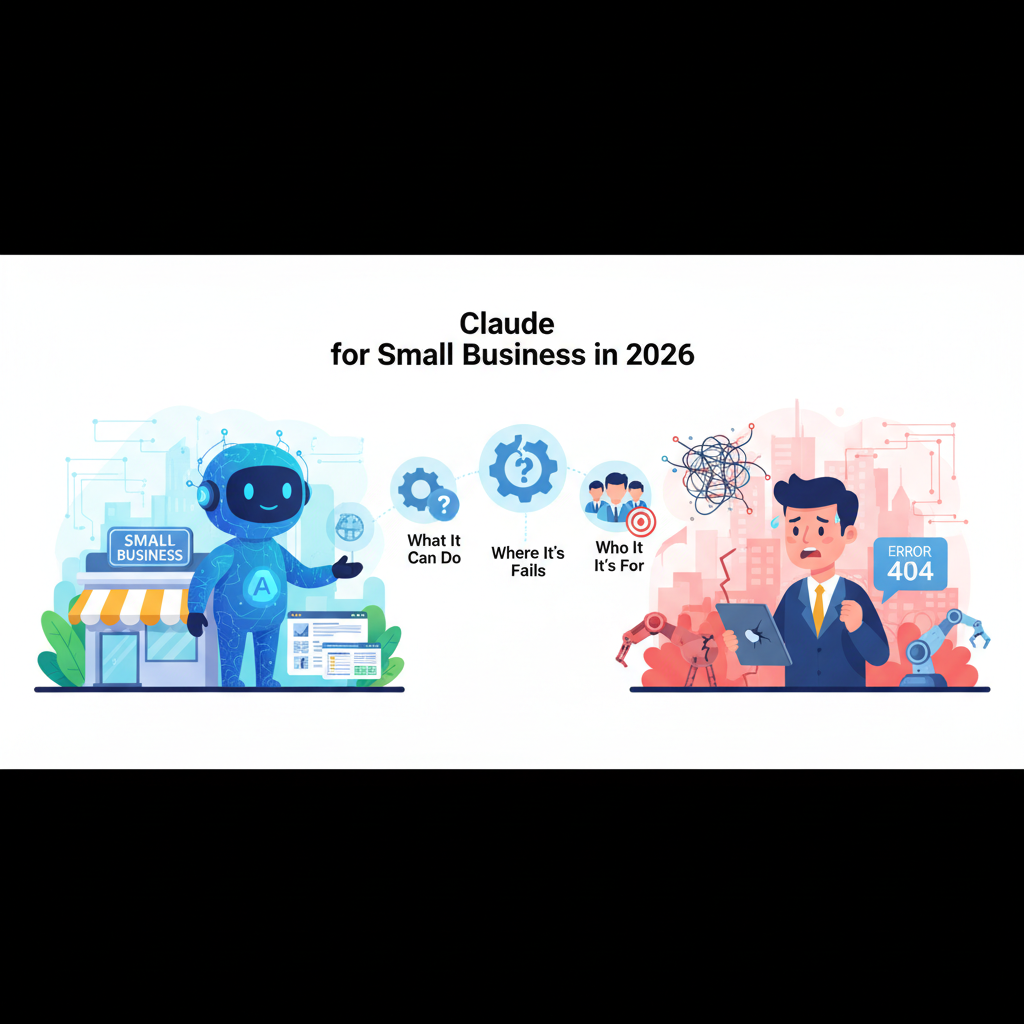
Image: AI-generated
Content & Communication at Scale: Claude’s forte remains nuanced language generation. This goes beyond drafting blog posts. It excels at creating varied marketing copy for different channels, personalizing customer outreach emails based on client history, writing clear SOPs and training manuals for new hires, and even crafting persuasive grant proposals or investor decks. Its ability to maintain a consistent brand voice across thousands of words is a massive time-saver.
Deep Document Analysis & Synthesis: This is Claude’s killer app for many businesses. Upload a stack of market research PDFs, financial statements, and competitor websites, and ask for a consolidated SWOT analysis. Provide it with a complex new regulation and your company policies, and have it draft a compliance gap analysis. This ability to digest, cross-reference, and summarize disparate information sources is invaluable for strategic planning, a task often neglected by busy small business owners.
Customer Interaction & Support: While not a full replacement for a human, Claude-powered chatbots and email triage systems in 2026 are remarkably sophisticated. They can handle complex, multi-part customer queries by drawing from your knowledge base, FAQ, and past support tickets. They draft detailed, empathetic responses for human review, drastically reducing first-response times and freeing up your team for high-touch issues. This directly impacts customer satisfaction and operational efficiency.
Idea Generation & Strategic Brainstorming: Stuck on a product name? Need a fresh angle for a marketing campaign? Claude acts as a boundless brainstorming partner. You can provide constraints (budget, target audience, brand values) and have it generate dozens of creative options, complete with pros and cons. It’s particularly good at playing devil’s advocate, helping you stress-test business ideas by anticipating potential pitfalls.
The Persistent Gaps: Where Claude Still Falls Short in 2026
Despite significant advances, Claude is not a magic bullet. Understanding its limitations is crucial to setting realistic expectations and avoiding costly missteps.
Mathematical & Deductive Reasoning: While improved, Claude is not a spreadsheet or a financial calculator. It can make logical errors in complex numerical tasks, misapply formulas, or hallucinate figures. You should never rely on it for final financial projections, complex pricing models, or precise data analysis without rigorous human verification. For these tasks, traditional tools or specialized AI data analysts are superior. Always cross-check its arithmetic.
Real-Time, Dynamic Data & True Automation: Claude’s knowledge is static between updates. It cannot access live stock levels, current website traffic, or real-time social media sentiment unless connected via API to other tools. This is where its true power is unlocked, but it requires setup. Out of the box, Claude cannot do things—it can only suggest things. To automate tasks (e.g., posting a generated social media update, updating a CRM), it must be integrated with workflow automation platforms like n8n or Make.com. As noted in our coverage of Claude Managed Agents, even advanced agent systems require careful orchestration.
Specialized, Domain-Specific Expertise: While Claude has broad general knowledge, it lacks the deep, tacit knowledge of a seasoned professional in niche fields. A custom furniture maker will find its design suggestions generic compared to a specialist CAD AI. A boutique medical practice should not use it for diagnostic advice. For highly specialized tasks, domain-fine-tuned models or human experts are still necessary.
Cost vs. Micropreneurs: For solopreneurs or ultra-lean startups, Claude’s commercial API costs, while more competitive in 2026, can still be a significant line item compared to using a blend of free or lower-cost specialized tools. The ROI needs to be clearly demonstrable.
The Ideal Claude Customer: Is This Your Small Business?
Claude isn’t for everyone. It shines brightest for specific business models and owner profiles.
- The Knowledge-Intensive Service Business: Consultants, marketing agencies, law firms, coaches, and financial advisors. These businesses live and die by their insights and communications. Claude’s ability to synthesize research, draft client reports, and manage communication is a direct force multiplier.
- The Content-Focused Creator or Publisher: Small media companies, niche bloggers, and content marketers who need to produce high-volume, high-quality written material consistently. Claude ensures the editorial pipeline never dries up.
- The Detail-Oriented Founder: Business owners who are systematizers. If you value documented processes, clear communication, and strategic planning, Claude aligns perfectly with your mindset. It helps you codify your operational knowledge.
- Businesses Prioritizing Brand Safety & Tone: Claude’s constitutional AI training makes it less prone to generating off-brand, offensive, or risky content—a key concern for businesses in regulated or reputation-sensitive industries.
Conversely, a brick-and-mortar retail shop with simple inventory needs and minimal content creation, or a trades business where the primary value is physical skill, may find the payoff less immediate.
Getting Started: A Pragmatic 2026 Implementation Plan
If Claude seems like a fit, avoid the “boil the ocean” approach. Start small and focused.
- Pilot with a Single, High-Impact Use Case: Don’t try to overhaul everything. Pick one painful area: answering RFPs, writing weekly newsletter content, or summarizing customer feedback. Run a one-month pilot, measuring time saved and quality improvements.
- Master Prompt Engineering & Context Management: Claude’s power is unlocked through precise prompting. Learn to provide clear instructions, examples, and structure. Use its massive context window strategically by uploading key reference documents at the start of a conversation. For developers looking to build on this, platforms like OpenRouter offer a gateway to compare Claude with other leading models for specific tasks.
- Integrate to Automate: The jump from assistant to automator is where true transformation happens. Use Claude’s API to connect it to your other tools. For instance, use a platform like Make.com to create a workflow where Claude analyzes incoming customer feedback from a form, categorizes sentiment, and posts a summary to a Slack channel while drafting a response for your review.
- Establish a Human-in-the-Loop (HITL) Protocol: Never deploy Claude’s output unchecked for critical functions. Designate a review step. Claude generates the first draft, the marketing manager approves it; Claude suggests a support response, the agent sends it. This balances efficiency with quality control.
The explosive growth of companies like Anthropic, as covered in our news feed on Anthropic’s compute race, underscores the breakneck pace of this sector. For the right small business in 2026, Claude is not a cost but a strategic investment in intellectual bandwidth. It excels at augmenting the cognitive and communicative load, freeing you, the owner, to focus on vision, relationships, and growth—the irreplaceably human aspects of your business. Its failures are primarily in the realms of pure calculation, real-time action, and deep specialization, areas where a hybrid human-AI workflow is essential. Assess your business’s core needs honestly: if they revolve around understanding, writing, planning, and synthesizing information at scale, Claude may well be your most valuable hire of the year.
Ready to Build Your AI Workflow?
Claude’s API is powerful, but to truly automate your business processes, you need a robust workflow engine. n8n is a powerful, code-optional platform that lets you connect Claude to hundreds of apps (like your CRM, email, and database) to create custom automations. Design sophisticated, multi-step workflows that put your AI assistant to work, moving beyond chat and into action.
What to Read Next
- Musk vs OpenAI 2026: Why Elon Musk Lost, What the Lawsuit Means, and What Happens Next
- The Top 5 Free AI Tools You Need to Try in 2026
- AI Data Analysis Tools in 2026: How to Analyse Data Without Being a Data Scientist
- AI Subscriptions in 2026: Why Enterprise Budgets Are Hitting a Tipping Point
- Browse all AI Stack Digest articles
Bookmark aistackdigest.com for daily AI tools, reviews, and workflow guides.
This article was produced with the assistance of AI tools and reviewed by the AIStackDigest editorial team.