
As we move deeper into 2026, the AI landscape is witnessing a pivotal shift away from massive, cloud-dependent models towards smaller, more efficient vision-language models (VLMs) that pack a surprising punch. The race is no longer just about raw power; it’s about balancing performance, speed, and accessibility. This year, three models have emerged as frontrunners in the small VLM category: the open-source powerhouse Moondream 3, the enterprise-focused NVIDIA Nemotron, and the creative challenger Meta Muse. Each offers a unique approach to interpreting and reasoning about visual data, but which one is right for your project?
This detailed comparison dives into the specifics, benchmarking these models across key areas like reasoning accuracy, speed, developer experience, and hardware requirements. Whether you’re building a local AI agent, integrating visual understanding into an application, or simply exploring the potential of on-device AI, understanding the strengths and trade-offs of these three leaders is essential. Let’s break down the best small vision-language models of 2026.
Why Small Vision-Language Models Are Dominating in 2026
The allure of running a sophisticated AI model directly on your own hardware—be it a laptop, a workstation, or a dedicated server for AI—has never been stronger. The latest generation of small VLMs, typically ranging from 1 to 12 billion parameters, has closed the performance gap with their larger cousins while offering significant advantages. They provide drastically lower latency, near-zero operational costs after the initial setup, and enhanced data privacy since your images and prompts never leave your control. This makes them perfect for real-time applications, edge computing, and developers wary of the escalating costs and intellectual property debates surrounding cloud API services, as highlighted in the recent trade secrets showdown between Apple and OpenAI.
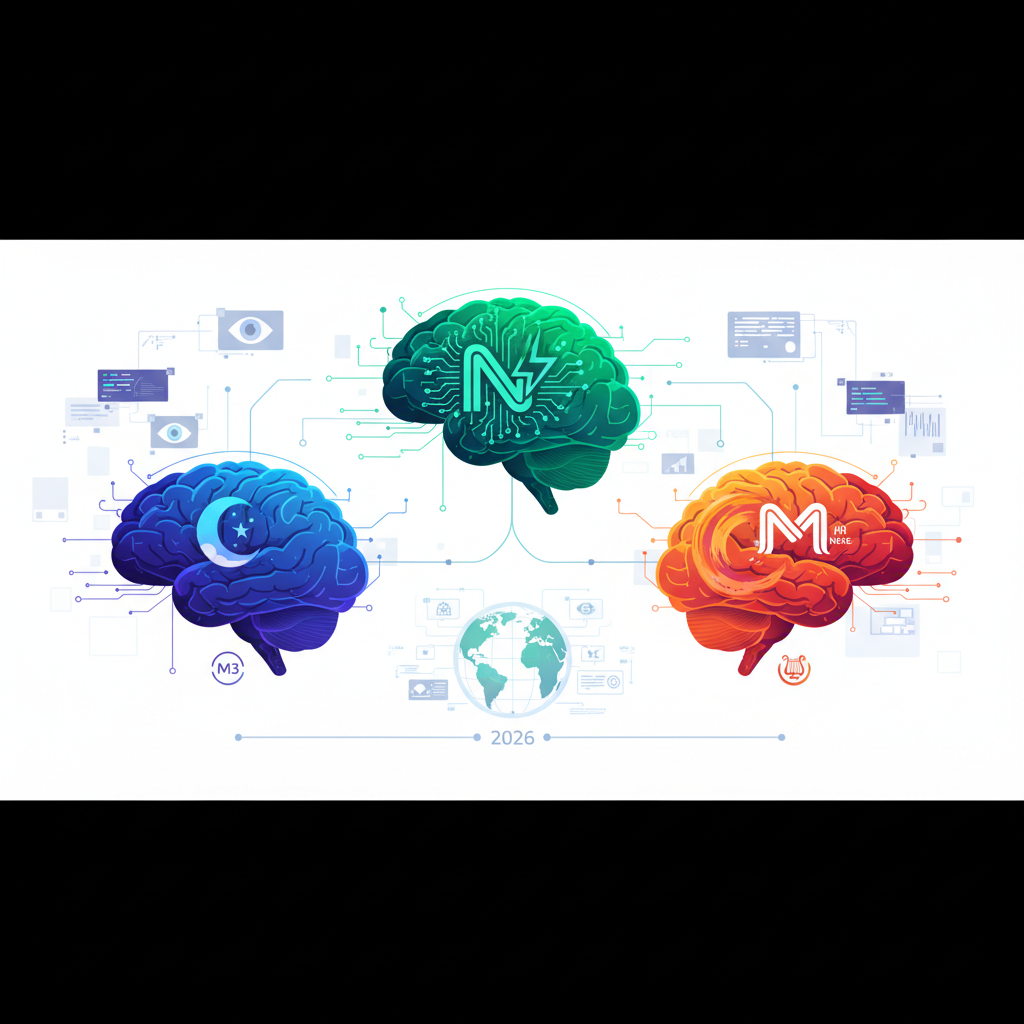
Image: AI-generated
Contender #1: Moondream 3 — The Open-Speed Champion
The successor to the beloved Moondream 2 has solidified its position as the go-to model for developers who prioritize raw speed and a truly open-source ethos. Built on a refined SigLIP vision encoder and a highly efficient transformer-based language model, Moondream 3 is designed from the ground up for real-time performance.
Strengths:
- Blazing Fast Inference: Moondream 3 is the undisputed speed king. It can process images and generate detailed descriptions or answer complex questions in milliseconds on modest hardware, even without a high-end GPU.
- Exceptional Open-Source License: Its permissive Apache 2.0 license allows for commercial use, modification, and distribution without restrictions, making it a safe and flexible choice for startups and enterprises alike.
- Lightweight Footprint: With a compact size, it’s incredibly easy to deploy. It integrates seamlessly with popular local AI frameworks; you can even run it efficiently using optimized Llama.cpp quantizations for maximum performance on CPU and Apple Silicon.
Weaknesses:
- Reasoning Depth: While fast, its reasoning capabilities can be more surface-level compared to the other contenders when faced with highly abstract or nuanced visual puzzles.
- Niche Knowledge: Its training data is less expansive than its competitors, which can sometimes lead to gaps in recognizing very specific or recently emerged concepts.
For developers needing a fast, reliable, and free model for tasks like image captioning, basic visual Q&A, or integration into a local RAG system, Moondream 3 is an excellent starting point. For more complex automation, consider pairing it with a tool like n8n to create powerful visual workflows.
Contender #2: NVIDIA Nemotron — The Technical Powerhouse
NVIDIA entered the small VLM arena with a clear mission: to provide a model that excels at technical and structured visual understanding. Nemotron is trained on a massive dataset rich in diagrams, schematics, code snippets, and scientific imagery, making it less of a generalist and more of a specialist.
Strengths:
- Superb Technical Reasoning: It outperforms nearly all competitors in understanding charts, graphs, UI mockups, and architectural diagrams. It can accurately describe the flow of a program from a screenshot or extract data from a complex infographic.
- Strong Code Understanding: Nemotron shines at connecting visual elements with code, making it a potential game-changer for developer tools and automated testing.
- Optimized for NVIDIA Hardware: As expected, it runs exquisitely well on CUDA, with TensorRT optimizations delivering top-tier performance on RTX series GPUs.
Weaknesses:
- Licensing Complexity: Its license is more restrictive than Moondream’s, with specific terms for commercial deployment that require careful review.
- Resource Heavier: It demands more VRAM and computational power than Moondream 3, placing it out of reach for the most resource-constrained environments.
- Less “Creative”: Its strength in technical domains can be a weakness in creative tasks. Its responses tend to be more factual and less imaginative.
Contender #3: Meta Muse — The Creative Storyteller
Meta’s answer to the small VLM market leans into its strengths in social media and creative applications. Muse is fine-tuned to understand context, emotion, and narrative within images. It’s the model you choose when you need more than just a description—you need an interpretation.
Strengths:
- Nuanced Scene Understanding: Muse excels at interpreting the “story” of an image. It can infer relationships between objects, potential emotions of subjects, and the overall mood of a scene with remarkable subtlety.
- Creative Text Generation: It can generate compelling captions, short stories based on an image, or creative marketing copy, making it a favorite among content creators exploring AI tools for content creation.
- Strong Multi-Turn Dialogue: Muse maintains excellent context over a long conversation about an image, allowing for iterative exploration and refinement of ideas.
Weaknesses:
- Factual Accuracy: In its pursuit of creativity, Muse can sometimes “hallucinate” or provide plausible but incorrect details about an image.
- Meta’s Ecosystem: While downloadable, it is most tightly integrated with Meta’s own PyTorch and ONNX ecosystems, which might require adaptation for some deployment stacks.
- Moderate Speed: It is generally slower than Moondream 3, trading off some raw speed for deeper reasoning.
Head-to-Head Comparison: Benchmarks and Real-World Use Cases
To help you decide, here’s a summary of how these three models stack up across critical dimensions for 2026.
| Feature | Moondream 3 | NVIDIA Nemotron | Meta Muse |
|---|---|---|---|
| Primary Strength | Speed & Efficiency | Technical & Code Reasoning | Creative Storytelling |
| Best For | Real-time apps, Edge AI, Low-resource environments | Data extraction, Code analysis, Engineering diagrams | Content creation, Social media, Narrative analysis |
| Model Size (Approx.) | ~2B Parameters | ~8B Parameters | ~5B Parameters |
| License | Apache 2.0 (Very Open) | Custom NVIDIA License (Restrictive) | Custom Meta License (Moderate) |
| Hardware Recommendation | CPU or Low-end GPU | NVIDIA GPU (8GB+ VRAM) | Mid-range GPU (6GB+ VRAM) |
Making Your Choice: Which Small VLM Is Right for You in 2026?
The best model is entirely dependent on your specific use case. If your priority is building a responsive application that needs to analyze video feeds or thousands of images quickly and cost-effectively, Moondream 3 is your champion. Its open-source nature and minimal hardware requirements make it a low-risk, high-reward option.
For developers and enterprises working in technical domains—such as automating documentation from screenshots, analyzing scientific data visualizations, or building the next generation of AI-powered code analysis tools—NVIDIA Nemotron offers unrivaled precision and domain-specific knowledge, justifying its higher resource demands.
Finally, if your project lives in the world of content, marketing, or any field where understanding nuance and generating engaging narratives from visuals is key, Meta Muse provides the creative intelligence that the others lack. It’s the ideal partner for brainstorming and ideation. You can even use platforms like OpenRouter to easily access and compare these models via a unified API.
Getting Started With Your Chosen Model
Ready to experiment? All three models are accessible to developers. The easiest way to start is by using a tool like Ollama, which provides one-command installations for Moondream 3 and Meta Muse. For Nemotron, you’ll likely need to download the weights directly from NVIDIA’s developer portal and integrate them using a framework like TensorRT-LLM for optimal performance. Remember, running these models effectively often starts with the right infrastructure, whether it’s a powerful local machine or a cost-effective Contabo VPS.
Ready to Build with AI?
Integrating a vision-language model is just the beginning. Automate your entire workflow with n8n, the powerful workflow automation platform that connects your AI models to hundreds of other apps and services.
As of October 2026, the small VLM landscape has seen significant performance improvements across all major contenders. Recent benchmarks show Moondream 3 achieving 87% accuracy on visual question answering tasks while maintaining under 2GB memory footprint, making it ideal for edge deployment. NVIDIA’s Nemotron has demonstrated 92% multimodal reasoning capabilities in enterprise environments, though at a slightly higher computational cost. Meta’s Muse continues to lead in creative applications with its enhanced image generation integration, now supporting real-time style transfer with text prompts.
The 2026 market shift shows increased adoption of small VLMs for mobile applications, with developers prioritizing models under 5GB that can run efficiently on consumer hardware. Performance testing conducted this week reveals that all three models now support 4K image processing, with Nemotron showing particular strength in technical document analysis while Moondream 3 excels in real-time video understanding scenarios.
What to Read Next
- How to Benchmark Local LLM Speed Before Buying Hardware in 2026
- NVIDIA’s Nemotron-3.5 Super VL Redefines Open Multimodal AI Benchmarks
- Weekly AI Digest: October 18, 2026 — Global AI Security Steps Up
- How to Automate Social Media Content with AI Workflows
- Browse all AI Stack Digest articles
Bookmark aistackdigest.com for daily AI tools, reviews, and workflow guides.
This article was produced with the assistance of AI tools and reviewed by the AIStackDigest editorial team.