
Senior AI Journalist
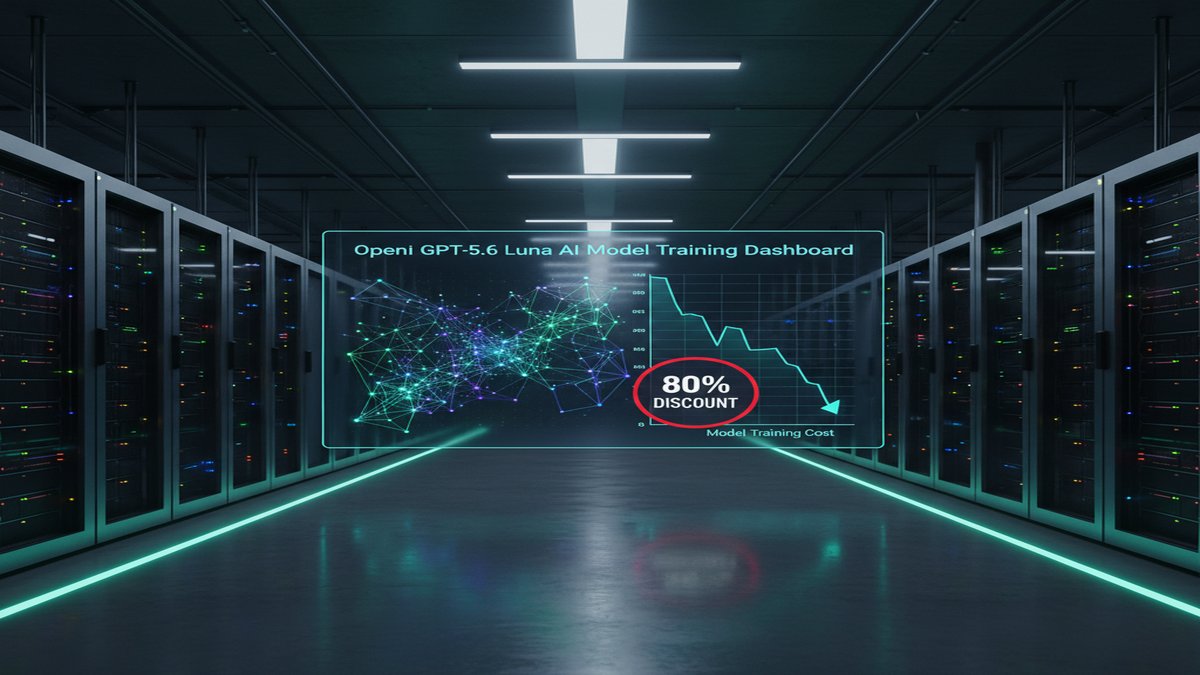
OpenAI Slashes GPT-5.6 Luna Prices by 80 Percent, Sparking New Era of AI Affordability
In a dramatic shift that signals intensifying competition in the generative AI market, OpenAI has announced an 80 percent price reduction on its smallest model, GPT-5.6 Luna, effective July 30. Luna now costs just $0.20 per million input tokens and $1.20 per million output tokens, compared to its previous pricing. The company’s mid-tier model, Terra, sees a more modest 20 percent cut to $2 and $12 per million tokens respectively. Terra remains at original rates.
OpenAI attributes the dramatic cost reductions to efficiency gains from its flagship GPT-5.6 Sol model, which reportedly optimized the company’s GPU infrastructure autonomously during development. Sol’s optimization efforts cut deployment costs by 20 percent and improved token generation speed by more than 15 percent through speculative decoding—a technique that predicts and generates later tokens before the model completes earlier computations. According to OpenAI, a task that previously cost one dollar with competing models now runs for approximately six cents on Luna, achieving nearly nine times faster throughput.
The price war reflects growing market pressure from low-cost providers, particularly Chinese AI companies that have disrupted Western pricing models. Microsoft is openly promoting its own MAI specialist models as cheaper alternatives to OpenAI, forcing frontier labs to compete aggressively on unit economics. Industry observers warn that sustained price pressure could threaten revenue growth at major AI labs whose balance sheets depend heavily on massive infrastructure investments. The cuts are available through ChatGPT Work, Codex, and the OpenAI API.
Source: The Decoder
Former OpenAI Researcher Predicts $100 Billion Flow Into Specialized Training Data
Andrew Ho, a former OpenAI researcher, and Cambridge researcher Adam Hunt are raising alarms about a fundamental shift in large language model development: models are becoming increasingly specialized rather than universally capable. While these models excel at coding and mathematics, they are stagnating or even regressing in other knowledge domains. This specialization trend suggests that raw model scaling alone—the primary strategy of frontier labs for the past several years—no longer delivers broad capability gains.
Ho is leaving OpenAI to start a company focused on high-quality, domain-specific training datasets. He predicts that AI development labs will need to invest more than $100 billion in targeted data collection, curation, and preparation over the next few years. This represents a fundamental pivot: rather than throwing more computational power at existing datasets, labs will need to invest heavily in understanding what data actually drives capability in specific domains.
The shift reflects a hard truth emerging from scaling law studies: the quality, diversity, and relevance of training data matter as much as model size. As frontier reasoning capabilities plateau on standard benchmarks, the next breakthrough may depend on labs’ ability to source, label, and fine-tune datasets that reflect real-world complexity. Ho’s bet suggests that the winners in next-generation AI development will be those who solve the training data problem, not just those with the biggest GPUs or largest budgets for compute.
Source: The Decoder
Pangram 4 Sets New Standard for AI Detection, Catching 99.66% of Generated Text
Pangram, a startup focused on AI-generated content detection, has released Pangram 4, a significantly upgraded model that represents a leap forward in identifying machine-generated text. The new model is six times larger than its predecessor and delivers dramatic improvements: 14 times fewer false positives and six times fewer false negatives compared to Pangram 3. In Pangram’s own benchmarks, the model correctly identifies 99.66 percent of all AI-generated text while falsely flagging human writing just 0.0041 percent of the time—roughly one error per 24,000 documents.
Pangram 4 introduces new capabilities that reflect the sophistication of modern AI writing tools. The model can distinguish between AI-assisted text (human writing refined by AI) and fully AI-generated content, a nuance that matters as more writers adopt AI for editing. It also resists “humanizer” tools designed to disguise AI writing as human-created, catching the AI component across 13 common humanizers 98.83 percent of the time. These features address a growing market of tools explicitly designed to make detection harder—an arms race between generation and detection technology.
The business momentum behind Pangram reflects explosive demand for AI detection. According to reporting from the New York Times, annual revenue has grown 35 times year over year, while monthly active users jumped from 2,700 in June 2025 to 120,000 in June 2026. As enterprises grapple with the challenges of AI-generated content in their workflows—from plagiarism concerns to misinformation risks—detection tools are becoming critical infrastructure. For those running large-scale content platforms or evaluating AI-generated work at scale, deployment on Contabo VPS infrastructure ensures cost-effective, reliable access to detection APIs without overprovisioning compute resources.
Source: The Decoder
What to Read Next
- How to Prevent Cognitive Debt from LLM-Generated Code in 2026: A Developer’s Survival Guide
- Top 5 Free AI Tools You Should Be Using Right Now (August 2026)
- Is Claude Pro Worth It in 2026? Honest Review After 3 Months
- n8n vs Make.com in 2026: Which AI Automation Platform Should You Build On?
- Browse all AI Stack Digest articles
Bookmark aistackdigest.com for daily AI tools, reviews, and workflow guides.
This article was produced with the assistance of AI tools and reviewed by the AIStackDigest editorial team.