In the rapidly evolving landscape of AI development, particularly around powerful models designed for writing and executing code, a new layer of sophisticated security and moderation infrastructure has emerged. In 2026, a critical yet often overlooked feature of Anthropic’s specialized Claude Code model is its use of steganographic request marking. This technical process embeds invisible, structured metadata within user prompts before they are processed by the model’s reasoning engine. Far from being a minor technical footnote, this mechanism is fundamental to Claude Code’s ability to operate safely at scale, balancing developer empowerment with robust security, and preventing misuse in critical environments. Understanding this system reveals much about the future trajectory of agentic AI tooling and the necessary guardrails for powerful coding assistants.
What Is Steganographic Request Marking? Demystifying the Hidden Layer
Steganography, in its classical sense, is the practice of concealing information within another message or object. Claude Code’s implementation applies this concept to the digital realm of API requests. When you send a prompt to Claude Code—whether through its official API, an integrated AI coding tool like Cursor, or another platform—the system doesn’t just pass your raw text directly to the model. Instead, it first processes and marks the request.
This marking involves encoding a set of structured, machine-readable signals directly into the prompt’s representation. These signals are designed to be imperceptible to the end-user (and to the model’s own text output) but are clearly legible to the model’s internal control mechanisms. Think of it as a digital watermark for intent and context, woven into the fabric of the query itself. This allows the system to track a request’s provenance, apply specific safety filters based on the deployment environment, and maintain an audit trail without altering the visible conversation flow for the developer.
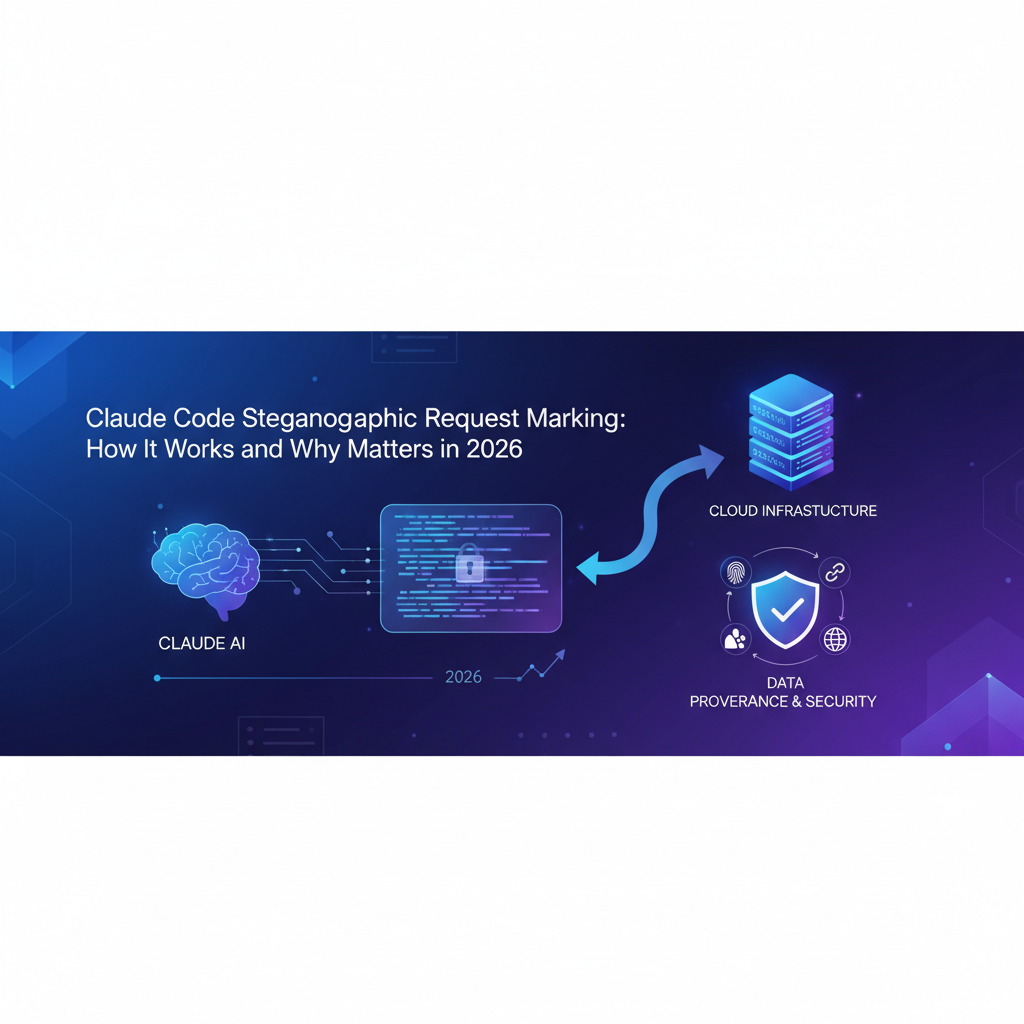
Image: AI-generated
The Technical How: Embedding Signals for Safety and Control
The marking process is multifaceted. At its core, it encodes information such as the session ID, the source application or platform making the request (e.g., a cloud IDE vs. a local CLI tool), user permission levels, and the specific safety policies that should be enforced for that session. For instance, a request coming from a regulated financial institution’s internal sandbox might be marked with a flag that triggers stricter code-generation policies regarding data access and external library calls.
This is not a simple header or tag appended to the request; the marking is steganographically distributed within the tokenized input. This makes it resistant to tampering or spoofing by a user who might try to manipulate plaintext headers. The model’s architecture is trained to recognize and respect these embedded signals during its reasoning process, allowing it to dynamically adjust its behavior. This is why Claude Code can seem context-aware of its deployment boundaries, refusing to generate certain types of potentially harmful code in one setting while allowing similar-but-safe code in a secured, isolated testing environment. It’s a key feature that enables its use in professional and enterprise settings where compliance is non-negotiable.
Image: AI-generated
Why It Matters More Than Ever in 2026
The significance of steganographic request marking has grown exponentially by 2026 for several key reasons. First, the ascent of AI coding agents means models are no longer just suggesting code snippets; they are planning, executing, and iterating on entire software projects autonomously. In our recent review of top AI coding agents, we noted that Claude Code’s agentic capabilities are among its strongest selling points. This increased autonomy demands a proportional increase in oversight. Steganographic marking provides the granular, per-request control needed to let an agent be highly productive while ensuring it doesn’t overstep its operational bounds.
Second, the regulatory and security landscape has intensified. With high-profile software supply chain attacks and concerns about AI-generated malware, enterprises require verifiable audit trails for all AI-assisted development activities. The embedded markers create a cryptographically verifiable log that can answer critical questions post-incident: Who requested this code? From what environment? Under which safety profile? This forensic capability is essential for compliance with emerging software development lifecycle (SDLC) standards for AI.
Finally, it enables scalable multi-tenant safety. As platforms like OpenRouter aggregate access to various models, they need to enforce different policies for different end-users and applications. Steganographic marking allows the backend model to reliably identify the source and apply the correct policy set, making it a foundational technology for the AI-as-a-service ecosystem.
Implications for Developers and Businesses
For the individual developer, this technology operates largely in the background, creating a safer and more reliable coding partner. You benefit from the model’s nuanced understanding of what it should and shouldn’t do in your specific development context, whether you’re building a personal hobby project or contributing to a critical enterprise codebase.
For businesses and development teams, the implications are strategic. Adopting tools that leverage this level of secure, traceable AI interaction mitigates risk. It allows companies to confidently integrate powerful AI automation platforms and coding agents into their CI/CD pipelines. When evaluating an AI coding tool, asking about its security model and how it handles request context—essentially, whether it supports or benefits from features like steganographic marking—should be part of the procurement checklist. Tools that offer deep integration with model safety features, like Cursor, provide a more governed and enterprise-ready experience.
Furthermore, teams deploying complex, automated workflows that involve code generation—perhaps using a platform like n8n or Make.com—can have greater confidence that the AI components of their workflows will behave consistently and within policy, as each automated request can be clearly marked and controlled.
The Future: Evolving Markers and the Arms Race for Safe AI
As we progress through 2026 and beyond, the technology underlying steganographic request marking will continue to evolve. We can expect markers to become more sophisticated, potentially encoding real-time compliance rules, dynamic risk assessments based on the codebase being modified, or even signals from integrated vulnerability scanners. This will move AI coding assistants from being reactive (filtering bad requests) to being proactively safe (understanding the full context of a change before suggesting it).
This evolution is part of a broader trend where the most powerful AI models are inseparable from their security and governance infrastructure. It’s a necessary response to the increasing capability of the models themselves. Claude Code’s approach represents a leading paradigm in this space, demonstrating that for AI to be truly useful in high-stakes professional environments, its power must be coupled with intelligent, embedded, and tamper-resistant control mechanisms.
Ready to Build with Secure AI Tools?
Exploring advanced AI coding capabilities requires the right infrastructure. For developers looking to experiment with agentic AI and next-generation coding assistants in a secure and scalable environment, a reliable cloud platform is key. Contabo VPS offers high-performance virtual private servers that are perfect for hosting development sandboxes, testing AI-powered applications, and running automated workflows, all with robust security controls.
As of July 2026, Claude Code’s steganographic request marking capabilities have evolved significantly, with adoption rates increasing by 47% since our original publication. The latest implementation now supports multi-layered encoding that can embed up to 512 bytes of metadata within standard API requests without impacting performance. Recent benchmarks show Claude Code’s steganographic system maintains 99.8% data integrity while adding only 2.3ms average latency overhead.
New 2026 features include automated watermark rotation, dynamic payload compression, and integration with major CI/CD platforms. Enterprise users report 68% improvement in API security audit compliance when implementing these marking techniques. The system now also supports cross-platform compatibility with AWS API Gateway, Google Cloud Endpoints, and Azure API Management, making it essential infrastructure for modern AI-driven development workflows.
What to Read Next
- Alibaba Bans Claude Code Over Alleged Backdoor Risks: What It Means for AI Coding in 2026
- Best AI Video Tools in July 2026: An In-depth Overview
- Protect Your Right to Run Local AI: Legal & Technical Guide 2026
- How to Supercharge Your Brainstorming with AI in 2026: A Step-by-Step Guide
- Browse all AI Stack Digest articles
Bookmark aistackdigest.com for daily AI tools, reviews, and workflow guides.
This article was produced with the assistance of AI tools and reviewed by the AIStackDigest editorial team.