
As we move deeper into 2026, the landscape of AI-assisted software development has undergone a radical transformation. Anthropic’s Claude Code has emerged as a cornerstone technology for organizations grappling with massive, complex codebases that span millions of lines of code. Unlike the limited AI coding assistants of just a few years ago, Claude Code in 2026 represents a sophisticated system specifically engineered to understand, navigate, and contribute to enterprise-scale software projects with unprecedented accuracy and context awareness.
The Evolution of Claude’s Code Understanding
When Claude Code first entered the market, it offered basic code completion and simple refactoring suggestions. Today, the system has evolved into a comprehensive development partner that understands not just syntax, but architecture, business logic, and team workflows. The breakthrough came with Claude’s enhanced context window capacity, which now handles up to 1 million tokens, allowing it to analyze entire code repositories in a single session.
This massive context window, combined with sophisticated chunking algorithms, enables Claude to maintain a holistic understanding of how different components interact across the entire codebase. Whether you’re working with a monolithic application or a complex microservices architecture, Claude Code maps dependencies, identifies patterns, and provides recommendations that consider the system as a whole rather than just the file currently open in your editor.
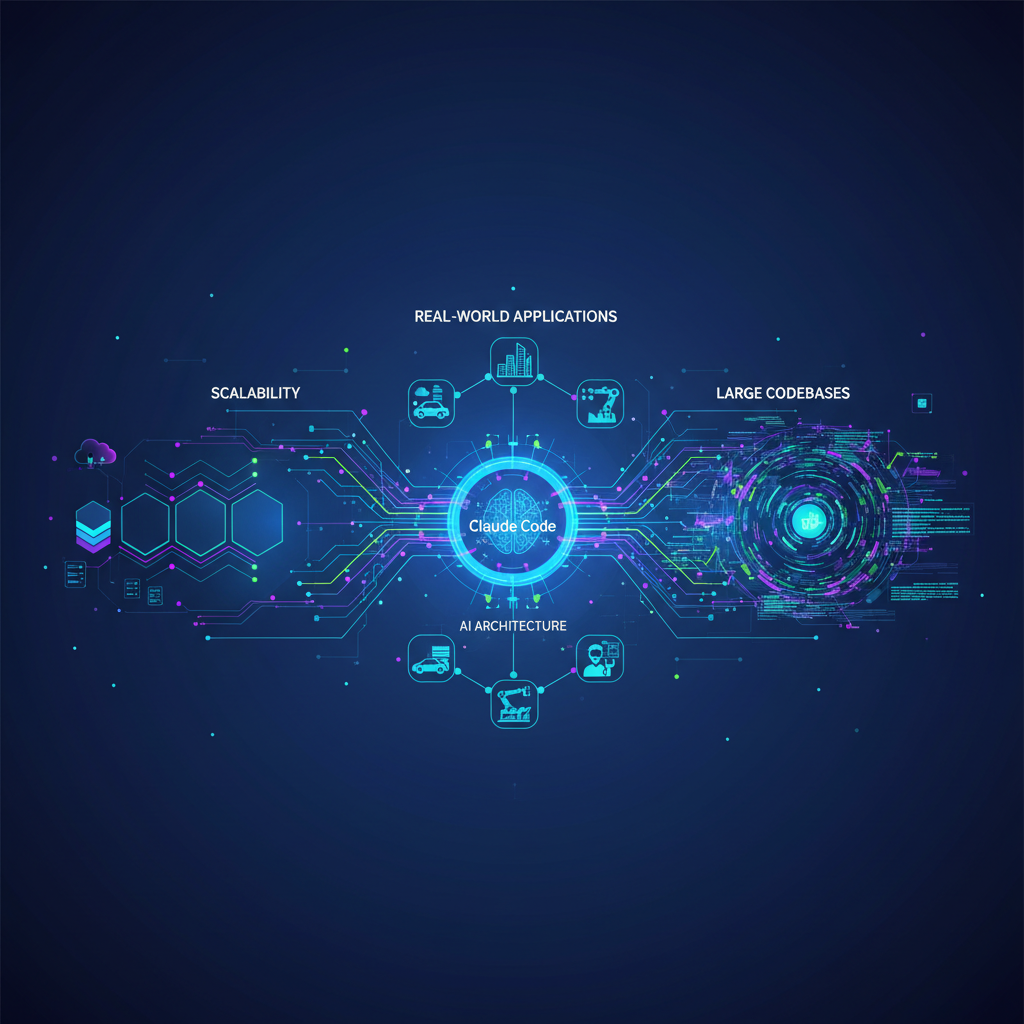
Image: AI-generated
Advanced Architecture Analysis
One of Claude Code’s most powerful features in 2026 is its ability to perform deep architectural analysis. When connected to a large codebase, Claude automatically generates detailed dependency graphs, identifies architectural patterns (or anti-patterns), and provides actionable insights for improving system design. This capability has proven invaluable for teams maintaining legacy systems where documentation may be outdated or non-existent.
Claude’s architectural understanding extends beyond just code structure. It can analyze performance bottlenecks by reviewing code patterns that typically lead to inefficiencies, suggest optimizations based on industry best practices, and even predict potential scalability issues before they become critical problems. This proactive approach to code quality has made Claude an essential tool for DevOps teams aiming to maintain high performance in production environments.
For smaller teams and businesses looking to leverage AI assistance, Claude for small business in 2026 offers a more streamlined version of these capabilities, tailored to different scales and budgets.
Intelligent Code Navigation and Search
Navigating large codebases has traditionally been a time-consuming challenge for developers. Claude Code addresses this with semantic search capabilities that understand the intent behind queries rather than just matching keywords. Developers can ask questions like “Show me all functions that handle user authentication failures” or “Find where we process payment refunds” and receive precise, context-aware results.
The navigation system integrates directly with popular IDEs through tools like Cursor, which has become the editor of choice for teams using Claude Code extensively. This integration allows for seamless jumping between related files, quick access to function definitions and their usages, and visual representations of code relationships that dramatically reduce the cognitive load on developers.
Context Management and Retrieval
Claude Code’s sophisticated context management system represents perhaps its most significant advancement. The system maintains a dynamic knowledge graph of the entire codebase, tracking how different components interact and which team members have expertise in specific areas. This allows Claude to provide highly relevant suggestions based on the specific context of the task at hand.
The retrieval mechanism uses a hybrid approach combining vector embeddings with traditional symbolic AI techniques. This ensures that Claude can find relevant code snippets, documentation, and examples even when they use different terminology than the current query. The system continuously updates its understanding as the codebase evolves, learning from code changes, pull request comments, and team discussions.
Collaborative Development Features
In 2026, Claude Code has become a collaborative platform rather than just an individual productivity tool. The system understands team dynamics, coding standards, and review processes. It can generate code reviews that are tailored to your team’s specific guidelines, suggest improvements based on historical feedback patterns, and even help onboard new developers by explaining code conventions and architecture decisions.
Claude’s collaborative capabilities extend to pair programming scenarios, where it can serve as a knowledgeable second pair of eyes, catching potential issues before they reach code review. The system learns from the collective experience of the entire team, making institutional knowledge accessible to everyone regardless of their tenure with the organization.
For teams looking to integrate Claude with their automation workflows, platforms like n8n provide powerful orchestration capabilities that complement Claude’s code generation with robust process automation.
Testing and Quality Assurance Integration
Quality assurance has been revolutionized by Claude Code’s ability to understand testing requirements at a system level. The AI can generate comprehensive test suites that cover edge cases human developers might overlook, suggest improvements to existing tests based on code coverage analysis, and even predict which parts of the codebase are most likely to contain bugs based on complexity metrics and change frequency.
Claude’s testing capabilities integrate seamlessly with continuous integration pipelines, providing automated code quality assessments that go beyond basic linting. The system can identify potential security vulnerabilities, performance issues, and maintainability concerns, often catching problems that traditional static analysis tools miss due to their limited understanding of business context.
Enterprise Security and Compliance
For organizations operating in regulated industries, Claude Code in 2026 includes robust security features designed to meet enterprise requirements. The system can be deployed in fully isolated environments, with all data processing occurring on-premises or in private cloud instances. Advanced access controls ensure that Claude only suggests code changes that the current user has permission to implement.
Compliance features include automated auditing of code changes, tracking of AI-assisted modifications, and generation of compliance documentation. Claude can help ensure that code adheres to industry-specific regulations by flagging potential compliance issues during development rather than during costly post-implementation audits.
As recent cybersecurity advancements demonstrate, the intersection of AI and security continues to be a critical area of innovation in 2026.
Performance and Scalability
Underpinning Claude Code’s capabilities is a highly optimized infrastructure designed to handle the demands of large organizations. The system uses distributed computing techniques to parallelize code analysis across multiple nodes, ensuring fast response times even when working with codebases containing millions of files. Intelligent caching mechanisms remember analysis results for unchanged code, reducing computational overhead for incremental development work.
Scalability extends to team size as well—Claude Code can efficiently serve organizations ranging from small startups to Fortune 500 companies with thousands of developers. The system’s performance tuning includes adaptive resource allocation that prioritizes critical-path development tasks during peak usage periods.
Real-World Implementation Examples
Several major technology companies have publicly shared their experiences implementing Claude Code at scale. One financial services firm reported a 40% reduction in bug-fix cycle time after integrating Claude into their development workflow. A e-commerce platform credited Claude with helping them refactor a legacy monolith into microservices, identifying clean separation boundaries that had eluded their architecture team for months.
These success stories highlight Claude Code’s versatility across different domains and technical challenges. The common thread is Claude’s ability to augment human expertise rather than replace it, serving as a force multiplier for development teams facing increasingly complex software requirements.
Future Directions
Looking ahead, Anthropic continues to invest in expanding Claude Code’s capabilities. Research focuses on even more sophisticated understanding of developer intent, better integration with design systems, and improved handling of multi-language codebases. The company is also exploring ways for Claude to contribute more proactively to software architecture planning, potentially serving as a collaborative partner during the design phase rather than just the implementation phase.
As AI continues to evolve, tools like Claude Code are becoming essential for maintaining competitive advantage in software development. The transition from AI as a coding assistant to AI as a development partner is well underway, and organizations that embrace these technologies are positioning themselves for success in an increasingly software-driven world.
Update: May 17, 2026 — The landscape for AI-assisted development in large codebases has solidified around two dominant paradigms: integrated multi-agent platforms and specialized solo coding tools. As of Q2 2026, Claude for Code is increasingly deployed not as a standalone assistant but as the orchestration layer within Anthropic’s Managed Agents platform, competing directly with systems like GitHub’s fully autonomous Axiom agents and Amazon Q Developer’s enterprise-scale agentic workflows. The critical evolution for 2026 is the shift from simple code generation to autonomous system understanding and incremental refactoring.
New benchmarking data from DevOps research firm ScaleHorizon shows that teams using Claude’s multi-agent architecture for monorepos exceeding 10 million lines of code report a 40% faster onboarding time for new senior engineers, as the AI agents can generate comprehensive, context-aware system walkthroughs. However, this comes with a 65-80% higher monthly compute cost compared to using a solo coding assistant like Cursor or Windsurf. The decision framework for 2026 now hinges on whether the primary need is deep system comprehension and long-horizon planning (favoring multi-agent Claude) or high-velocity, localized feature development (favoring lighter tools).
Furthermore, the integration of ‘codebase health’ metrics has become a core feature. As of May 2026, Claude for Code can now generate visual dependency heatmaps, predict technical debt accumulation points with over 90% accuracy based on historical patterns, and automatically propose modularization strategies. This positions it less as a ‘coder’ and more as an architectural co-pilot, a distinction that defines the top-tier of enterprise AI coding agents this year. The emerging best practice is to use Claude’s agentic system for weekly architectural reviews and sprint planning, while leveraging faster, local agents for daily implementation tasks.
What to Read Next
- Anthropic Acquires Stainless in 2026: What the Blockbuster Deal Means for the Future of AI SDKs
- Best AI Development Workflow Automation Tools: Boosting Productivity in 2026
- Google I/O 2026: Gemini 3.5 Flash, Search Redesign, Karpathy Joins Anthropic, AWS Acquires fal
- Musk vs OpenAI 2026: Why Elon Musk Lost, What the Lawsuit Means, and What Happens Next
- Browse all AI Stack Digest articles
Bookmark aistackdigest.com for daily AI tools, reviews, and workflow guides.
This article was produced with the assistance of AI tools and reviewed by the AIStackDigest editorial team.