
The AI assistant landscape in 2026 is dominated by two titans: OpenAI’s ChatGPT 5.5 Pro and Anthropic’s Claude Opus. Both models represent the pinnacle of their respective organizations’ research, boasting impressive capabilities that promise to revolutionize how we work and create. But for developers, writers, and businesses making a critical choice in 2026, the question remains: which one delivers superior real-world performance?
This isn’t just a spec-sheet comparison. We’ve moved beyond simple benchmark scores. To truly understand which model might be right for your needs, we subjected both ChatGPT 5.5 Pro and Claude Opus to a series of practical, everyday tasks. We tested coding proficiency, long-form content creation, complex reasoning, and integration into modern automation workflows. The results reveal distinct strengths, surprising weaknesses, and a clearer picture of the AI frontrunner for 2026.
The Contenders: A 2026 Snapshot
Before diving into the tests, let’s briefly outline the competitors. ChatGPT 5.5 Pro is OpenAI’s refined, pro-tier offering, building on the GPT-5 architecture. It’s optimized for speed, creativity, and a conversational tone that feels remarkably human. Its context window has seen significant expansion, allowing it to handle larger documents and maintain longer threads.
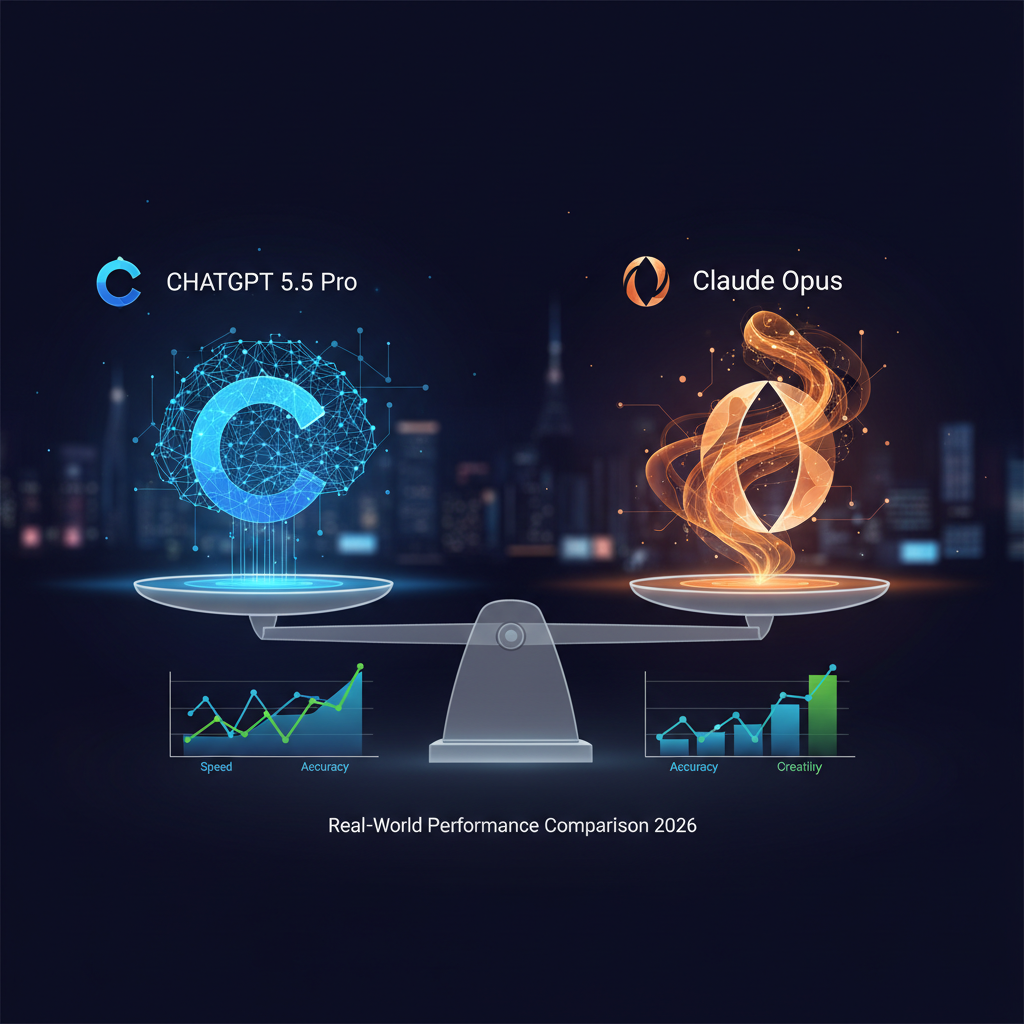
Image: AI-generated
Claude Opus, from Anthropic, has cemented its reputation as a meticulous and reliable workhorse. Known for its deep reasoning capabilities and steadfast adherence to instructions, Claude often feels more like a conscientious colleague than a mere tool. Its constitutional AI principles continue to shape its outputs, prioritizing helpfulness, honesty, and harmlessness.
Round 1: Coding and Development Prowess
For our first test, we presented both models with a complex Python task: building a small Flask API with user authentication, database integration, and error handling. We also asked them to debug a snippet of obfuscated JavaScript.
ChatGPT 5.5 Pro excelled in speed. It generated functional, well-commented code almost instantly. Its solutions were creative and often incorporated the latest 2026 libraries and practices. However, we occasionally noticed it would over-engineer a solution or introduce unnecessary complexity.
Claude Opus was slower but more methodical. Its code was exceptionally clean, secure, and well-documented by default. It asked clarifying questions about edge cases before writing a single line, demonstrating a deeper understanding of the problem’s requirements. For mission-critical, production-ready code, Claude’s thoroughness was impressive. This aligns with trends we’re seeing in our broader developer comparison guides.
Winner: Draw. Choose ChatGPT 5.5 Pro for rapid prototyping and brainstorming. Choose Claude Opus for robust, well-architected code and deep debugging. For many developers, using a dedicated AI-powered IDE like Cursor, which can leverage these models, is becoming the standard workflow.
Round 2: Long-Form Content and Creative Writing
Next, we tasked each model with drafting a 1500-word, SEO-optimized article on a technical topic and writing a short story in the style of a famous author.
ChatGPT 5.5 Pro is a content generation powerhouse. It produced the article draft in record time, naturally weaving in relevant keywords and structuring it for readability. Its creative writing was vibrant, engaging, and captured the requested author’s style with flair. It’s a top choice for marketers and content creators looking to scale their output, especially when combined with advanced prompting techniques.
Claude Opus took a more measured approach. Its article was meticulously researched-feeling, with a logical flow that built a compelling argument. The prose was more formal and academic but undeniably high-quality. Its short story was structurally sound but lacked the playful creativity of its competitor. It is less likely to produce the kind of low-effort output that is contributing to the growing problem of AI slop in digital spaces.
Winner: ChatGPT 5.5 Pro for sheer speed and creative versatility. Claude remains a strong choice for technical manuals, detailed reports, and any content where accuracy and depth trump stylistic flourish.
Round 3: Complex Reasoning and Analysis
Here, we pushed the models with a multi-step reasoning puzzle involving logic, mathematics, and real-world constraints. We also uploaded a lengthy research PDF and asked for a detailed summary and critique.
This is Claude Opus’s home turf. It dismantled the logic puzzle with ease, explaining its reasoning step-by-step. Its analysis of the research paper was critical, insightful, and highlighted both strengths and methodological weaknesses we hadn’t initially noticed. Its ability to “think out loud” is a significant advantage for complex analysis.
ChatGPT 5.5 Pro solved the puzzle correctly but its reasoning was less transparent. It arrived at the answer quickly but sometimes skipped over intermediary steps. Its PDF analysis was good for a high-level summary but lacked the critical depth of Claude’s. It was more prone to accepting the paper’s conclusions at face value.
Winner: Claude Opus. For tasks requiring deep analysis, critical thinking, and transparent reasoning, Claude is the undisputed champion in 2026.
Round 4: Workflow and Automation Integration
Modern AI isn’t used in a vacuum. It’s part of a larger toolchain. We tested how well each model’s API could be integrated into automated workflows using popular platforms like n8n or Make.com to handle tasks like processing inbound emails, summarizing meeting notes, and generating reports.
Both models offer robust APIs, but their strengths shine in different areas. ChatGPT 5.5 Pro’s speed makes it ideal for high-volume, low-latency tasks where quick responses are crucial, such as powering customer chat interfaces or generating social media content on the fly.
Claude Opus is the go-to for asynchronous, high-value processing. Its reliability makes it perfect for tasks like automating email summaries and responses or reviewing legal documents overnight, where precision is more important than instant results. Running these automations on a reliable VPS for Python projects ensures they run smoothly 24/7.
Winner: Draw. The best model depends entirely on the specific automation task.
Verdict: Choosing Your 2026 AI Partner
So, who wins the 2026 crown? The answer is frustratingly practical: it depends.
Choose ChatGPT 5.5 Pro if: Your priorities are speed, creativity, and engaging content generation. It’s the ideal partner for marketers, content creators, and developers who need to brainstorm and prototype rapidly.
Choose Claude Opus if: You value meticulous accuracy, deep reasoning, and robust, reliable outputs. It’s the superior choice for researchers, analysts, and engineers working on complex, critical problems where error tolerance is low.
The beauty of the current ecosystem is that you don’t always have to choose. Many power users access both models through aggregation platforms like OpenRouter, selecting the best tool for each specific job. This flexibility is becoming the standard for sophisticated AI workflows in 2026.
Update (2026-05-10) – The HackerNews Effect: The launch discussion of ChatGPT 5.5 Pro across developer forums has solidified a clear trend: performance is now measured holistically. Beyond raw benchmark scores, developers in 2026 are prioritizing latency-per-dollar and real-world workflow integration. Early community reports from the past week indicate a significant portion of queries are not about peak capability, but about sustainable cost for high-volume tasks. This shifts the ‘vs’ debate from a theoretical showdown to a practical tool selection guide.
Furthermore, the conversation around the ‘AI scaffolding layer’ (as noted in our recent news digest) directly impacts this comparison. Teams are finding that Claude Opus’s predictable, high-accuracy output can reduce the need for complex, error-prone post-processing logic in automated pipelines. Conversely, ChatGPT 5.5 Pro’s speed makes it a contender for real-time, user-facing applications where cost structures are absorbed differently. The optimal choice in mid-2026 is less about a ‘winner’ and more about aligning the model’s operational profile with your specific application’s tolerance for cost, speed, and verification overhead.
What to Read Next
- If AI Writes Your Code, Why Still Use Python in 2026?
- The Developer’s Edge: Mastering AI Coding Assistants in 2026
- Best Local AI Tools for 2026: On-Device Privacy & Performance Compared
- The 5 Best Free AI Tools Changing the Game in 2026
- Browse all AI Stack Digest articles
Bookmark aistackdigest.com for daily AI tools, reviews, and workflow guides.
This article was produced with the assistance of AI tools and reviewed by the AIStackDigest editorial team.