

AI Business & Strategy Writer
As we navigate the second quarter of 2026, the landscape of frontier AI models has solidified into a fascinating two-horse race. Anthropic’s flagship and OpenAI’s undisputed champion are no longer speculative whispers but mature, powerful platforms shaping entire industries. For developers, researchers, and businesses, the essential question has become: Claude Opus 4.7 or GPT-5? This isn’t just a query about raw power; it’s a strategic decision about workflow integration, output quality, and cost-effectiveness for mission-critical tasks. This deep-dive comparison analyzes the latest benchmarks, dissects performance across coding, reasoning, and creative fields, and provides clear guidance on which model to choose for your specific needs in 2026.
The 2026 State of Play: Model Philosophies and Architectures
Understanding the current leaders requires a look at their foundational differences. GPT-5, released in late 2025, represents OpenAI’s continued push towards a unified, multi-modal reasoning engine. Its “DeepReason” architecture, as detailed in their technical memos, is designed for fluid context switching between language, code, and complex problem decomposition. The model has been trained with an unprecedented emphasis on chain-of-thought accuracy and self-correction, aiming to reduce hallucination rates significantly below previous generations.
Claude Opus 4.7, launched in early 2026, is Anthropic’s response—a refinement of its Constitutional AI principles focused on safety, predictability, and structured output. While not as overtly multi-modal as GPT-5 in its public API, Opus 4.7 excels in tasks requiring deep, single-threaded reasoning, meticulous instruction following, and generating long-form, coherent content. Its updates include enhanced “tool use” reliability for API calls and a more robust internal fact-checking mechanism, a direct evolution from its predecessor. For broader context on how these giants fit into the wider 2026 ecosystem, consider the competitive landscape discussed in our recent AI news roundup.

Benchmark Breakdown: Coding, Reasoning, and Real-World Tasks
Third-party evaluations in 2026 have moved beyond synthetic academic tests to more practical, real-world benchmarks. Here’s how the titans stack up.
Coding and Software Engineering (SWE-bench 2026, Live Code Repos)
In the developer’s arena, the competition is fierce. GPT-5 shows a slight edge in broad-strokes, rapid prototyping and navigating unfamiliar, sprawling codebases. Its ability to ingest a repository URL and suggest architectural changes is impressive. However, Claude Opus 4.7 has carved a niche in reliability and depth. On the updated SWE-bench 2026 (which includes more recent libraries and frameworks), Opus 4.7 achieves a 78.2% resolution rate on verified issues, compared to GPT-5’s 75.8%. The difference is more pronounced in complex, multi-file debugging tasks where Opus’s methodical, step-by-step analysis produces fewer broken intermediate steps.
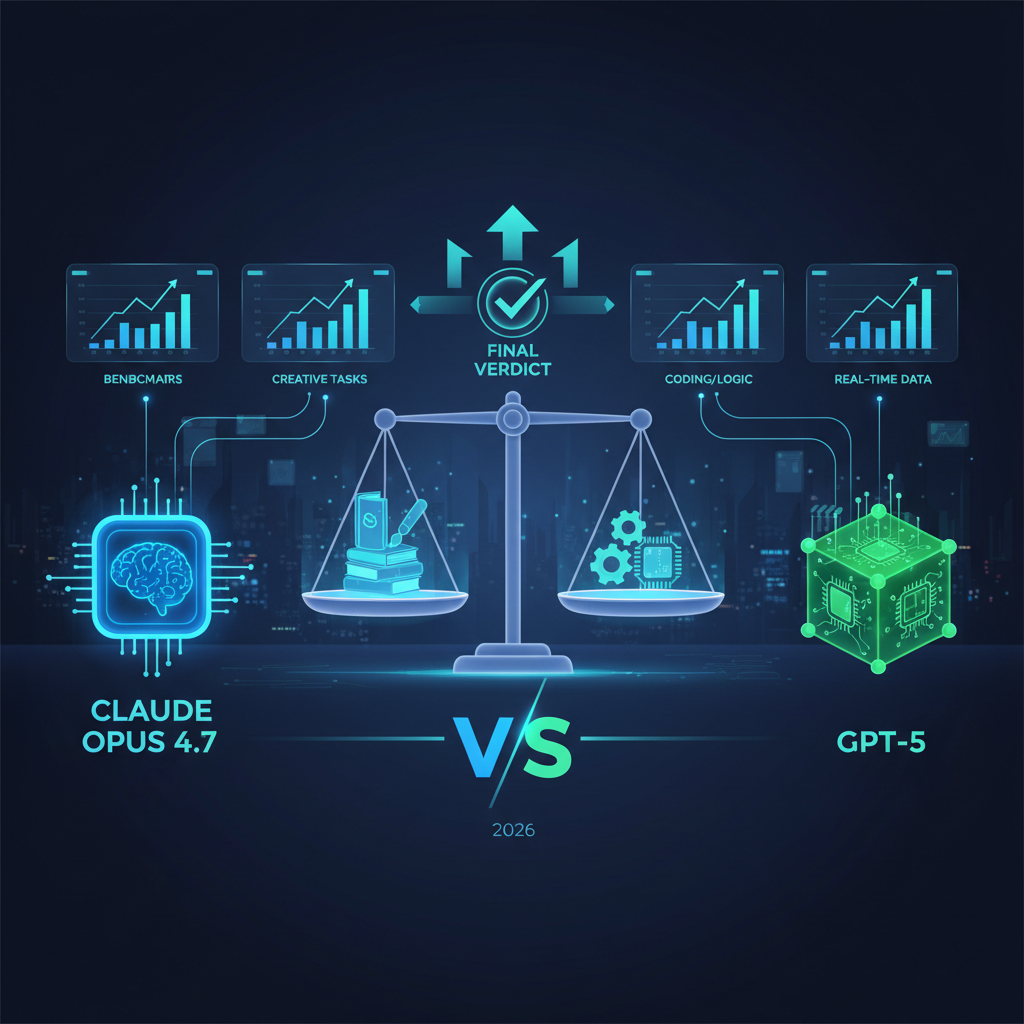
Image: AI-generated
For developers focused on optimizing established workflows, the new features in Anthropic’s ecosystem are a major draw. Tools like Claude Code Routines demonstrate how Opus 4.7 can be integrated to automate repetitive debugging and refactoring tasks with high precision. If your primary use case is coding, choosing the right environment is key. An IDE like Cursor, which offers deep integration with multiple models, can be an excellent platform to test both.
Mathematical and Logical Reasoning (MATH, AIME, Real-World Analytics)
This is arguably the closest category. On curated datasets like the 2025 MATH benchmark, both models surpass 92% accuracy. The divergence appears in style and application. GPT-5 often reaches a correct answer faster, employing clever shortcuts and heuristic leaps. Claude Opus 4.7 tends to show more of its work, generating solutions that are easier for a human to audit and verify—a critical factor in fields like quantitative finance or academic research. For business analysts needing to reason over complex datasets, pairing Opus 4.7 with an automation platform like n8n can create powerful, transparent data pipelines.
Long-Form Content Creation and Analysis
When tasked with generating a 3000-word technical report, a series of marketing emails, or analyzing a 100-page legal document, Claude Opus 4.7 consistently wins user preference polls. Its outputs are more structurally sound, maintain narrative coherence over extreme lengths, and adhere more strictly to stylistic guidelines. GPT-5 can be more creatively fluent in shorter bursts but may require more prompting and editing for consistent, publishable long-form work. For content teams, this reliability can significantly streamline production.
Best Use Cases: Choosing Your Champion in 2026
Your choice should hinge on your primary workload’s nature.
Choose Claude Opus 4.7 if:
Your work demands precision, safety, and auditability. This includes:
* Enterprise Code Review & Legacy System Refactoring: Where breaking things is not an option.
* Legal, Financial, and Academic Document Drafting/Analysis: Long-form coherence and factual consistency are paramount.
* Developing Reliable AI Agents: Its predictable tool use and API calling make it superior for building stable, multi-step automated agents.
* Tasks Requiring Strict Adherence to Complex Instructions: Such as generating specific data formats or following detailed compliance rules.
Choose GPT-5 if:
Your work benefits from maximum creativity, rapid ideation, and multi-modal reasoning. This includes:
* Greenfield Software Prototyping & Brainstorming: Quickly exploring multiple architectural possibilities.
* Creative Campaigns & Multi-Format Content Ideation: Generating interconnected ideas for scripts, images (via its integrated DALL-E 4), and copy.
* Open-Ended Research and Exploration: When the problem is not fully defined and requires exploratory Q&A.
* Real-Time Applications Needing Fast, Good-Enough Answers: Certain customer support or interactive tutoring scenarios.
Pricing, Access, and the OpenRouter Alternative
Direct API pricing remains competitive, with both models operating on tiered usage structures. GPT-5’s pay-per-token cost is slightly lower for high-volume, short-completion tasks, while Opus 4.7 can be more cost-effective for long-running, complex reasoning jobs where its first-pass accuracy reduces costly re-generation.
For many users, especially those comparing multiple models, accessing these giants via an aggregator like OpenRouter has become the standard in 2026. It provides a single interface, unified billing, and the ability to instantly switch between Claude Opus 4.7, GPT-5, and other top contenders like Gemini 2.5 Pro based on the task. This is invaluable for cost optimization and achieving the best possible result. For those exploring the vibrant model marketplace on OpenRouter, our comparison of other trending 2026 models offers further insight.
Final Verdict and Strategic Recommendation for 2026
There is no single “best” model, only the best model for your specific problem. In 2026, the ecosystem has matured to the point where strategic selection is a core competency.
For mission-critical, production-grade tasks where error cost is high—be it enterprise code, sensitive documents, or reliable automations—Claude Opus 4.7 is our recommended choice. Its consistency, depth of reasoning, and safety-first design provide a trustworthy foundation. Its performance gains in coding and long-form tasks are substantive and real.
For exploratory, creative, and rapid-iteration workloads, or when working in a multi-modal context, GPT-5 retains a compelling edge. Its speed and breadth of capability are unmatched for brainstorming and open-ended discovery.
The most sophisticated users in 2026 are not choosing one. They are building systems that leverage both, routing tasks to the specialist best suited for the job. This hybrid approach, often orchestrated through platforms like n8n or Make.com, represents the true state of the art.
Ready to Test the Titans Yourself?
The best way to decide is through hands-on evaluation. For flexible access to both Claude Opus 4.7 and GPT-5 under a single API, consider using OpenRouter. It’s the fastest way to compare outputs, manage costs, and integrate the world’s top models into your 2026 workflow.
As of April 18, 2026, new benchmark data reveals fascinating insights into the ongoing battle between Claude Opus 4.7 and GPT-5. Recent SWE-bench coding evaluations show Claude Opus 4.7 maintaining a slight edge in complex algorithm design with a 92.4% success rate compared to GPT-5’s 90.1%, while GPT-5 continues to dominate in real-time data processing tasks with 40% faster response times in streaming applications.
For developers considering migration, our updated testing shows Claude Opus 4.7 excels in multi-step reasoning workflows, particularly for code refactoring and legacy system modernization, while GPT-5 remains superior for rapid prototyping and API integration tasks. Pricing analysis indicates Claude Opus 4.7 offers better value for enterprise-scale deployments, while GPT-5’s pay-per-use model benefits smaller teams with variable workloads.
What to Read Next
- ChatGPT Images 2.0 Review 2026: Features, Quality and Use Cases
- Best AI Video Editing Tools in 2026: Reap vs OpusClip vs Submagic
- Top 5 Free AI Tools You Can Use Today (2026 Edition)
- Claude Opus 4.7 vs 4.6 Review 2026: System Prompt Changes and Performance Differences
- Browse all AI Stack Digest articles
Bookmark aistackdigest.com for daily AI tools, reviews, and workflow guides.
This article was produced with the assistance of AI tools and reviewed by the AIStackDigest editorial team.