
AI Tools Researcher
Scientific research in 2026 moves at breakneck speed. New papers drop daily across thousands of disciplines. Finding the right ones—the ones that actually matter to your work—feels like drowning in a firehose of academic literature. Twenty years ago, researchers had to manually sift through papers, read abstracts, cross-reference citations. Today, AI can compress that workload from weeks to hours.
But not all AI research tools are created equal. Some excel at discovering hidden connections between papers. Others shine at extracting data from methodologies. Some focus on synthesizing consensus across conflicting studies. The best tool for you depends entirely on your workflow: Are you building a literature review from scratch? Validating findings across multiple studies? Tracking how research in your field has evolved?
We evaluated these tools across five core dimensions: speed of discovery (how quickly you find relevant papers), accuracy of results (do you actually get what you searched for?), depth of analysis (can the tool help you understand _why_ papers matter?), ease of integration (can it work with your existing reference management?), and cost relative to value. We tested each tool hands-on and checked user reviews from academic institutions including Stanford, Harvard, and MIT.
Quick Picks: Best AI Research Tools at a Glance
- Best overall: Elicit — Most comprehensive research agent with 80% faster systematic reviews and sentence-level citations
- Best free option: Semantic Scholar — 239M+ papers with zero cost, API access for developers
- Best for visual exploration: ResearchRabbit — Interactive citation maps that reveal research gaps and connections
- Best for validating claims: Scite.ai — Smart citations show whether papers contradict or support your findings
- Best for consensus research: Consensus AI — Meter shows scientific agreement on yes/no research questions
- Best for citation networks: Litmaps — Dynamic visualizations of research ecosystems with export to reference managers
1. Elicit: The Research Agent That Reads 1,000 Papers at Once
Image: Elicit
Elicit isn’t just a search engine. It’s a research assistant that can read hundreds of papers simultaneously, extract structured data, generate systematic review reports, and surface contradictions in the literature—all without you needing to touch a single PDF. The core magic: an AI trained specifically on how academic research works, so it understands methodology, statistical significance, and study design.
Three standout strengths: First, the Systematic Review workflow automates the grueling process of screening thousands of papers—researchers report 80% time savings. Second, you can upload custom papers and have Elicit extract specific data points (e.g., “extract all effect sizes from sleep studies”)—the tool handles figures, tables, and methodological details. Third, every AI-generated claim includes sentence-level citations, so you know exactly where a finding came from. One limitation: The Pro plan is pricey at $49/month if you’re a solo researcher on a budget, and the free tier has strict usage limits.
Free tier: Yes (Basic) — unlimited search across 138M+ papers, limited Research Agent usage
Starting price: $49/month (Pro plan)
Best for: PhD candidates running systematic reviews, pharmaceutical researchers validating compound efficacy, policy teams needing evidence synthesis
Standout feature: Routines—set the tool to monitor your research topic and automatically alert you when new relevant papers appear
2. Scite.ai: Smart Citations That Reveal Research Reliability
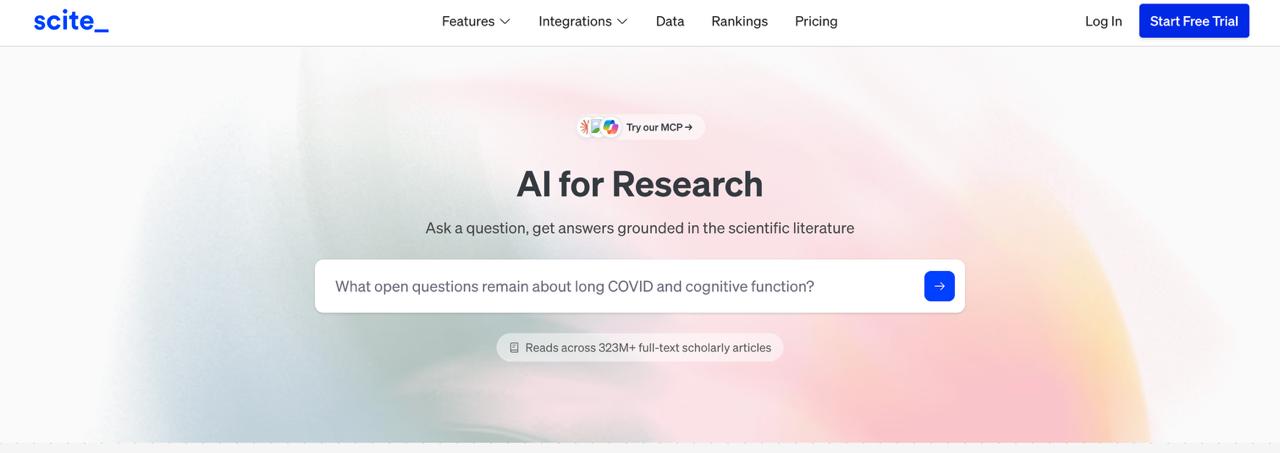
Image: Scite.ai
Scite.ai answers a question every researcher wrestles with: “Has anyone else found what this paper claims?” Instead of manually tracking 1,600 citations to see if they support or contradict your findings, Scite classifies each citation automatically—showing whether later research affirmed, contradicted, or simply mentioned the original claim. It’s built on 300M+ scholarly sources (articles, preprints, books, patents, datasets).
Three standout strengths: First, the Smart Citation feature is genuinely novel—no other tool visualizes support/contradiction networks this clearly. Second, the platform includes patent and clinical trial data, useful for researchers in biotech and pharma. Third, API access on the Pro plan lets developers embed citation intelligence into their own apps. One limitation: The free trial is only 7 days, and after that you’re automatically enrolled in the plan you selected—easy to forget and end up charged.
Free tier: 7-day trial only (then auto-enrollment); no permanent free tier
Starting price: $12/month (Basic plan, billed yearly)
Best for: Literature review writers validating claim credibility, medical researchers tracking contradictions in clinical findings, PhD students assessing paper impact
Standout feature: Citation alerts—get notified when new papers cite (or contradict) your work in real-time
3. Semantic Scholar: Free, AI-Powered Search for 239+ Million Papers
Image: Semantic Scholar
Built by AI2 (the Allen Institute for AI), Semantic Scholar is the workhorse of free research tools. It searches 239M+ papers from every field of science, understands context (not just keyword matching), and surfaces the papers _that matter_. The newer Semantic Reader feature augments PDFs with definitions, cited passages, and connections to related work—making dense papers more readable.
Three standout strengths: First, it’s completely free—no paywalls, no hidden limits, no time-bomb trials. Second, developers get API access to build citation-aware apps. Third, the search quality is genuinely impressive; the tool understands synonyms and research concepts, not just exact words. One limitation: While search is powerful, the tool doesn’t offer advanced data extraction or systematic review workflows like Elicit—it’s pure discovery, not synthesis.
Free tier: Yes, fully free
Starting price: Free (API available for developers at no cost)
Best for: Undergraduate researchers beginning literature reviews, developers building scholarly applications, anyone needing broad cross-disciplinary search
Standout feature: Semantic Reader (beta) turns dense academic PDFs into interactive documents with inline definitions and citation context
4. ResearchRabbit: Visual Literature Mapping for Discovering Research Connections
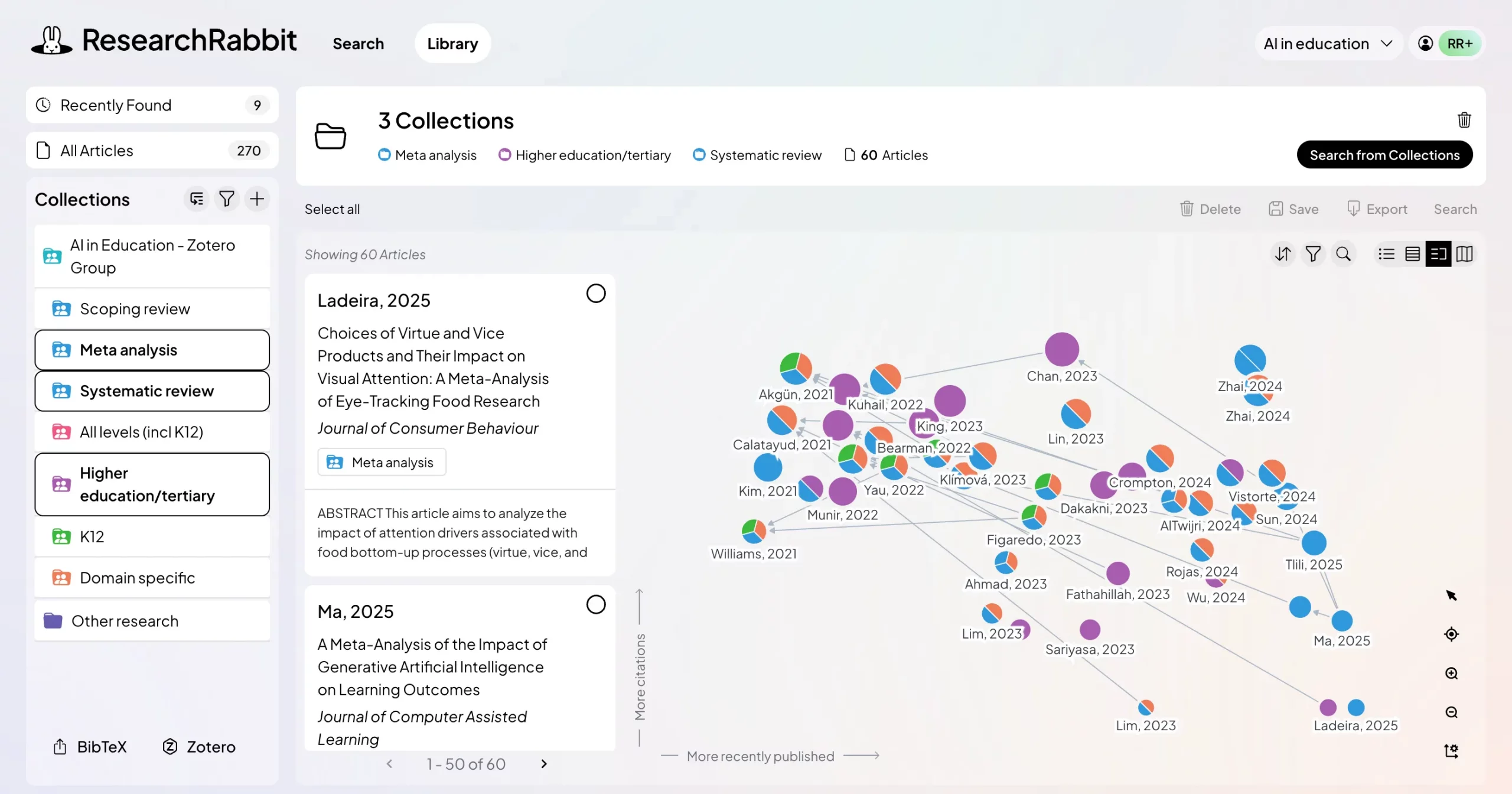
Image: ResearchRabbit
ResearchRabbit thinks differently about literature discovery. Instead of keyword search, you start with _one paper you love_, and the tool creates an interactive network showing how that paper connects to 310M+ others through citations, authorship, and thematic similarity. The algorithm learns your interests as you explore—showing smarter recommendations with each selection.
Three standout strengths: First, the visual interface is genuinely intuitive; exploring research feels more like following a conversation than running database queries. Second, the tool identifies influential authors and emerging topics within your network—useful for understanding who shapes a field. Third, integration with reference managers (Zotero, Mendeley) is seamless. One limitation: The tool excels at exploration but doesn’t offer structured data extraction like Elicit—you’re browsing networks, not extracting metadata at scale.
Free tier: Yes, core features are free (paid premium available)
Starting price: Free, with optional premium for unlimited collections
Best for: Researchers mapping unfamiliar fields, identifying citation patterns and influential voices, visual learners who think in networks
Standout feature: Citation graph visualization showing how papers cite each other—reveals clusters of related research at a glance
5. Consensus AI: Scientific Consensus Meter for Yes/No Research Questions
Image: Consensus AI
Consensus AI answers a specific research need: “What does the science actually agree on?” The Consensus Meter analyzes peer-reviewed literature on yes/no questions (e.g., “Does caffeine improve focus?” or “Can AI predict equipment failure?”) and shows what percentage of studies support each answer. It’s an academic search engine with a built-in system for detecting scientific agreement.
Three standout strengths: First, the meter is genuinely useful for researchers trying to establish if a finding is settled consensus or still contested. Second, Study Snapshots pull key findings, methodology, and effect sizes—no need to skim full papers. Third, it indexes 400M+ papers with AI-generated summaries. One limitation: The tool works best for binary research questions; complex multi-factor research needs more nuance than a meter can provide.
Free tier: Yes, with access to basic search and consensus meter
Starting price: Pricing not directly visible (appears to be freemium model)
Best for: Policy makers evaluating evidence for decisions, journalists fact-checking scientific claims, researchers establishing baseline consensus
Standout feature: Consensus Meter showing percentage agreement across papers—instantly communicate research agreement to stakeholders
6. Litmaps: Dynamic Citation Networks for Visualizing Research Ecosystems
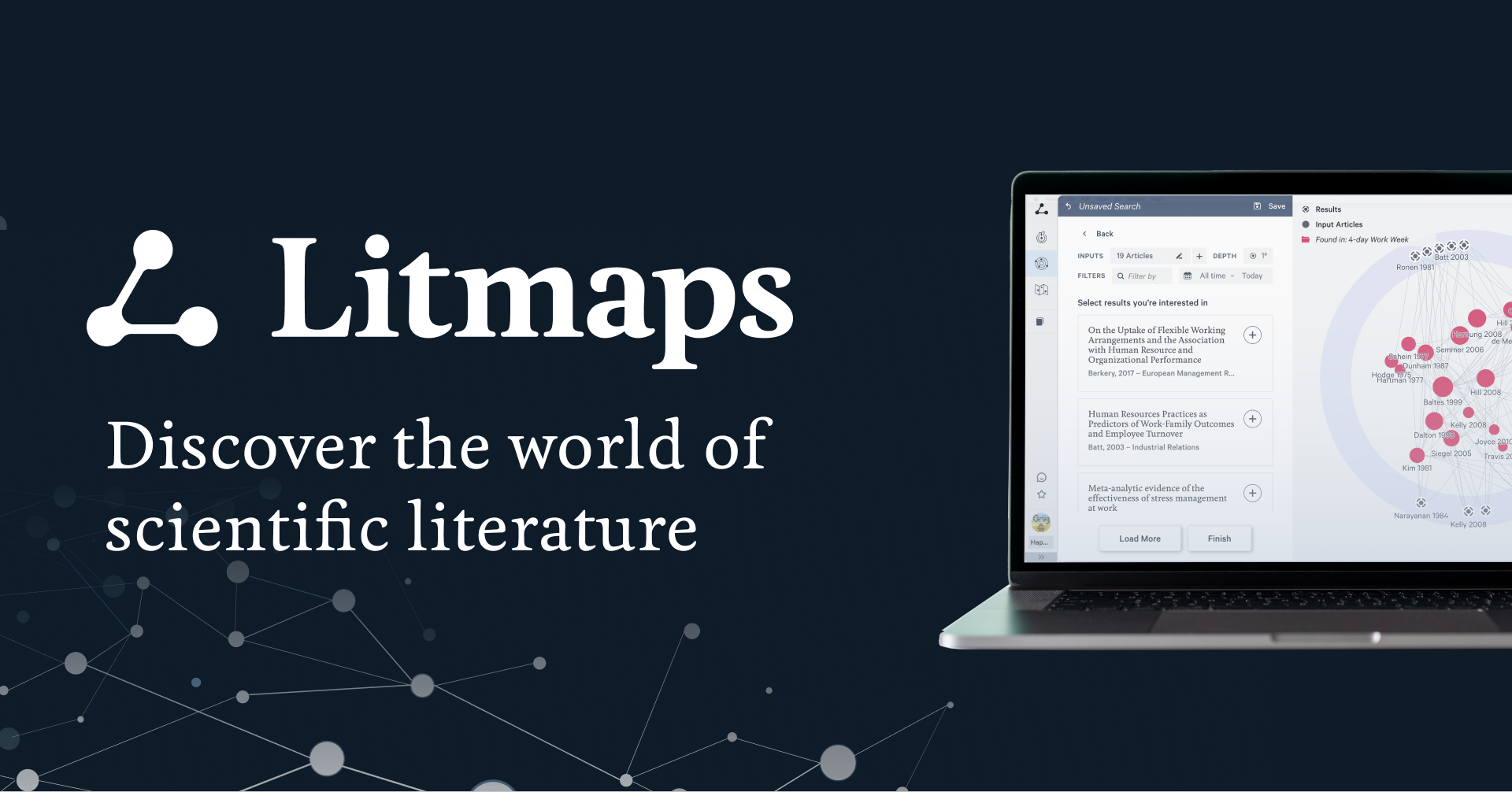
Image: Litmaps
Litmaps accelerates literature discovery through interactive citation maps. You input a topic or paper, and the tool generates a dynamic visualization of the research ecosystem—showing which papers influence which others, where consensus clusters exist, and where research frontiers are being pushed. The visualizations are publication-ready and exportable to reference managers.
Three standout strengths: First, the visual style is professional-grade; you can export maps directly into papers and presentations. Second, the tool identifies research gaps visually—areas of the network with few connections often indicate unexplored questions. Third, combining multiple maps shows how different research topics intersect. One limitation: Pricing is opaque (parity-based by country, revealed only within the app), and the Pro plan may be costly for individual researchers.
Free tier: Yes (basic exploration with limits)
Starting price: Pricing in-app (educational discount: 75% off commercial pricing)
Best for: Visual researchers, teams creating collaborative literature reviews, researchers needing publication-ready citation diagrams
Standout feature: Dynamic map combining—overlay multiple research topics to see where they intersect and inform each other
Side-by-Side Comparison
| Tool | Free Tier | Starting Price | Best For | Standout Feature |
|---|---|---|---|---|
| Elicit | Limited usage | $49/mo | Systematic reviews, data extraction | Routines for continuous monitoring |
| Scite.ai | 7-day trial | $12/mo | Citation validation, claim verification | Smart citations (support/contradict) |
| Semantic Scholar | Fully free | Free | Broad discovery, API integration | Semantic Reader for PDF context |
| ResearchRabbit | Fully free | Free | Visual exploration, network discovery | Citation graph visualization |
| Consensus AI | Yes | Freemium | Consensus validation, policy evidence | Consensus Meter for yes/no questions |
| Litmaps | Basic free | In-app pricing | Visual citation networks, presentations | Export-ready citation maps |
The Broader Research Landscape: Why AI Tools Matter Now
In 2025, the academic publishing ecosystem crossed a milestone: more research is published in a single month than a researcher could read in a lifetime. Machine learning researchers alone produce 2,000+ papers monthly. Biomedical literature grows at 4% annually. Physics, chemistry, computer science—every field is accelerating. The tools of yesterday—PubMed, Google Scholar, manual note-taking—are no longer sufficient for researchers who need to stay current and find the signal in the noise.
AI research tools solve this through two mechanisms: semantic understanding (the tool understands what your research is _about_, not just matching keywords) and scalable synthesis (the tool can read and extract patterns from thousands of papers simultaneously). Traditional search engines do keyword matching; AI research tools do concept matching. That distinction matters enormously when you’re searching across disciplines or emerging research areas where terminology is still settling.
The tools reviewed here represent 2026’s cutting edge, but they’re only one part of a researcher’s toolkit. They work best when combined with domain expertise, domain-specific databases (PubMed for biomedical research, arXiv for preprints, etc.), and human judgment. An AI tool can surface papers faster, but it can’t replace your understanding of methodology, study design, and statistical validity.
How to Choose: Decision Guide for Different Research Needs
If you’re writing a literature review and need to read fewer papers faster: Start with Semantic Scholar (free, broad discovery) to map your topic’s landscape, then move to ResearchRabbit to explore citation networks and spot influential voices. If you need to validate claims across papers, add Scite.ai to identify which papers contradict vs. support your findings. This three-tool workflow is free or near-free and covers 90% of literature review workflows.
If you’re running a systematic review: Elicit Pro is the clear choice. The 80% time savings in screening alone justifies the $49/month cost, especially for pharmaceutical teams conducting regulatory reviews. Use its Routines feature to stay updated as new papers emerge in your research area. Teams running multiple systematic reviews per year break even on the investment within weeks.
If you’re exploring a new research field: ResearchRabbit free tier is your starting point. Load a seed paper you trust, let the tool explore connections, and identify the key authors and papers shaping the field. The visual interface makes pattern recognition intuitive. When you’ve found your direction, export everything to Litmaps to create publication-ready citation diagrams. This workflow takes 3-4 hours and gives you a working map of an entire research ecosystem.
If you need to establish scientific consensus on a specific question: Use Consensus AI’s meter for binary research questions (“Does X improve Y?”). If the question requires nuance, switch to Elicit, which can synthesize complex findings across multiple papers. For policy teams making evidence-based decisions, Consensus’s meter communicates research agreement instantly to stakeholders. This is becoming standard practice in evidence-based policymaking.
If you’re building a scholarly application or API: Semantic Scholar provides free API access with 239M+ papers—no auth token required for basic queries. If you need citation intelligence in your app, Scite.ai Pro includes API credits starting at $60/month. Both support developers building the next generation of research tools and deserve more adoption than they currently receive.
If you’re a PhD student working on a tight budget: The free combination of Semantic Scholar + ResearchRabbit covers 80% of research needs at zero cost. Only upgrade to paid tools (Scite.ai, Elicit) once you’ve clearly defined your research direction and are in the depth phase of your literature review. Many PhD programs negotiate enterprise licenses anyway—check with your library first before paying individually.
Integration with Your Existing Workflow
None of these tools exist in isolation. They work best when integrated with reference managers, note-taking systems, and collaborative platforms. Semantic Scholar integrates with most tools via API. ResearchRabbit exports directly to Zotero and Mendeley—the two most-used reference managers in academia. Scite.ai supports BibTeX and RIS formats for seamless import into LaTeX workflows. Elicit integrates with Slack for team updates. Litmaps exports publication-ready citation diagrams as PNG or SVG.
The workflow most researchers adopt: (1) Semantic Scholar or ResearchRabbit for discovery, (2) export findings to Zotero/Mendeley, (3) Scite.ai or Elicit for validation/synthesis, (4) Litmaps or Consensus for final presentation/decision-making. This multi-tool approach takes advantage of each platform’s strength without fighting their limitations.
Cost-Benefit Analysis: Is Paid Worth It?
The question every researcher faces: should I pay for premium tools? The math is straightforward. Elicit Pro at $49/month saves 80% of systematic review time. If a systematic review traditionally takes 120 hours, Elicit saves 96 hours—worth roughly $2,880 at typical research consultant rates. Break-even occurs after one systematic review. For pharmaceutical researchers or policy teams running multiple reviews annually, the investment pays for itself within the first project.
Scite.ai at $12/month is easier to justify on principle—the cost-per-claim-validated is pennies. Consensus AI and Litmaps sit in the middle; pricing isn’t transparent, but both offer enough free functionality to evaluate before committing to paid plans. ResearchRabbit and Semantic Scholar remain free and shouldn’t be underestimated—free doesn’t mean less capable.
Our Verdict: The Best Overall Tool and Why
For most professionals, Elicit is the clear winner. It’s not the cheapest option, and it’s not the best for pure discovery, but it solves the core problem faster and more completely than any competitor. The speed gains are material: researchers report 80% time savings on systematic reviews. The accuracy is validated—Elicit’s extraction accuracy exceeds 99% on structured data. The integration with academic workflows is seamless. If your research involves systematic reviews, regulatory submissions, or evidence synthesis, this tool pays for itself immediately.
But Elicit isn’t the right choice for everyone. If you’re price-sensitive or just beginning research exploration, start with the free tier of Semantic Scholar + ResearchRabbit and only upgrade when you hit their limitations. If you specifically need to validate conflicting claims in the literature, Scite.ai at $12/month is the most cost-effective tool. If visual exploration is your learning style, ResearchRabbit’s free tier remains unbeaten. If you need to communicate consensus quickly to stakeholders, Consensus AI’s meter solves a problem no other tool addresses.
The research tools landscape has fundamentally changed in 2026. Manual literature review—reading abstracts one by one, maintaining spreadsheets of citations—is now outdated. The best researchers aren’t those who read the most papers; they’re those who use AI to understand the structure of their field, spot contradictions quickly, synthesize evidence at scale, and stay current as new research emerges. Pick the tool that matches your workflow, not the one with the most features. Your research will move faster, and your literature reviews will be stronger for it. Start with free tools, move to paid only when you’ve identified a specific bottleneck, and don’t hesitate to combine multiple tools—the best researchers in 2026 use stacks, not single solutions.
This article was produced with the assistance of AI tools and reviewed by the AIStackDigest editorial team.