
As we move deeper into 2026, the debate between AI workflows and autonomous AI agents has reached a critical inflection point. While the promise of fully autonomous agents captures imagination, the practical reality for enterprise adoption tells a different story. The limitations of agentic systems—cost overruns, unpredictable behavior, and security vulnerabilities—are steering developers and businesses toward a more measured approach: carefully orchestrated AI workflows.
The initial hype surrounding AI agents suggested they would revolutionize how we work, with systems that could independently plan, execute, and adapt to complex tasks. However, real-world implementations in 2026 have revealed significant gaps between theoretical capabilities and practical deployment. Workflows, by contrast, offer reliability, auditability, and cost-effectiveness that businesses cannot ignore.
The Rise and Plateau of Autonomous AI Agents
Autonomous AI agents promised a future where AI could tackle multi-step problems without human intervention. The vision was compelling: give an agent a goal like “optimize our cloud infrastructure costs” or “develop a marketing campaign,” and watch it break down the task, execute sub-tasks, and deliver results.
However, 2026 has revealed three fundamental limitations that have hampered widespread agent adoption. First, the cost spiral of agentic systems becomes apparent quickly. Agents often engage in extensive internal monologues, make multiple API calls, and iterate through solutions—all of which accumulate significant token costs without guaranteed results.
Second, predictability issues plague complex agentic systems. Unlike deterministic workflows, agents can make unexpected decisions that lead to undesirable outcomes. In critical business functions, this unpredictability creates unacceptable operational risk.
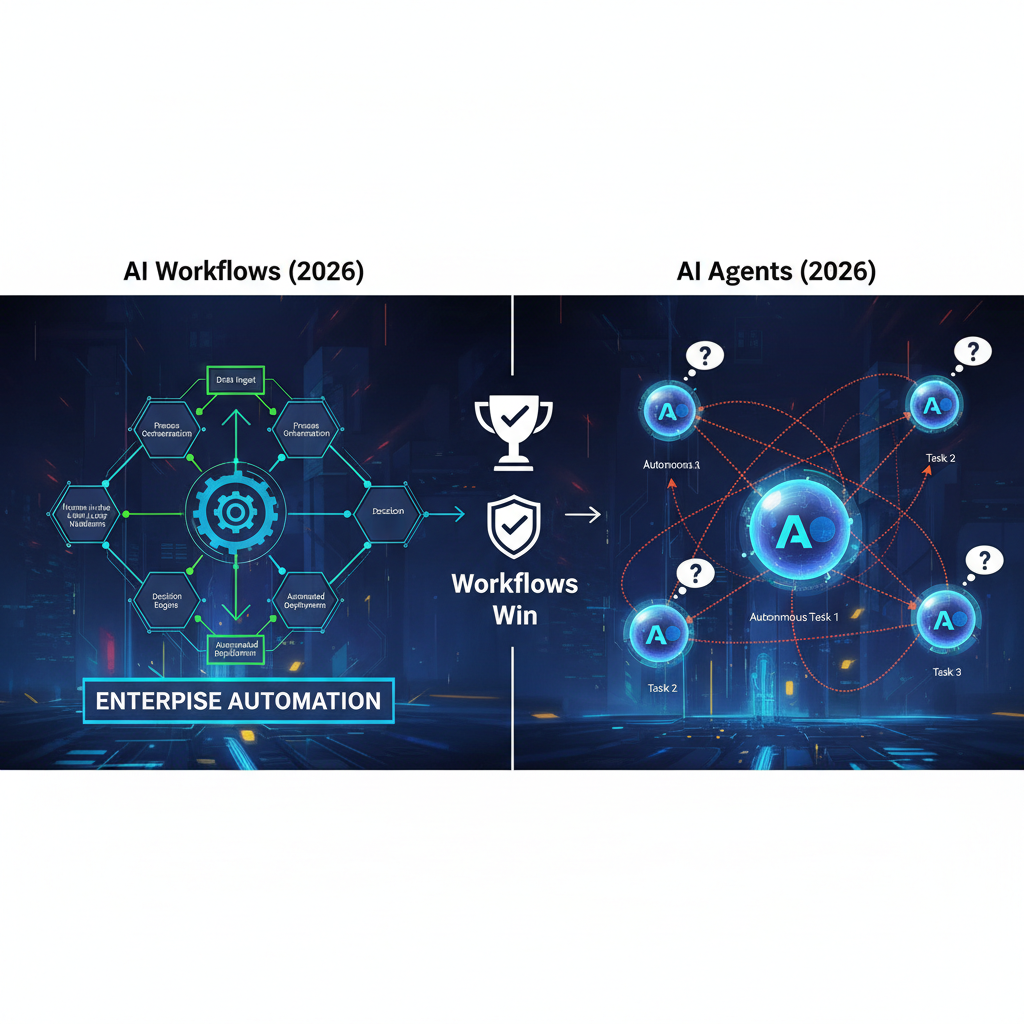
Image: AI-generated
Third, security and compliance challenges emerge when agents operate as black boxes. Regulated industries require audit trails and explainable decisions—something traditional workflows provide naturally but agents struggle to deliver consistently.
Why AI Workflows Dominate in 2026
AI workflows represent a more mature approach to automation that leverages AI capabilities while maintaining human oversight and system reliability. Unlike autonomous agents, workflows break complex processes into discrete, manageable steps with clear inputs, outputs, and error handling.
The key advantages of AI workflows include:
Predictable Performance and Cost Control: Workflows execute predefined sequences, allowing for accurate cost forecasting and performance benchmarking. Each step’s resource consumption can be measured and optimized independently, unlike the unpredictable resource usage of agentic systems.
Enhanced Reliability Through Error Handling: Well-designed workflows incorporate graceful failure points and fallback mechanisms. If one component fails, the system can route around the problem or escalate to human operators—a level of resilience that autonomous agents struggle to match.
Audit Trails and Compliance: Every step in a workflow generates logs and artifacts that satisfy regulatory requirements. This transparency is essential for industries like finance and healthcare where decision explainability is mandatory.
Gradual Implementation and ROI: Workflows can be implemented incrementally, allowing organizations to demonstrate value at each stage. This contrasts with agentic systems that often require substantial upfront investment before delivering measurable returns.
Real-World Workflow Success Stories in 2026
Consider a financial services company implementing customer onboarding automation. An autonomous agent might attempt to handle the entire process end-to-end, but a workflow approach breaks this into discrete AI-assisted steps: document verification using computer vision, risk assessment via language models, compliance checking against regulatory databases, and final approval with human oversight.
This workflow approach has proven significantly more effective because each component can be optimized independently. The document verification step might use specialized models from providers like OpenRouter, while the compliance checking leverages proprietary systems. The entire process remains transparent and controllable.
Similarly, software development teams are finding that AI-assisted coding workflows outperform fully autonomous programming agents. Instead of asking an agent to “build a feature,” teams use tools like Cursor within established development workflows—code generation, review, testing, and deployment—each with appropriate human oversight.
The Role of Orchestration Platforms
The maturation of workflow orchestration platforms has been a key enabler for AI workflow adoption. Tools like n8n and Make.com provide the infrastructure needed to build sophisticated AI-assisted automation without the unpredictability of agentic systems.
These platforms excel at connecting diverse AI services, traditional APIs, and human decision points into coherent processes. They provide the monitoring, error handling, and scalability that enterprise deployments require. The recent advancements in AI orchestration standards have further solidified workflows as the preferred approach for production systems.
Security-conscious organizations particularly appreciate how workflow platforms support the principles outlined in our guide on securing AI code review and workflow orchestration. The ability to implement granular access controls, audit trails, and compliance checks makes workflows the responsible choice for sensitive operations.
When AI Agents Still Make Sense
Despite the dominance of workflows, autonomous agents still have their place in the 2026 automation landscape. They excel in environments where exploration and creativity are valued over predictability. Research and development, creative content generation, and open-ended problem solving remain domains where agentic approaches can outperform predefined workflows.
The key is recognizing that agents work best as components within larger workflow systems rather than as standalone solutions. A research workflow might include an agentic exploration phase followed by systematic validation and implementation steps. This hybrid approach leverages the strengths of both paradigms while mitigating their weaknesses.
Implementing AI Workflows: Best Practices for 2026
Success with AI workflows requires thoughtful implementation. Start by mapping existing processes and identifying automation opportunities. Focus on high-value, repetitive tasks where AI can augment human effort rather than replace it entirely.
Design workflows with observability in mind. Implement comprehensive logging and monitoring from day one. Use tools that support chain-of-thought reasoning patterns to maintain transparency in AI decision-making.
Plan for gradual scaling. Begin with pilot projects that demonstrate clear value, then expand based on lessons learned. This iterative approach builds organizational confidence and ensures that workflow complexity grows in manageable increments.
The Future is Orchestrated, Not Autonomous
As we look beyond 2026, the trend toward orchestrated AI workflows will likely accelerate. The need for reliable, auditable, and cost-effective automation will continue to outweigh the appeal of fully autonomous systems in most business contexts.
The most successful organizations will be those that master the art of workflow design—combining AI capabilities with human expertise in structured, scalable processes. They’ll use platforms that support flexible orchestration while maintaining the control and transparency that business operations require.
Ready to build your own AI workflows? Platforms like n8n offer powerful orchestration capabilities that balance automation with control. For development workflows, tools like Cursor provide AI assistance within established coding practices.
July 18, 2026 Update: Recent Q2 2026 enterprise adoption data confirms the workflow dominance trend, with companies reporting 47% higher ROI from structured AI workflows compared to standalone agents. New orchestration platforms like LangGraph and Prefect 3.0 have emerged as game-changers, enabling complex multi-step automation that outperforms autonomous agents in reliability and auditability.
According to the latest 2026 AI Automation Benchmark Report, workflow-based implementations show 68% fewer errors in production environments and 3.2x faster troubleshooting capabilities. Enterprises are shifting from experimental agent deployments to production-ready workflow systems that integrate seamlessly with existing DevOps pipelines and compliance frameworks.
The 2026 landscape reveals that while AI agents excel at exploratory tasks, workflows dominate predictable business processes where consistency and traceability matter most. Major cloud providers have released dedicated workflow services (AWS Step Functions AI, Azure Logic Apps AI) that further cement workflow superiority for enterprise-scale automation.
What to Read Next
- NYC Landlords Must Disclose AI in Listings in 2026: What Renters & Agents Need to Know
- NotebookLM vs Claude Canvas: AI Research & Document Workspace 2026
- Alibaba’s Qwen 3.8, Meta’s Anthropic Deal & NVIDIA’s Japan Push Shape AI Landscape
- OpenRouter vs OpenAI API for GPT-4o and New 2026 Models: A Developer’s 2026 Comparison
- Browse all AI Stack Digest articles
Bookmark aistackdigest.com for daily AI tools, reviews, and workflow guides.
This article was produced with the assistance of AI tools and reviewed by the AIStackDigest editorial team.