The landmark decisions by S&P Dow Jones Indices in 2026 to maintain its stringent profitability and governance requirements have sent shockwaves through the artificial intelligence investment landscape. By effectively rejecting fast-track inclusion for high-profile, privately-held AI companies like SpaceX, OpenAI, and Anthropic, the index committee has drawn a clear line in the sand: revolutionary technology alone isn’t enough to warrant a coveted spot in America’s most important equity benchmark. This definitive stance creates a complex roadmap for AI IPOs in 2026 and beyond, forcing companies valued in the tens of billions to reconsider their path to public markets.
The S&P 500’s Unchanged Gatekeeping Rules
At the heart of the matter are the S&P 500’s long-standing listing criteria, which require companies to demonstrate four consecutive quarters of profitability under GAAP accounting standards. For AI behemoths like OpenAI and Anthropic, who pour billions into research, infrastructure, and compute costs, achieving consistent profitability remains a distant goal despite their staggering revenues. The index committee specifically reviewed and rejected proposals to create special fast-track provisions for “strategic technology sectors,” arguing that maintaining consistent, objective standards protects the integrity of the index and its investors.
This decision highlights a fundamental tension between Silicon Valley’s “growth at all costs” mentality and the traditional financial world’s emphasis on sustainable business models. While companies like SpaceX have achieved remarkable technological milestones, their complex corporate structures and irregular profitability cycles present significant challenges for index inclusion. The rejection signals that even the most promising AI ventures must eventually conform to conventional financial discipline before joining the market’s most exclusive club.
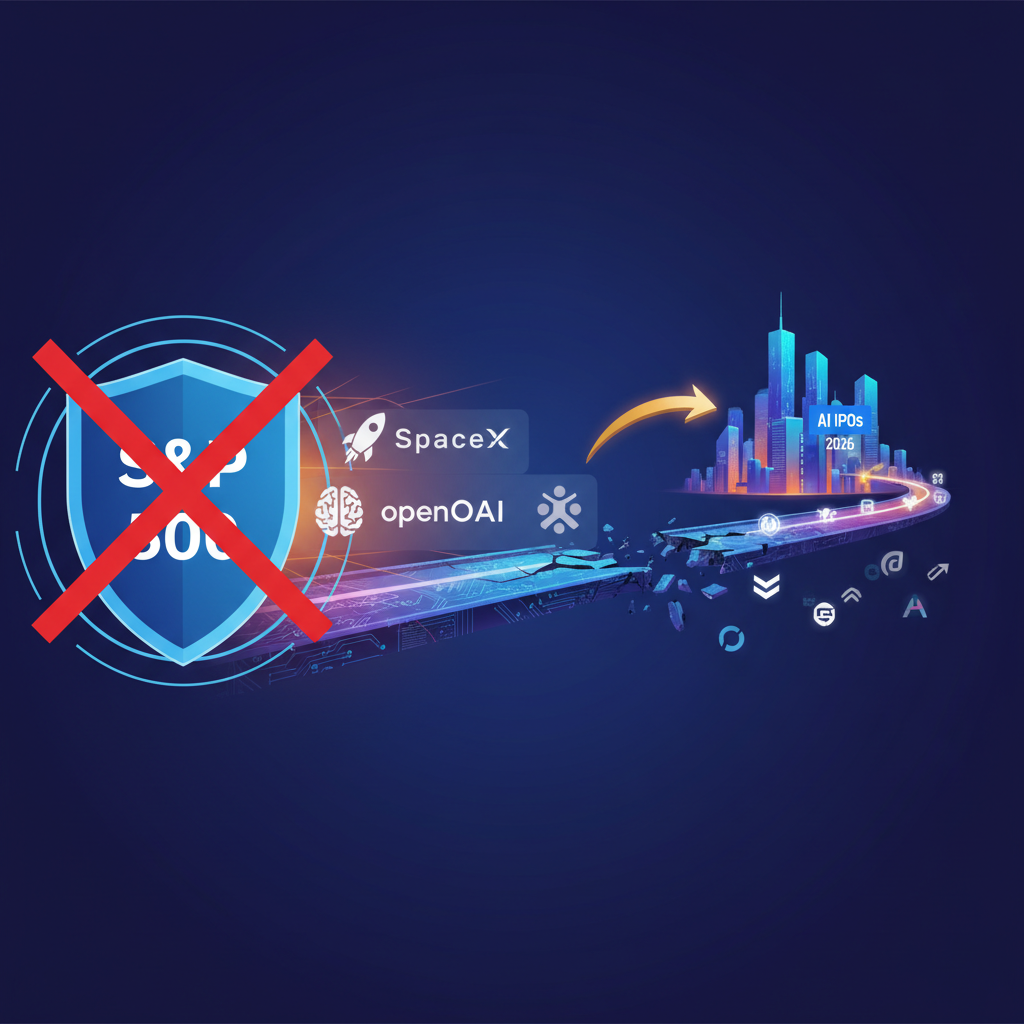
Image: AI-generated
Immediate Impact on AI Company Valuations and Funding
The S&P 500’s stance creates immediate ripple effects across private markets. Venture capital firms and late-stage investors who anticipated near-term public exits for their AI portfolio companies now face extended holding periods. This potentially delays liquidity events that many funds had baked into their investment theses. The validation that comes from S&P 500 inclusion—often triggering automatic buying from index funds and ETFs—will remain out of reach, possibly putting downward pressure on private market valuations.
Companies themselves must now navigate extended private funding rounds or explore alternative financing structures. We’re likely to see increased activity in secondary markets and special purpose vehicles designed to provide liquidity to early employees and investors without a traditional IPO. This extended private status could actually benefit some companies by allowing them to focus on long-term R&D away from quarterly earnings pressure, but it also means continued reliance on a shrinking pool of mega-funds capable of writing billion-dollar checks.
The situation echoes previous technological revolutions where market infrastructure struggled to accommodate disruptive business models. Just as Amazon traded for years while posting minimal profits during its infrastructure build-out phase, today’s AI leaders may need to convince investors of their path to profitability while burning tremendous cash. The difference in 2026 is the sheer scale of investment required—training frontier AI models demands computational resources that make Amazon’s early warehouse expansion look modest by comparison.
The Road to 2026: Alternative Paths for AI Giants
With the traditional S&P 500 path blocked for now, AI companies are exploring several alternative routes to public markets:
Direct Listings and Special Purpose Acquisitions
Some companies may pursue direct listings that bypass traditional IPO processes, though these still require solving the profitability puzzle. SPACs, which gained popularity during the pandemic, have fallen out of favor but could see a resurgence for AI companies seeking alternative paths to public capital. However, the regulatory scrutiny and investor skepticism surrounding SPACs make this a challenging option for premier AI brands concerned with their reputation.
Strategic Partnerships and Corporate Carve-Outs
We may see increased strategic investments from tech giants looking to gain AI capabilities without full acquisitions. Microsoft’s complex relationship with OpenAI provides a template for how large corporations can provide funding and infrastructure support while allowing AI companies to maintain operational independence. These partnerships can provide crucial funding bridges until companies achieve the financial metrics needed for public market success. The recent news that Microsoft’s AI chief feels the company has been “set free” from OpenAI to pursue superintelligence independently suggests these relationships continue to evolve in surprising ways.
International Listings
Exchanges in financial centers like London, Hong Kong, or Singapore may roll out more accommodating listing standards specifically designed to attract AI companies. However, the depth of liquidity and prestige of U.S. markets make this a less attractive option for companies aiming for maximum visibility and valuation.
Broader Implications for the AI Ecosystem
The S&P 500’s decision affects not just the headline companies but the entire AI value chain. Startups developing AI productivity tools for business efficiency must now anticipate a longer journey to liquidity events. Hardware companies building specialized AI chips, data providers, and application developers all face adjusted timelines for market validation through public listings.
This extended private phase may accelerate industry consolidation as well-capitalized players acquire smaller innovators before either reaches public markets. Companies that have mastered specific niches, such as those featured in our weekly AI digest, might become attractive acquisition targets rather than pursuing independent public offerings.
For investors, the landscape requires more sophisticated due diligence. Evaluating AI companies demands understanding not just technology but paths to monetization and profitability—skills that traditional tech investors are still developing. The delay in public market validation means investors must rely more heavily on technical metrics like training efficiency, model performance, and developer adoption rather than conventional financial statements.
The Silver Lining: Forcing Sustainable Business Models
While the S&P 500’s stance presents challenges, it may ultimately benefit the AI industry by forcing companies to develop sustainable business models earlier in their lifecycle. The era of unlimited funding for promising but unproven technologies appears to be closing, replaced by a more disciplined approach that balances innovation with financial responsibility.
Companies that succeed in this environment will likely emerge stronger, with business models that can withstand economic cycles and competitive pressures. The focus may shift from pure research breakthroughs to practical applications that generate recurring revenue—a transition that could accelerate AI adoption across traditional industries.
This discipline extends to operational efficiency as well. As companies like Anthropic develop more sophisticated frameworks, such as their AI vulnerability discovery system, they’re also building the governance structures needed for public market confidence. This combination of technological innovation and operational maturity will be essential for eventually meeting S&P 500 standards.
June 8, 2026 Update: The S&P 500’s steadfast rejection of major AI players has sent shockwaves through investment circles, with analysts now questioning whether companies like Anthropic and OpenAI will need to pursue alternative listing strategies. New data from Wall Street shows that AI stocks facing S&P 500 eligibility challenges have seen increased volatility of up to 35% compared to traditional tech listings.
Industry experts suggest that the 2026 IPO landscape may favor special purpose acquisition companies (SPACs) or direct listings for AI firms that don’t meet the S&P’s stringent profitability requirements. This shift could fundamentally alter how retail and institutional investors access the AI market, potentially creating a two-tier system between S&P-listed traditional tech and specialty AI exchanges.
According to recent SEC filings, both OpenAI and Anthropic have accelerated their path to profitability targets, with OpenAI projecting positive EBITDA by Q4 2026 and Anthropic targeting breakeven by Q1 2027. This suggests that while 2026 may see these companies excluded from the premier index, 2027 could present a very different landscape for AI investment opportunities.
What to Read Next
- Claude Fable 5 Review 2026: Anthropic’s Masterpiece of Creative and Analytical AI
- Anthropic Launches Claude Fable 5: The Largest Generally Available Model Yet
- Best Cheap VPS for Running LLMs in 2026 (Under $15/month)
- The AI Coding Tool Guide: Navigating the New Era of Software Development
- Browse all AI Stack Digest articles
Bookmark aistackdigest.com for daily AI tools, reviews, and workflow guides.
This article was produced with the assistance of AI tools and reviewed by the AIStackDigest editorial team.