
The year 2026 marks a pivotal moment for artificial intelligence in education, as school districts nationwide grapple with the urgent need for comprehensive AI education policies. What began as experimental pilot programs in the early 2020s has now become an essential component of modern educational infrastructure. Schools are no longer asking if they should integrate AI, but how to do so responsibly, equitably, and effectively.
The Current State of AI in Education
As we approach 2026, AI tools have evolved from basic tutoring assistants to sophisticated learning companions capable of personalized instruction, automated grading, and even emotional intelligence assessment. The rapid adoption has created a regulatory gap that schools are now urgently working to fill. Without clear policies, educators face challenges ranging from academic integrity concerns to data privacy issues and accessibility disparities.
The most forward-thinking districts have recognized that AI policy isn’t just about restrictions—it’s about creating frameworks that empower teachers while protecting students. These policies address everything from acceptable use of generative AI for assignments to data security protocols for AI-powered learning platforms.
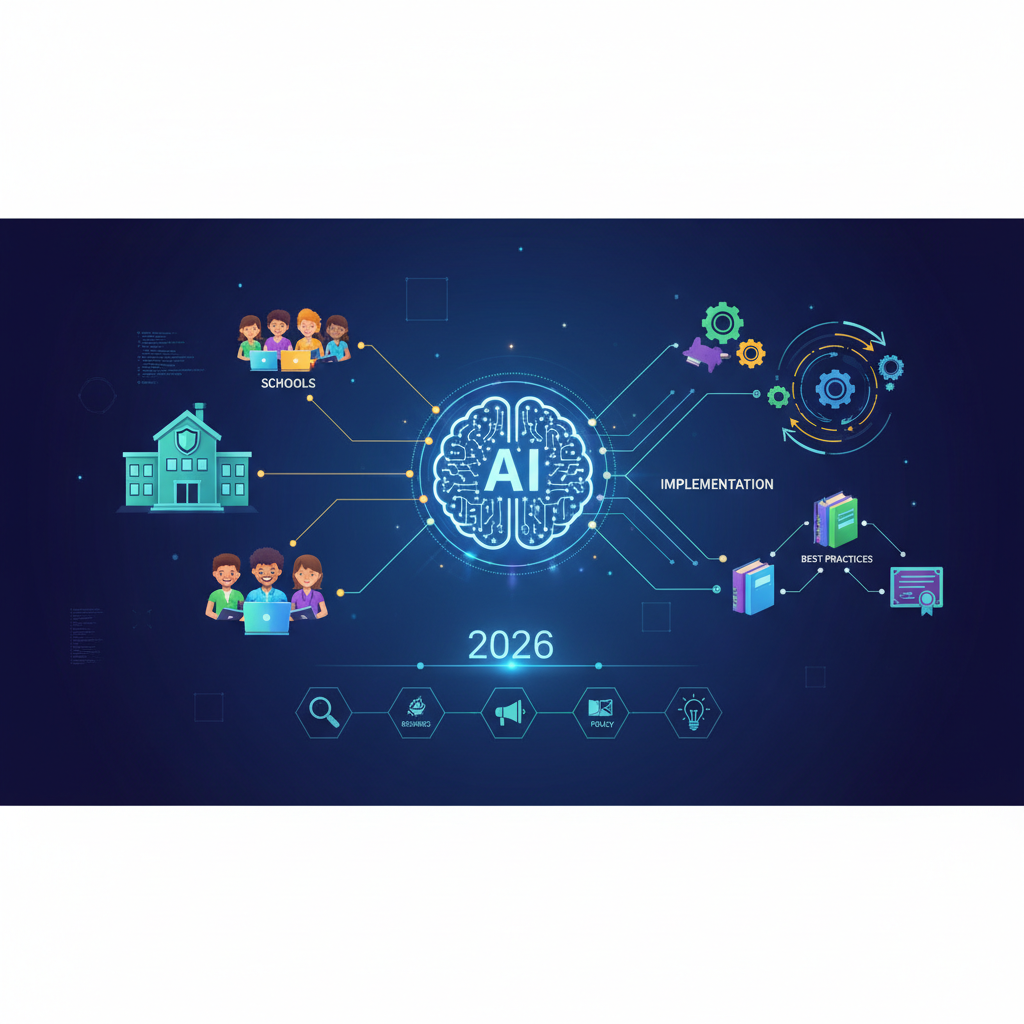
Image: AI-generated
Key Components of an Effective 2026 AI Education Policy
Academic Integrity and AI-Assisted Learning
The most immediate concern for educators in 2026 remains academic integrity. However, the conversation has shifted from outright banning AI tools to defining appropriate use cases. Progressive policies now distinguish between AI as a cheating tool and AI as a learning assistant. For instance, policies might permit students to use AI for brainstorming and drafting while requiring disclosure and human refinement of final submissions.
Many districts have adopted tiered approaches based on grade levels. Elementary students might use AI primarily for skill reinforcement under teacher supervision, while high school students learn to leverage AI for research synthesis and complex project development. The key is transparency—students must understand when and how AI contributes to their work.
Data Privacy and Student Protection
With AI systems processing vast amounts of student data, privacy protections have become non-negotiable. Effective 2026 policies mandate that any AI tool used in schools must comply with FERPA, COPPA, and state-specific privacy laws. This includes requirements for data encryption, limited retention periods, and strict controls on how data trains AI models.
Districts are increasingly opting for educational versions of AI tools that guarantee data sovereignty, or they’re implementing locally-hosted solutions where student data never leaves school-controlled servers. This approach mirrors broader trends in enterprise AI, where companies are learning to balance innovation with responsible data handling.
Equity and Accessibility
Perhaps the most significant policy challenge in 2026 is ensuring equitable access to AI tools. Schools must address both the digital divide—ensuring all students have device and internet access—and the “AI literacy gap” where some students arrive with extensive AI experience while others have none.
Forward-thinking policies include provisions for school-provided devices with pre-installed AI tools, after-school AI literacy programs, and teacher training specifically focused on supporting students with varying levels of technological familiarity. Some districts have partnered with platforms like OpenRouter to provide controlled access to multiple AI models while maintaining safety filters appropriate for different age groups.
Teacher Training and Professional Development
No AI policy can succeed without comprehensive teacher support. The most effective 2026 policies include mandatory professional development that goes beyond basic tool usage to encompass pedagogical strategies for AI-integrated classrooms. Teachers learn to design assignments that leverage AI productively while assessing authentic student learning.
Many districts have created “AI champion” programs where tech-savvy educators mentor colleagues and help adapt curriculum materials. This bottom-up approach has proven more effective than top-down mandates, as it builds buy-in and shares practical classroom strategies.
Implementation Strategies for School Districts
Phased Rollout Approach
Successful districts in 2026 typically avoid blanket AI implementations. Instead, they adopt phased approaches starting with volunteer teacher pilot programs. These pilots generate valuable data and success stories that help build momentum for broader adoption. The initial phase often focuses on non-graded activities and teacher productivity tools before expanding to student-facing applications.
Middle schools might begin with AI-assisted reading comprehension tools, while high schools pilot coding assistants like those powering platforms such as Cursor, which has gained popularity in educational coding programs. Each phase includes evaluation checkpoints to assess effectiveness and identify needed policy adjustments.
Stakeholder Engagement and Communication
Effective AI policy development in 2026 involves all stakeholders—teachers, administrators, students, parents, and even community members. Districts that succeed typically form representative committees that meet regularly to review policy effectiveness and suggest improvements.
Clear communication with parents is particularly crucial. Many schools host AI literacy nights where families can experience the tools their children are using and understand the safeguards in place. This transparency helps alleviate concerns and builds trust in the school’s approach to emerging technologies.
Assessment and AI: Rethinking Evaluation in 2026
Traditional assessment methods have become increasingly inadequate in the age of AI. Rather than trying to police AI use in take-home assignments, innovative schools are redesigning assessments to focus on process over product. This might include more in-class presentations, project-based learning with documented development processes, and oral examinations that test understanding rather than regurgitation.
Some districts are experimenting with AI-powered assessment tools that analyze student thought processes and provide detailed feedback on problem-solving approaches. These tools complement rather than replace teacher evaluation, offering insights into student learning patterns that were previously difficult to capture at scale.
Future-Proofing AI Policies
The most sophisticated 2026 policies include mechanisms for regular review and adaptation. Given the rapid pace of AI development, policies must be living documents rather than static rules. Many districts schedule quarterly reviews of their AI guidelines and maintain relationships with university researchers and industry experts to stay informed about emerging trends.
This adaptive approach acknowledges that today’s cutting-edge tool might be obsolete in six months, while new capabilities could emerge that require entirely new policy considerations. The goal isn’t to create a perfect permanent policy but to build a responsive framework that can evolve with the technology.
Case Study: Successful District Implementation
The Lincoln Unified School District in California provides an illustrative example of effective AI policy implementation. Beginning in early 2025, they formed a stakeholder committee that spent six months developing a comprehensive policy framework. Their approach included:
- Phased teacher training starting with voluntary “AI explorer” cohorts
- Clear grade-level benchmarks for AI literacy skills
- Partnership with a local university for ongoing policy evaluation
- Student digital citizenship curriculum updated to include AI ethics
After one year, the district reported increased student engagement in STEM subjects and improved teacher satisfaction with technology integration. Crucially, they maintained academic integrity while preparing students for a future where AI proficiency will be essential.
Getting Started with Your School’s AI Policy
For schools beginning their AI policy journey in 2026, the process can seem daunting. However, several resources can help:
- Template policies from educational organizations like ISTE and CoSN
- Professional learning communities where districts share best practices
- Consulting services specializing in educational technology integration
- Partnerships with platforms like n8n that offer educational discounts and tailored solutions
The key is to start with a clear vision of what you want to achieve—whether it’s improving equity, enhancing learning outcomes, or preparing students for future careers—and build your policy around those goals.
Ready to Implement AI Tools in Your Educational Workflow?
Platforms like n8n offer powerful automation capabilities that can streamline administrative tasks, allowing educators to focus more on teaching. Whether you’re automating communication with parents or managing classroom resources, the right tools make AI integration smoother and more effective.
Updated June 20, 2026: As we move further into the school year, the conversation around AI in education has shifted from ‘whether’ to ‘how.’ A recent 2026 survey by the Consortium for School Networking (CoSN) found that while **over 73% of U.S. districts have formal AI guidance in development**, only 28% feel their policies are fully actionable for classroom-level implementation. This gap highlights the critical need for practical frameworks that move beyond abstract principles. New AI literacy benchmarks released by the U.S. Department of Education in early 2026 now emphasize ‘skill progression standards’ that districts must integrate into their curricula, starting as early as the 4th grade.
Successful policy implementation now hinges on two key 2026 models: the **’Sandbox-to-Scale’ Framework** and the **’Teacher-Led AI Co-Pilot’ Program.** The Sandbox approach involves designated classrooms or subjects where new AI tools are piloted under clear safety and evaluation protocols, with successful pilots then scaled district-wide. The Co-Pilot model empowers lead educators to become AI tool specialists, supporting colleagues in real time. Districts adopting these models report a **40% higher teacher comfort level** with AI-assisted lesson planning and student support.
Furthermore, 2026’s policy landscape requires clear ‘how-to’ guidance on acceptable use. The most forward-looking policies now include **appendix checklists for teacher tool evaluation**, **sample student project rubrics that credit the ethical use of AI**, and **guardrails for generative AI use in formative assessments**. The ultimate goal is no longer just to create a policy document but to build a living, adaptable system that evolves with the technology itself.
What to Read Next
- Best Sovereign AI Models 2026: Apertus, Claude, and Local LLM Options
- Identity Verification on Claude in 2026: Latest Privacy Updates & User Impact Analysis
- AI’s Next Big Hurdle: Benchmarks Reveal Struggle with Real-World Knowledge Work
- Best AI Video Tools in June 2026: Revolutionizing Content Creation
- Browse all AI Stack Digest articles
Bookmark aistackdigest.com for daily AI tools, reviews, and workflow guides.
This article was produced with the assistance of AI tools and reviewed by the AIStackDigest editorial team.