
The AI landscape in 2026 is defined by a new tier of powerful language models, and among the most discussed are the GPT-6.2 variants, Astra and Sol. For developers, businesses, and AI enthusiasts navigating the API ecosystem through platforms like OpenRouter, understanding the nuanced differences between these two models is crucial for making cost-effective and performance-oriented decisions. This comparison breaks down what we know about Astra and Sol to help you determine which variant is best suited for your specific needs this year.
Understanding the GPT-6.2 Family
The GPT-6.2 series represents a significant step forward in language model technology. Unlike its predecessors, this family appears to be structured around specialized variants rather than a single monolithic model. This approach allows for more tailored performance, potentially offering better efficiency for specific tasks. The emergence of Astra and Sol suggests a bifurcation in design philosophy, likely targeting different user bases and application profiles.
When evaluating any AI model, it’s essential to consider your primary use case. Are you building a creative writing assistant, a technical coding copilot, or a high-volume customer service chatbot? The answer will significantly influence which model variant aligns with your goals. For a deeper dive into how specialized models are shaping the enterprise space, our analysis of Microsoft’s specialized MAI models provides relevant context.
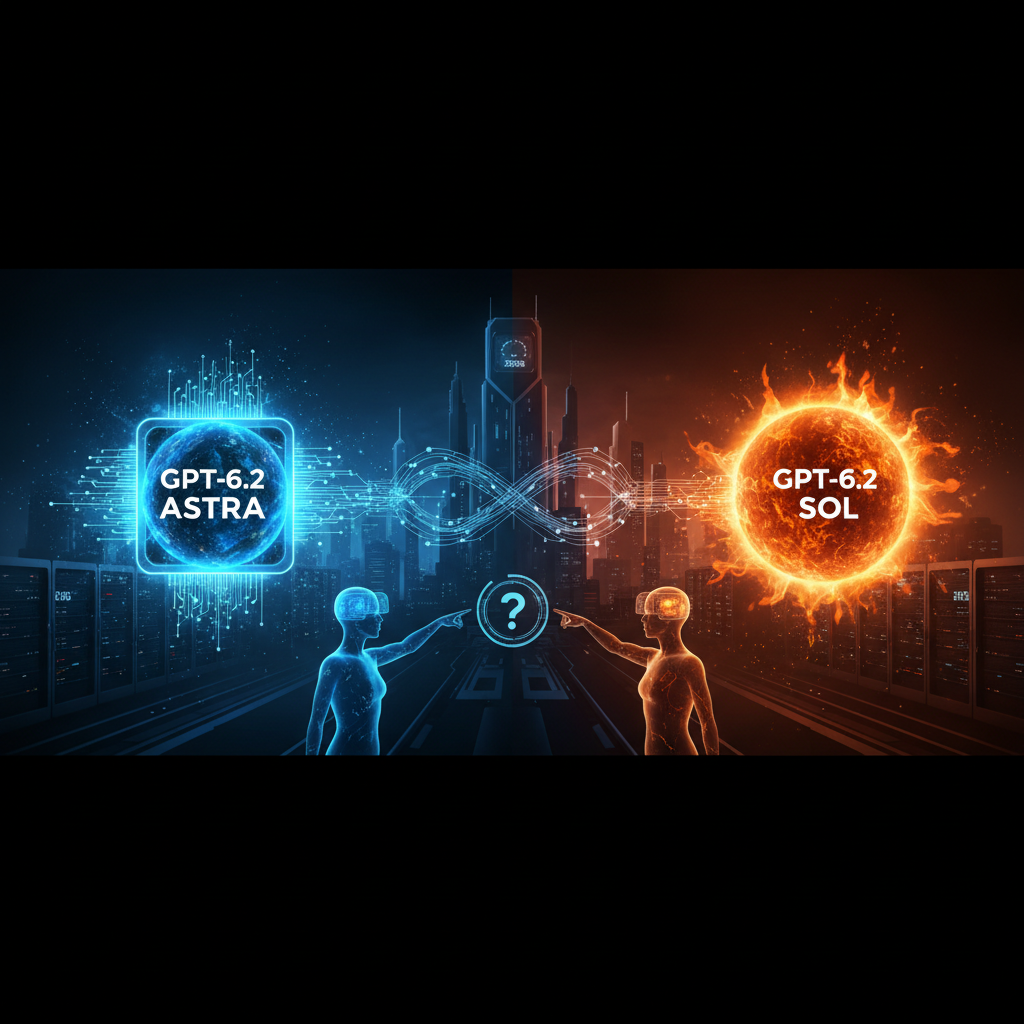
Image: AI-generated
GPT-6.2 Astra: The Specialist
Based on its namesake, which often implies a focus on precision and targeted performance, the GPT-6.2 Astra variant is likely optimized for specific, high-accuracy tasks. The name ‘Astra’ suggests qualities like being star-like, precise, or focused. In practical terms, this could translate to exceptional performance in areas such as:
- Code Generation and Explanation: Providing highly accurate, syntactically correct code snippets and detailed technical explanations.
- Logical Reasoning and Structured Outputs: Excelling at tasks that require following complex instructions, generating JSON/XML, or performing structured data extraction.
- Technical Summarization: Distilling complex research papers, technical documentation, or financial reports into concise summaries.
If your project demands unwavering accuracy and deep expertise in a narrow domain, Astra is presumably the variant to investigate first. Its architecture is likely fine-tuned to reduce hallucinations and provide verifiable outputs in its areas of specialization.

GPT-6.2 Sol: The Generalist
In contrast, the GPT-6.2 Sol variant takes its name from the sun—a source of broad, general energy. This suggests a model designed for versatility and creative breadth. Sol is probably the better choice for applications that require:
- Creative Content Generation: Writing engaging marketing copy, brainstorming story ideas, generating poetry, or creating varied conversational dialogue.
- Broad Knowledge Synthesis: Answering open-ended questions that draw from a wide array of topics, from history to pop culture.
- Idea Exploration and Brainstorming: Generating a large number of diverse ideas, concepts, or solutions to a problem.
Sol’s strength likely lies in its ability to make novel connections across disparate fields, offering more surprising and inventive outputs. This makes it ideal for early-stage prototyping or tasks where ‘outside-the-box’ thinking is valued over pinpoint accuracy.
Key Decision Factors for 2026
Choosing between Astra and Sol isn’t just about raw capability; it’s about aligning the model’s strengths with your project’s requirements and constraints. Here are the critical factors to weigh:
1. Task Specificity
The most straightforward way to decide is to analyze your primary task. Is it a well-defined, repeatable problem (leaning toward Astra) or an open-ended, creative one (leaning toward Sol)? For mission-critical applications where error tolerance is low, the specialized precision of Astra is likely indispensable. For more exploratory or creative workflows, Sol’s generalist capabilities will provide more value.
2. Cost and Token Efficiency
While specific pricing is not available, specialized models like Astra often command a premium for their expert-level performance in a specific domain. However, this higher cost per token can be offset by greater accuracy and efficiency, meaning you might achieve your desired result in fewer API calls. Generalist models like Sol might have a lower cost per token but could require more extensive prompt engineering or multiple generations to achieve a specific result. Always factor in the total cost to achieve a outcome, not just the per-token price.
3. Latency and Throughput
Model architecture differences can also impact performance. A specialized model might be optimized for faster inference times on its specific tasks. If you’re building a real-time application, such as a live coding assistant or a customer support chat, the latency of the model response is a critical factor. Be sure to benchmark both variants for speed in your specific use case.
4. Integration and Workflow
Consider how the model will fit into your larger workflow. Will it be a standalone tool or part of a complex automation? For advanced multi-model workflows, especially those involving orchestration between different AI services, platforms like n8n can be invaluable. You might even find that the optimal strategy involves using both models—Astra for precision tasks and Sol for creative ones—within a single automated process.
Testing and Evaluation: A Practical Approach
Given the speculative nature of these model differences, the only way to know for sure is to test them yourself. Develop a set of benchmark prompts that accurately represent the tasks your application will perform. Run these prompts through both the Astra and Sol variants available on OpenRouter and compare the outputs based on:
- Accuracy and factual correctness
- Creativity and originality
- Relevance and adherence to instruction
- Output length and structure
- Time to first token and total generation time
This hands-on testing will provide you with concrete data to make an informed decision rather than relying on theoretical advantages. Remember, effective prompt engineering is also key to getting the best results, a topic covered in our guide on stopping token waste in AI debugging.
Conclusion: Astra for Precision, Sol for Breadth
The choice between GPT-6.2 Astra and GPT-6.2 Sol in 2026 ultimately boils down to a classic trade-off: specialization versus generalization. For tasks demanding high reliability, deep technical expertise, and precise outputs, the Astra variant appears to be the logical choice. Its design is likely intended for users who need a scalpel. For projects that thrive on creativity, broad knowledge, and exploratory thinking, the Sol variant probably holds the advantage, acting more like a Swiss Army knife.
The best way to start is to access both models through a unified platform like OpenRouter, which simplifies the process of testing and comparing different AI APIs. By defining your requirements clearly and conducting rigorous benchmarks, you can confidently select the GPT-6.2 variant that will deliver the best performance for your specific application this year.
What to Read Next
- Google Workers Push Back on AI in Schools: What the Employee Revolt Means for AI Ethics in 2026
- Frostbite AI-Designed CPU Architecture: What It Is and Why It Matters in 2026
- Gemini 4 Neon Review 2026: Benchmarks, Features, and API Pricing | Commercial Investigation
- AI Discovers Java4Shell: Critical OpenJDK RCE Vulnerability Now Patched
- Browse all AI Stack Digest articles
Bookmark aistackdigest.com for daily AI tools, reviews, and workflow guides.
This article was produced with the assistance of AI tools and reviewed by the AIStackDigest editorial team.