
AI Tools & Automation Specialist
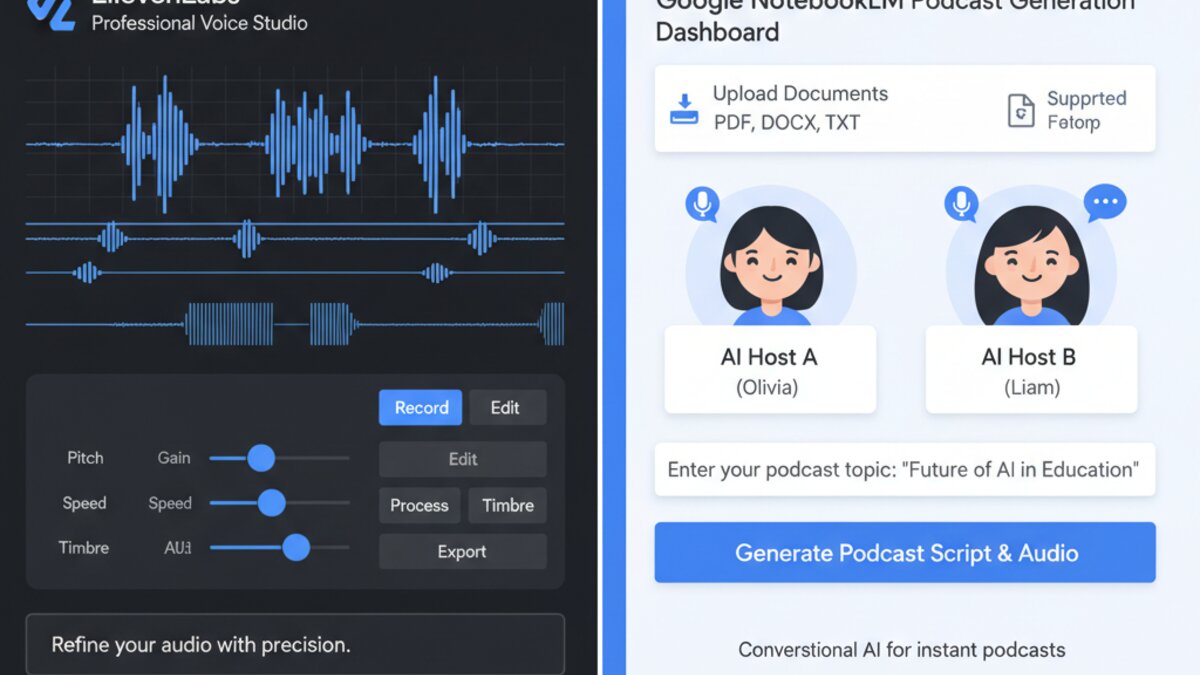
ElevenLabs vs Google NotebookLM Audio 2026: AI Voice Generation & Podcast Creation Showdown
The AI audio landscape has undergone a seismic shift. Where once voice generation meant robotic TTS outputs and limited customization, today’s platforms deliver hyper-realistic speech synthesis and automatic podcast creation. Two platforms stand at the forefront: ElevenLabs, the specialist in voice cloning and speech synthesis, and Google NotebookLM Audio (now integrated with Gemini 2.5), which automates the entire podcast generation workflow from research documents. This 2026 comparison examines which platform wins for creators, researchers, and content teams.
What Are ElevenLabs and Google NotebookLM Audio?
ElevenLabs is a voice AI platform specializing in natural-sounding speech synthesis and voice cloning. Founded in 2022, it has become the go-to choice for:
- Content creators needing multilingual voiceovers
- Audiobook authors scaling production
- Game developers requiring dynamic NPC voices
- Educational platforms automating video narration
Google NotebookLM Audio (launched as a Gemini feature in 2024, now standalone) automates podcast creation from text documents. Feed it research papers, blog posts, or notes, and it generates conversational podcast audio with AI-driven hosts discussing the content. It’s built for:
- Researchers turning papers into audio summaries
- Writers repurposing blog content into podcasts
- Teams creating internal training podcasts
- Anyone wanting passive listening options
Core Features Comparison
Voice Quality & Realism
ElevenLabs: Unparalleled voice fidelity. Their latest multilingual voices (32+ languages) sound almost indistinguishable from human narration. The platform excels at:
- Natural prosody and intonation variation
- Emotional expression (joy, sadness, urgency)
- Accent-specific authenticity
- Custom voice cloning from 1-minute samples
Google NotebookLM Audio: Conversational, character-driven approach. Rather than single-voice narration, NotebookLM generates two AI hosts having a natural dialogue about your content. Quality is high but conversational (less formal than ElevenLabs), with:
- Distinct host personalities (Olivia & Marcus, or others)
- Dynamic back-and-forth banter
- Occasional interruptions and overlapping speech (realistic podcast feel)
- Automatic content parsing and topic extraction
Use Case Optimization
ElevenLabs Wins For:
- Audiobooks — Professional-grade narration quality for self-published authors
- E-learning — Consistent single narrator for course modules
- Gaming — Dynamic NPC voice generation at scale
- Brand Voiceovers — Maintaining consistent brand voice across content
- Localization — Dubbing content into 30+ languages without hiring voice actors
Google NotebookLM Audio Wins For:
- Research Dissemination — Converting academic papers to listenable podcasts
- Content Repurposing — Turning blog posts into podcast episodes automatically
- Internal Training — Generating training materials from documentation
- Thought Leadership — Creating “interview-style” podcasts from your own writing
- Accessibility — Quick audio versions of text content for blind/low-vision users
Pricing & Accessibility
ElevenLabs
Flexible pricing model based on character usage:
- Free tier: 10,000 characters/month (roughly 15 minutes of narration)
- Starter: $5/month for 50,000 characters
- Creator: $99/month for 500,000 characters
- Professional: $1,000+/month custom plans
- Voice cloning: Available on Creator tier and up
Realistic scenario: An audiobook author narrating a 50,000-word novel (roughly 250,000 characters) would spend $99/month on the Creator plan — competitive with hiring a voice actor for a single chapter.
Google NotebookLM Audio
Integrated into Google’s subscription ecosystem:
- Gemini Free: Limited access to NotebookLM Audio features
- Gemini 2.5 Pro: $20/month — Full audio generation with priority processing
- Gemini 2.5 Advanced: $40/month — Faster generation and custom host options (coming late 2026)
Key advantage: If you’re already paying for Gemini 2.5 Pro ($20/month), NotebookLM Audio is included at no extra cost.
Speed & Workflow
ElevenLabs
Input: Text or API integration
Processing: 10,000 characters typically render in 1-2 minutes (Premium tier). Free tier has queuing delays.
Output: MP3 download or API streaming
Workflow: Straightforward but manual — paste text, select voice, generate, download.
Google NotebookLM Audio
Input: Upload document (PDF, Google Doc, web link, pasted text)
Processing: 5-15 minutes for full podcast generation (includes content analysis and dialogue scripting)
Output: MP3 with associated transcript and show notes
Workflow: Drag-and-drop automation — upload document, hit “Generate Podcast,” get finished product with metadata.
Winner for speed: ElevenLabs for single-voice output; NotebookLM for end-to-end automation.
Customization & Control
ElevenLabs
Granular control over output:
- Voice selection: 500+ pre-built voices or custom clones
- Pronunciation: SSML support for exact phonetic control
- Speed/stability: Adjustable speech rate and emotional tone
- Real-time API: Streaming voice generation for interactive apps
Google NotebookLM Audio
Limited but intelligent customization:
- Host selection: Choose from preset host pairs or styles (coming: custom voices)
- Document focus: Highlight sections to prioritize in podcast generation
- Tone/style: Casual, professional, or academic podcast settings
- No SSML: Audio output is fully AI-determined based on content
Trade-off: ElevenLabs gives you precise control; NotebookLM trades control for simplicity.
Integration & Developer Experience
ElevenLabs
Excellent developer support:
- REST API with clear documentation
- WebSockets for real-time streaming
- SDKs: Python, JavaScript, Go, Ruby
- Zapier integration for no-code workflows
- Use in production: Many startups embed ElevenLabs voices in their products
Google NotebookLM Audio
Growing but nascent API surface:
- REST API available for Workspace enterprise customers
- Limited third-party integrations (expanding mid-2026)
- Primary access: Web UI or Gemini API
- Roadmap: Native Workspace integration coming Q4 2026
Winner for developers: ElevenLabs has a mature ecosystem; NotebookLM is catching up.
Accuracy & Content Fidelity
ElevenLabs
What you input, you get output — with perfect accuracy in rendering your text. No edits, no interpretations.
Google NotebookLM Audio
Uses AI to interpret and restructure content for conversational flow. Benefits:
- Automatically summarizes dense sections
- Adds context and bridges between topics
- Creates natural dialogue flow
Drawbacks:
- Not suitable for legal or medical content requiring verbatim accuracy
- May omit minor details to focus on main themes
- Can misinterpret highly technical jargon
Real-World Scenarios: Who Wins?
Scenario 1: Audiobook Author
Goal: Produce high-quality audiobook narration for self-published novel (80,000 words).
Winner: ElevenLabs
Why: Consistent, professional-grade voice quality. NotebookLM Audio would create a conversational podcast vibe rather than traditional audiobook narration.
Scenario 2: Academic Researcher
Goal: Convert 20-page research paper into a 20-minute podcast for accessibility and reach.
Winner: Google NotebookLM Audio
Why: Fully automated. No manual script writing. Content is intelligently repurposed for conversation format in minutes.
Scenario 3: SaaS Startup
Goal: Generate dynamic user notifications with personalized voice messages.
Winner: ElevenLabs
Why: Real-time streaming API, custom voice cloning, developer-friendly SDKs. Perfect for embedded voice experiences.
Scenario 4: Content Creator (Newsletter Writer)
Goal: Repurpose weekly 2,000-word newsletter into podcast format.
Winner: Google NotebookLM Audio
Why: Lowest friction. Upload document, get podcast. ElevenLabs would require manual narration scripting.
Scenario 5: Game Studio
Goal: Generate thousands of NPC voice variations for open-world game.
Winner: ElevenLabs
Why: Voice cloning + API scalability. Can produce infinite voice variations at low cost per character.
Limitations & Gotchas
ElevenLabs
- No automatic content understanding — you must manually create the text to narrate
- Cost scales with length — long-form content can get expensive quickly
- Voice cloning requires training — custom voices need 1-minute+ sample uploads
- License restrictions — free tier prohibits commercial use
Google NotebookLM Audio
- Limited to conversational format — not suitable for formal narration
- Requires Gemini 2.5 Pro subscription — can’t scale cheaply
- API limited to Workspace enterprises — consumer API access rolling out
- Document size limits — currently capped at documents under 10,000 tokens
The Verdict
Choose ElevenLabs if you need:
- Professional-quality voiceovers for commercial use
- Consistent single-narrator voice across projects
- Custom voice cloning
- Real-time voice API for apps and games
- Fine-grained control over pronunciation and tone
Choose Google NotebookLM Audio if you need:
- Fast document-to-podcast automation
- Conversational, interview-style audio format
- Integrated Gemini ecosystem (if already paying for Gemini 2.5 Pro)
- Minimal setup friction
- Content repurposing at scale (blog → podcast)
The Hybrid Approach
Savvy content teams use both in tandem:
- Use NotebookLM Audio to generate initial podcast structure and dialogue from research documents
- Export the transcript and refine it in your preferred editor
- Use ElevenLabs to regenerate audio with higher-quality voices or custom brand voice
This hybrid workflow combines NotebookLM’s automation brilliance with ElevenLabs’ audio quality.
2026 Outlook: What’s Coming
ElevenLabs Roadmap
- Real-time voice cloning (Q4 2026) — Clone voices from shorter samples (15-30 seconds)
- Emotion intensity fine-tuning — More granular control over emotional expression
- Cross-lingual voice cloning — Maintain speaker identity across language pairs
Google NotebookLM Audio Roadmap
- Custom host creation (Q3 2026) — Train hosts on your brand voice/tone
- Multi-document support — Create podcasts from multiple sources in one generation
- Workspace API GA (Q4 2026) — Full API access for enterprises and developers
- Longer document support — Increase token limits for research papers
Final Takeaway
In 2026, the AI audio market has split into two clear lanes: ElevenLabs dominates voice synthesis and production quality, while Google NotebookLM Audio dominates automation and accessibility. The best choice depends on your workflow. But for teams creating audio content at scale, the answer isn’t “either/or” — it’s “both/and.”
The future of content is multimodal, and voice is no longer an afterthought. Whether you’re publishing audiobooks, creating podcasts, or building voice-driven products, these two platforms represent the state of the art in 2026.
This article was produced with the assistance of AI tools and reviewed by the AIStackDigest editorial team.