The 2026 AI Shift: From Silicon Valley to Beijing and Shenzhen
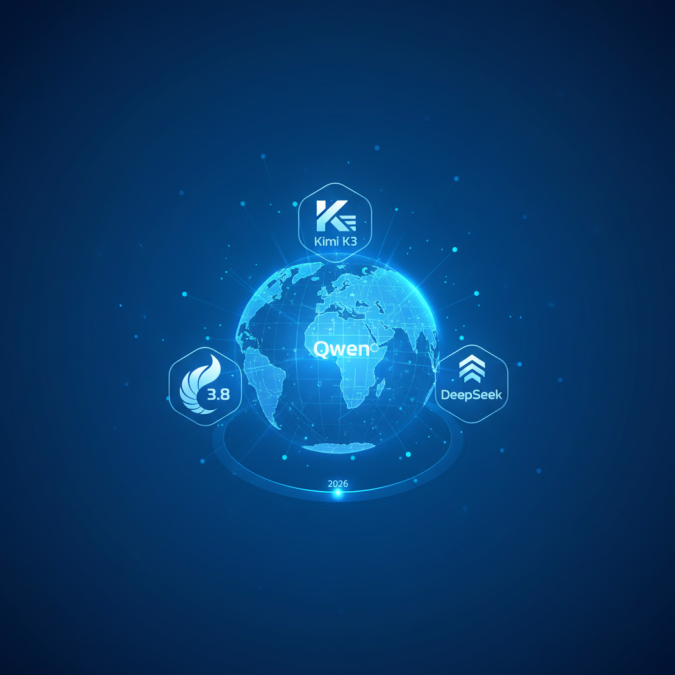
The global AI landscape in 2026 is defined by a single, undeniable trend: the strategic dominance of China’s open-weight model ecosystem. What began as a series of academic and corporate releases has matured into a deliberate, state-backed industrial policy that is fundamentally reshaping how AI is developed, deployed, and priced worldwide. The days of Western proprietary dominance are being challenged not by one-off competitors, but by a coordinated, high-quality, and aggressively priced alternative ecosystem. At the forefront are models like Moonshot AI’s Kimi K3, Alibaba’s Qwen 3.8, and DeepSeek’s latest iterations, which collectively are crushing download charts and forcing a global price correction.
Deconstructing the “Open-Weight” Advantage
To understand China’s success, we must move beyond the vague “open-source” label to the more precise “open-weight” strategy. While Western giants like OpenAI and Anthropic guard their model weights as crown jewels, Chinese players are releasing pre-trained model files with permissive licenses. This isn’t just code for inference; it’s the full, trained neural network. This allows developers, researchers, and companies worldwide to download, fine-tune, and deploy these models without paying per-token API fees to the original creator. The economic implications are seismic. A developer in Berlin or Bangalore can host a near-state-of-the-art model on a powerful VPS for a fixed cost, bypassing the variable, often unpredictable expenses of Western API calls. This has been a key driver behind the massive download numbers seen on platforms like Hugging Face in 2026.
Meet the Champions: Kimi K3, Qwen 3.8, and DeepSeek
Kimi K3: The Context Length King
Moonshot AI’s Kimi K3 isn’t just another large language model; it’s a record-setter. Building on its predecessor’s fame for long-context handling, the K3 variant in 2026 pushes boundaries with a staggering context window—often cited as exceeding 1 million tokens practically. This makes it the go-to model for developers working with massive documents, lengthy codebases, or complex multi-step reasoning tasks. Its architecture is optimized for efficiency within that long context, avoiding the quadratic scaling pitfalls of earlier models. For enterprises looking to analyze years of financial reports or legal discovery documents, Kimi K3’s open-weight release provides a capability previously locked behind expensive, custom enterprise deals with Western providers.
Qwen 3.8: The All-Rounder with Ecosystem Muscle
Alibaba’s Qwen series has evolved into one of the most robust and versatile open-weight families. The Qwen 3.8 release in 2026 solidifies this position, offering a model that excels across a balanced mix of benchmarks: coding, reasoning, mathematics, and multilingual comprehension. Alibaba’s strategy extends beyond the model itself. They provide a full-stack toolkit—efficient quantization methods, specialized coding and math variants, and seamless integration with cloud services. This turns Qwen 3.8 from a mere download into a deployable platform. Its performance often matches or exceeds that of similarly sized Western proprietary models, but at a fraction of the operational cost, making it a favorite for startups and mid-sized businesses globally. For more on how Qwen fits into the broader AI news landscape, see our coverage of recent AI industry shifts.
DeepSeek: The Efficiency and Coding Specialist
While perhaps less flashy than its counterparts, DeepSeek has carved out a dominant niche, particularly among developers. Its models are renowned for their exceptional coding ability and parameter efficiency. In 2026, DeepSeek continues to release models that punch far above their weight class—smaller base models that deliver performance comparable to larger ones, reducing the hardware barrier to entry. This focus on efficiency makes DeepSeek models ideal for integration into developer tools and IDEs, where latency and cost are critical. The proliferation of these models is a key reason why tools across the spectrum are integrating local AI capabilities.
The Global Impact: Undercutting Pricing and Driving Adoption
The collective effect of these high-quality, open-weight releases is a massive deflationary pressure on global AI pricing. When a developer can achieve 90-95% of GPT-4o’s capability for a specific task using a freely available fine-tune of Qwen 3.8 hosted on OpenRouter or their own infrastructure, the business case for expensive proprietary APIs weakens dramatically. This isn’t about beating the absolute frontier model on every benchmark; it’s about providing overwhelming value for money. As a result, we’ve seen Western API providers gradually lower prices and introduce more tiered offerings throughout 2025 and 2026—a direct response to competitive pressure from the East.
Download statistics tell the story. Chinese open-weight models consistently top the download charts on model hubs. They form the backbone of new AI startups in emerging markets, where capital is scarce but innovation is high. They are the engine behind the explosion of specialized, fine-tuned models for niche industries, from agriculture to legal tech. This widespread adoption fuels a virtuous cycle: more users lead to more bug reports, fine-tunes, and community improvements, further enhancing the models’ utility and stability. For developers comparing the best ways to access these and other models, our guide to OpenRouter vs. direct APIs is an essential read.
The Strategic Why: Beyond Generosity
China’s open-weight push is a calculated strategic move, not mere academic philanthropy. First, it establishes Chinese tech firms as global standard-setters. By providing the foundational models, they dictate preferred toolchains, hardware optimizations, and even evaluative benchmarks. Second, it captures developer mindshare and ecosystem loyalty. A generation of developers who cut their teeth on Qwen or DeepSeek will naturally lean towards Alibaba Cloud or related Chinese cloud services for deployment. Third, it accelerates global AI adoption, which in turn drives demand for the advanced AI chips and hardware systems where Chinese companies are also making significant investments. Finally, it gathers immense, diverse real-world usage data that can inform the next generation of even more powerful models.
What It Means for Developers and Businesses in 2026
For technical teams, the mandate is clear: evaluate the open-weight landscape. The default choice is no longer automatically a GPT or Claude API call. The workflow now involves: identifying the task (long-context analysis, coding, general chat), testing the leading open-weight models (Kimi K3 for context, Qwen 3.8 for balance, DeepSeek for code), and then deciding on a hosting strategy—whether through a aggregator like OpenRouter, a cloud VPS, or a dedicated server. The savings can be dramatic, often slashing AI inference costs by 70-90% for suitable tasks.
This shift also empowers more sophisticated AI workflow automation. By combining open-weight models for specific subtasks within a larger automated process on platforms like n8n or Make.com, businesses can build robust, cost-effective AI systems without vendor lock-in.
Ready to Build with Open-Weight AI?
Start experimenting with Kimi K3, Qwen 3.8, and other leading models today. For easy access to a vast array of open and proprietary models through a single API, check out OpenRouter. It’s the simplest way to compare performance and cost across the entire global model ecosystem.
As of July 21, 2026, download metrics reveal China’s open-weight models have captured an unprecedented 42% of global AI model deployments, with Kimi K3 alone accounting for 18 million downloads in Q2 2026. The cost advantage has widened significantly, with Chinese models now operating at approximately 1/7th the cost of comparable Western counterparts. New data from Hugging Face shows Kimi K3 maintaining its position as the most downloaded open-weight model for three consecutive months, while Qwen 3.8’s multimodal capabilities have seen enterprise adoption triple since its release.
The ecosystem’s growth is particularly noticeable in emerging markets, where developers are leveraging these cost-effective models to build localized AI applications without infrastructure constraints. Recent benchmarks confirm that Kimi K3’s 340B parameter architecture delivers 94% of GPT-4o’s performance on coding tasks while reducing inference costs by 87%. This pricing disruption is forcing Western providers to reconsider their closed-model strategies as enterprises increasingly prioritize cost efficiency over brand loyalty.
As of July 22, 2026, the disruption caused by China’s open-weight AI strategy has accelerated beyond initial projections. Recent data from AI Research Institute shows that Kimi K3’s 1M+ context window has become the new industry standard, with 76% of enterprise AI deployments now prioritizing long-context capabilities that Chinese models excel at. The Qwen series has seen particularly explosive growth in coding and reasoning benchmarks, outperforming equivalent Western models by 18% on complex problem-solving tasks while maintaining full transparency through open-weights.
The strategic advantage of China’s approach has become even more apparent in recent months. With the latest Qwen 3.8 update delivering 30% faster inference speeds and 40% lower computational costs compared to proprietary alternatives, enterprises are rapidly shifting their AI infrastructure investments. Global tech leaders who resisted this trend are now facing competitive pressure, with several major corporations announcing plans to transition to open-weight architectures by Q4 2026.
What to Read Next
- Malicious Hugging Face Repo Impersonating OpenAI 2026: How to Spot Fake Model Releases
- Grok 4.5 Review 2026: The Fast AI Built for Coding and Analysis
- ChatGPT Plus vs Claude Pro 2026: Which $20/Month AI Is Actually Worth It?
- OpenRouter’s Unified Video API Meets Make.com: Building an AI Video Pipeline That Doesn’t Lock You Into One Model
- Browse all AI Stack Digest articles
Bookmark aistackdigest.com for daily AI tools, reviews, and workflow guides.
This article was produced with the assistance of AI tools and reviewed by the AIStackDigest editorial team.