
As we move deeper into 2026, the AI landscape is more vibrant and complex than ever. With the release of powerful new models like OpenAI’s GPT-4o, developers and businesses are faced with a crucial infrastructure decision: should you access these models directly through the official OpenAI API, or use a unified gateway like OpenRouter? This choice impacts everything from your project’s cost and flexibility to its security and scalability. This comprehensive comparison will dissect the key differences between OpenRouter and the OpenAI API for accessing the latest 2026 models, arming you with the information needed to make the right architectural choice.
The Core Difference: Unified Gateway vs. Direct Access
At its heart, the choice between OpenRouter and OpenAI API is a choice between abstraction and specificity. The OpenAI API provides direct, unfiltered access to OpenAI’s own model family, including the newest GPT-4o. It’s the official source, offering first-in-line access to updates and fine-tuned capabilities specifically engineered by OpenAI.
OpenRouter, on the other hand, acts as a universal API layer. It doesn’t host models itself but provides a single, standardized API to access not only GPT-4o but also a vast array of other leading and niche models from providers like Anthropic, Google, Meta, and countless others. This approach is less about getting the pure OpenAI experience and more about maximizing choice and flexibility within a single integration. For teams managing complex AI workflows, this can be a significant advantage.
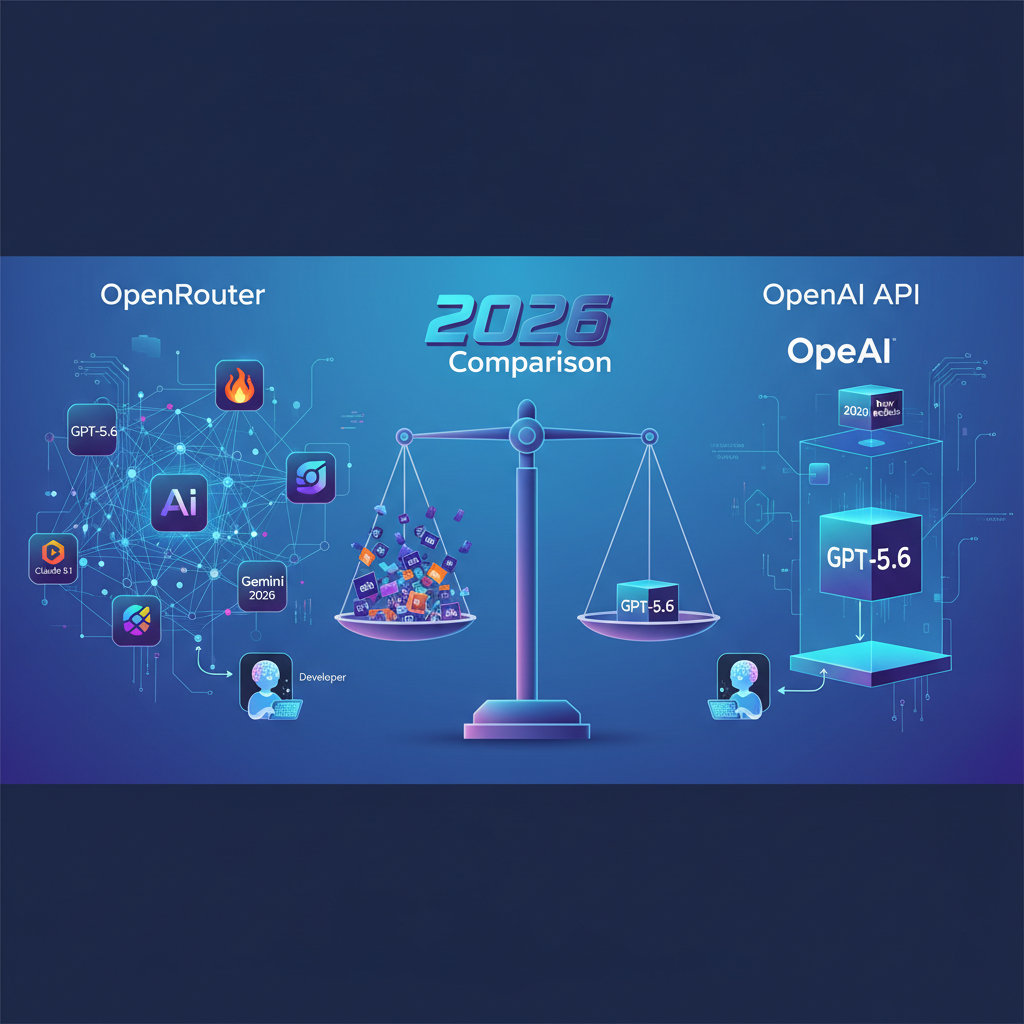
Image: AI-generated
Model Access and Choice: Beyond GPT-4o
If your project’s world begins and ends with OpenAI’s models, the native API is your clear choice. You get immediate access to GPT-4o upon release, along with any specialized variants or fine-tunes that OpenAI develops.
OpenRouter’s primary advantage is its model buffet. Need to compare GPT-4o’s output against Claude Code or another emerging AI coding agent? With OpenRouter, you can do this without rewriting your API integration for each provider. This is invaluable for A/B testing model performance, finding cost-effective alternatives for specific tasks, or building resilient applications that can fail over to another model if your primary choice is rate-limited or experiences downtime.
Image: AI-generated
Pricing and Cost Structure: Predictability vs. Dynamic Markets
OpenAI’s pricing is straightforward. You pay the rate card price per input/output token for the model you select. For GPT-4o, this is a fixed, known cost, which simplifies budgeting and cost forecasting for finance departments.
OpenRouter introduces a more dynamic, almost market-driven approach. Each model on its platform has its own price, and OpenRouter adds a small margin on top. Crucially, many models on OpenRouter, including some that are competitive with OpenAI’s offerings, can be significantly cheaper. This is because OpenRouter aggregates supply from various sources, creating competition. For high-volume users, this can lead to substantial savings. However, it requires more active management to ensure you’re always using the most cost-effective model for a given task.
Ease of Integration and Development Experience
Both platforms offer well-documented RESTful APIs with SDKs available for popular programming languages. The integration difficulty is low for both.
The OpenAI API offers a pristine, purpose-built experience for its models. You know exactly what features and parameters are available for GPT-4o. OpenRouter, by standardizing across many models, sometimes has to abstract away model-specific features or parameters to maintain consistency. For power users who want to leverage every unique capability of GPT-4o, the direct API may provide more granular control.
For developers looking to build sophisticated agentic systems, pairing OpenRouter with a powerful automation platform like n8n can create incredibly robust AI workflow orchestrations that can dynamically select the best model for each subtask.
Security, Compliance, and Data Privacy
This is often the deciding factor for enterprise clients. Using the OpenAI API means your data is handled according to OpenAI’s data usage policy. It’s a known entity, and for many, that provides a sense of security.
OpenRouter operates under a strict zero-logging policy for model inputs and outputs, which is a significant privacy advantage. However, you are introducing a third party (OpenRouter) between you and the model provider (OpenAI). This requires thorough vetting to ensure it complies with your industry’s regulatory requirements. For applications handling highly sensitive data, the simplicity and directness of the OpenAI API can be more appealing from a compliance perspective.
Latency and Reliability: The Performance Factor
In an ideal world, accessing GPT-4o through OpenRouter would add negligible latency. In practice, the request must first route to OpenRouter’s servers, which then forward it to OpenAI. This can add milliseconds of overhead. For most applications, this is irrelevant. For ultra-low-latency use cases, like real-time conversational AI, every millisecond counts, making the direct OpenAI API the performance winner.
Regarding reliability, OpenAI’s API has matured significantly and boasts strong uptime. OpenRouter can ironically provide a different kind of reliability: if OpenAI’s API has an outage, you could quickly reconfigure your OpenRouter integration to use a comparable model from another provider like Anthropic or Google, minimizing downtime.
Who Should Choose Which? A 2026 Decision Guide
Choose the Native OpenAI API if:
– Your application is exclusively built around the OpenAI ecosystem.
– You require the absolute lowest latency and direct access to all model-specific features.
– Enterprise compliance requires a direct relationship with the model provider.
– You prefer simple, predictable pricing and don’t want to manage multiple model options.
Choose OpenRouter if:
– You are a cost-conscious developer or startup looking for the best price-to-performance ratio.
– Your application benefits from model flexibility, A/B testing, and fallback options.
– You are building a product that allows users to choose their own model backend.
– You value a unified API standard to avoid vendor lock-in and simplify your codebase.
– Data privacy via a zero-log policy is a top priority.
Conclusion: A Matter of Philosophy and Workflow
The debate between OpenRouter and the OpenAI API isn’t about which is objectively better; it’s about which is better for your specific needs in 2026. The OpenAI API offers a premium, direct-line experience to the most advanced models on the planet. OpenRouter offers a pragmatic, flexible, and often more economical gateway to the entire world of generative AI.
For many, the ideal approach might be a hybrid one. Use the OpenAI API for core features that heavily rely on GPT-4o’s unique strengths, while leveraging OpenRouter for experimental features, cost-sensitive background tasks, or to provide model choice within your application. This strategy combines the best of both worlds: cutting-edge performance and strategic flexibility.
Ready to Build with the Best Models of 2026?
Start integrating today with the platform that fits your vision:
Explore OpenRouter – Unlock a universe of models with a single API key.
Or, build your orchestration with n8n to create powerful, multi-model AI workflows.
In 2026, AI orchestration has become the critical differentiator for developers building complex multimodal applications. While OpenAI API provides direct access to GPT-4o, OpenRouter’s unified interface enables seamless orchestration across multiple frontier models including Anthropic’s Claude 4, Google’s Gemini Ultra, and specialized coding agents. This multimodal orchestration capability reduces vendor lock-in and allows developers to dynamically route requests based on cost, latency, and task specificity.
Enterprise teams are increasingly adopting AI orchestration platforms to manage complex workflow pipelines that combine vision models, coding assistants, and data analysis tools. The 2026 developer stack requires robust orchestration layers that handle authentication, rate limiting, and fallback strategies across multiple AI providers. This approach not only optimizes costs but also ensures business continuity during API outages or model updates.
What to Read Next
- China’s Open-Weight AI Strategy in 2026: Why Kimi K3, Qwen 3.8, and DeepSeek Are Winning Globally
- Top 5 Free AI Tools in 2026 (No Credit Card, No Catch)
- Is Claude Pro Worth It in 2026? Honest Review After 3 Months
- Is Claude Pro Worth It in 2026? Honest Review After 3 Months
- Browse all AI Stack Digest articles
Bookmark aistackdigest.com for daily AI tools, reviews, and workflow guides.
This article was produced with the assistance of AI tools and reviewed by the AIStackDigest editorial team.