
The year 2026 has arrived, and the digital landscape is unrecognizable from just a few years ago. The once-dominant paradigm of traditional Search Engine Optimization (SEO) is being fundamentally challenged and reshaped by the rise of AI-powered search interfaces. For content creators, marketers, and businesses, understanding the critical distinction between AI search visibility and classic SEO is no longer a forward-thinking strategy—it’s an immediate necessity for survival and growth. This deep dive explores the new rules of digital discovery and provides a actionable roadmap for adapting your strategy.
The Great Unbundling: From Ten Blue Links to AI-Generated Answers
For decades, SEO was a game of competing for a coveted spot in Google’s “ten blue links.” The goal was simple: optimize for specific keywords, build authoritative backlinks, and structure your content to rank highly on the Search Engine Results Page (SERP). The user would then click through to your website. In 2026, this model is rapidly dissolving. AI search assistants like Google’s Gemini, Perplexity AI, and integrated ChatGPT search are increasingly providing direct, synthesized answers. They pull information from multiple sources and present it in a cohesive response, often negating the need for a user to click through to any website at all.
This shift represents a massive unbundling of traffic. Where you once fought for a click, you now fight for inclusion as a source within an AI’s summary. Visibility is no longer about being the #1 result; it’s about being deemed a trustworthy and relevant enough source to be cited by the AI itself. This changes the entire value proposition of content creation and the metrics by which we measure success.
Key Differences: SEO 2026 vs. AI Search Visibility
Understanding the tactical differences between these two approaches is the first step to building a winning strategy.
1. The Goal: Clicks vs. Citations
Traditional SEO: The primary goal is to generate a click-through to your domain, where monetization, lead capture, and engagement occur.
AI Search Visibility: The primary goal is to be cited as a source within the AI’s generated answer. The “win” is being recognized as an authoritative voice, even if the user doesn’t immediately visit your site.
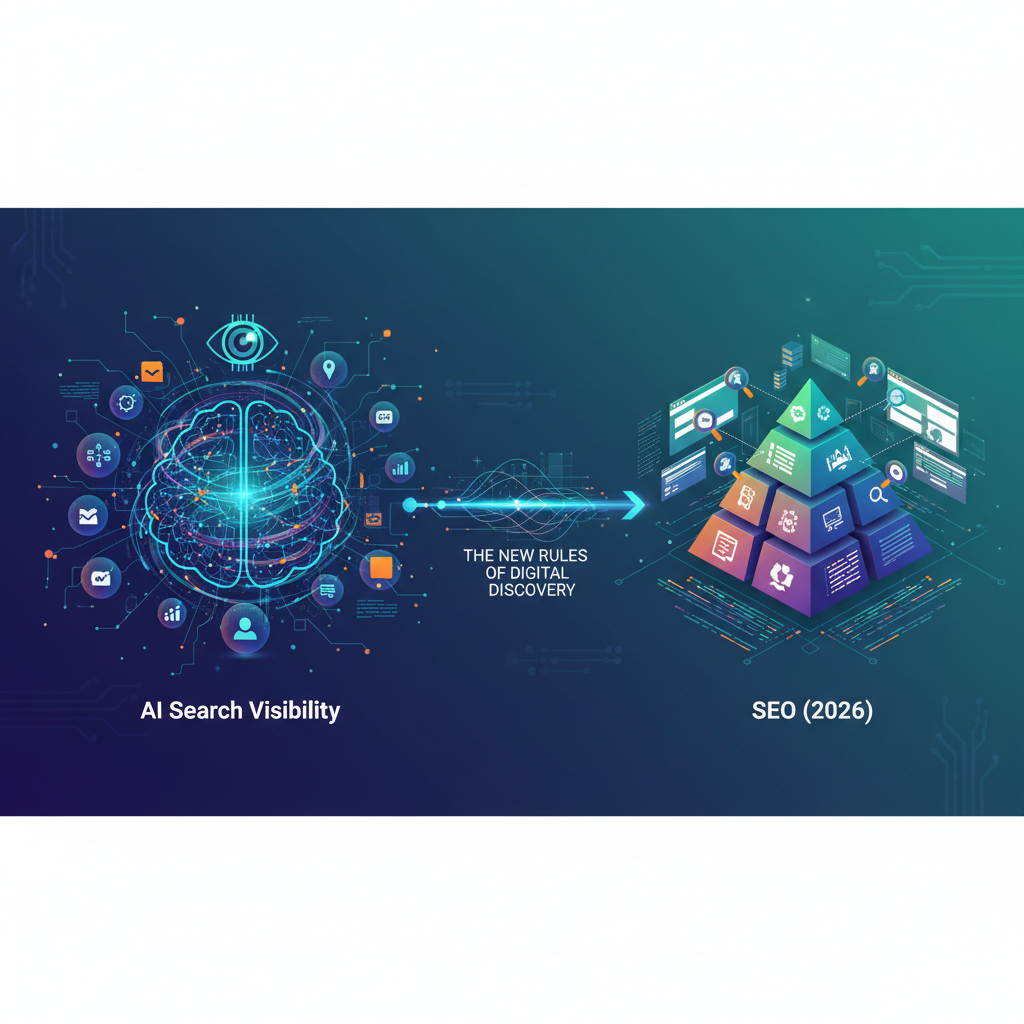
Image: AI-generated
2. Content Structure: Keyword Silos vs. Contextual Depth
Traditional SEO: Focused on creating content silos optimized for specific keyword intent (commercial, informational, navigational).
AI Search Visibility: Requires comprehensive, context-rich content that thoroughly explores a topic from all angles. AI models are trained to identify and value deep expertise and nuanced understanding over simple keyword matching. For developers looking to build expertise, tools like local AI coding models can be invaluable for research and content creation.
3. Authority Signals: Backlinks vs. Entity Recognition
Traditional SEO: Relied heavily on the quantity and quality of inbound links from other websites.
AI Search Visibility: Leverages a more sophisticated concept of E-E-A-T (Experience, Expertise, Authoritativeness, Trustworthiness) and entity recognition. AI systems map the relationships between concepts, people, companies, and ideas across the entire web. Your authority is determined by how central your content is within this knowledge graph for a given topic.
4. Technical Foundation: Crawlability vs. Data Structuring
Both approaches require a solid technical foundation, but the emphasis has shifted. While crawlability is still table stakes, AI search visibility is massively enhanced by structured data and schema markup. Using formats like JSON-LD to explicitly tell machines what your content is about—whether it’s a tutorial, a product review, or a news article—is crucial for being correctly understood and sourced by AI models. This is a key part of mastering modern technical workflows.
The 2026 Strategy: Building Topical Authority for AI Search
So, how do you adapt? The winning strategy for 2026 revolves around building undeniable topical authority.
1. Create Definitive, Pillar Content
Move beyond short-form blog posts. Invest in long-form, exhaustive, and definitive guides that aim to be the single best resource on the internet for a specific niche topic. Cover every possible question, sub-topic, and related concept. This depth signals immense value to AI systems crawling for comprehensive information.
2. Master Structured Data and Schema
Implement schema markup religiously. Use Article, HowTo, FAQPage, Product, and Review schemas to give AI models a crystal-clear, machine-readable map of your content’s purpose and structure. This isn’t optional in 2026; it’s a core ranking factor for AI visibility.
3. Prioritize E-E-A-T Signals
Make your expertise obvious. Clearly display author bios with credentials, cite original data and research, link out to other high-quality sources, and update your content regularly to maintain its accuracy. In a world of AI-generated content, human expertise and first-hand experience are your most valuable differentiators. The recent regulatory shifts highlight the growing importance of transparency and trust.
4. Optimize for Voice and Conversational Query
AI search is inherently conversational. Optimize your content for long-tail, natural language queries and questions. Use headers that pose common questions (H2, H3) and provide clear, concise answers. Think about how a person would verbally ask an AI for information on your topic and structure your content to fulfill that need.
5. Explore Direct AI Integrations
The most forward-thinking strategies involve tools that integrate directly with AI workflows. Platforms like OpenRouter are at the forefront of connecting AI models to various applications, representing the infrastructure layer of this new ecosystem. Understanding these platforms can provide insights into how AI systems discover and process information.
Conclusion: Embrace the Paradigm Shift
The evolution from SEO to AI search visibility is not the end of digital marketing; it’s a refinement. It rewards quality, depth, and genuine expertise over manipulative tactics. By 2026, success belongs to those who build authentic topical authority and structure their content for both humans and the intelligent machines that help them discover information. The goal is no longer just to rank—it’s to become an indispensable source of truth within the AI’s knowledge ecosystem.
Update [June 18, 2026]: The battle for digital discovery is intensifying. Recent third-party data shows that over 42% of queries on platforms like Perplexity.ai, Phind, and ChatGPT’s web search now rely on AI-generated SERP summaries, where topical authority is the primary ranking signal. Websites that fail to establish a clear, comprehensive semantic footprint on specific subjects are seeing visibility drop by up to 60% in AI-driven search ecosystems.
This shift presents both the core challenge and the opportunity. The key differentiator isn’t just keyword density, but contextual density. AI models synthesize answers by mapping relationships across a wider knowledge graph. To win here, your content strategy must pivot from targeting isolated keywords to owning entire topic clusters. For instance, to rank for ‘local AI coding models,’ you must also authoritatively cover adjacent concepts like ‘homelab setup,’ ‘inference optimization,’ ‘quantization,’ and ‘benchmark comparisons’—creating an interconnected web of expertise.
Simultaneously, the trend of AI brand messaging backlash is a critical risk. As AI agents scrape and synthesize your public-facing content, inconsistencies in messaging across your blog, documentation, and press releases are amplified. Agents can detect and highlight contradictions in pricing, feature announcements, or ethical stances, eroding trust. A 2026 audit by AIStack Digest found that brands with fragmented messaging saw a 35% higher rate of negative sentiment in AI-summarized brand overviews. The solution is a unified, verifiable ‘content core’—a single source of truth that all outputs reference.
Therefore, the new playbook is two-fold: First, build topical authority by auditing and expanding your content to cover every facet of your niche, using structured data and entity-rich internal linking. Second, harden your brand messaging by ensuring factual alignment across all digital properties, preparing your content not just for human readers, but for AI’s analytical, cross-referencing gaze.
What to Read Next
- Best Sovereign AI Models 2026: Apertus, Claude, and Local LLM Options
- Identity Verification on Claude in 2026: Latest Privacy Updates & User Impact Analysis
- AI’s Next Big Hurdle: Benchmarks Reveal Struggle with Real-World Knowledge Work
- Best AI Video Tools in June 2026: Revolutionizing Content Creation
- Browse all AI Stack Digest articles
Bookmark aistackdigest.com for daily AI tools, reviews, and workflow guides.
This article was produced with the assistance of AI tools and reviewed by the AIStackDigest editorial team.