
Senior AI Journalist
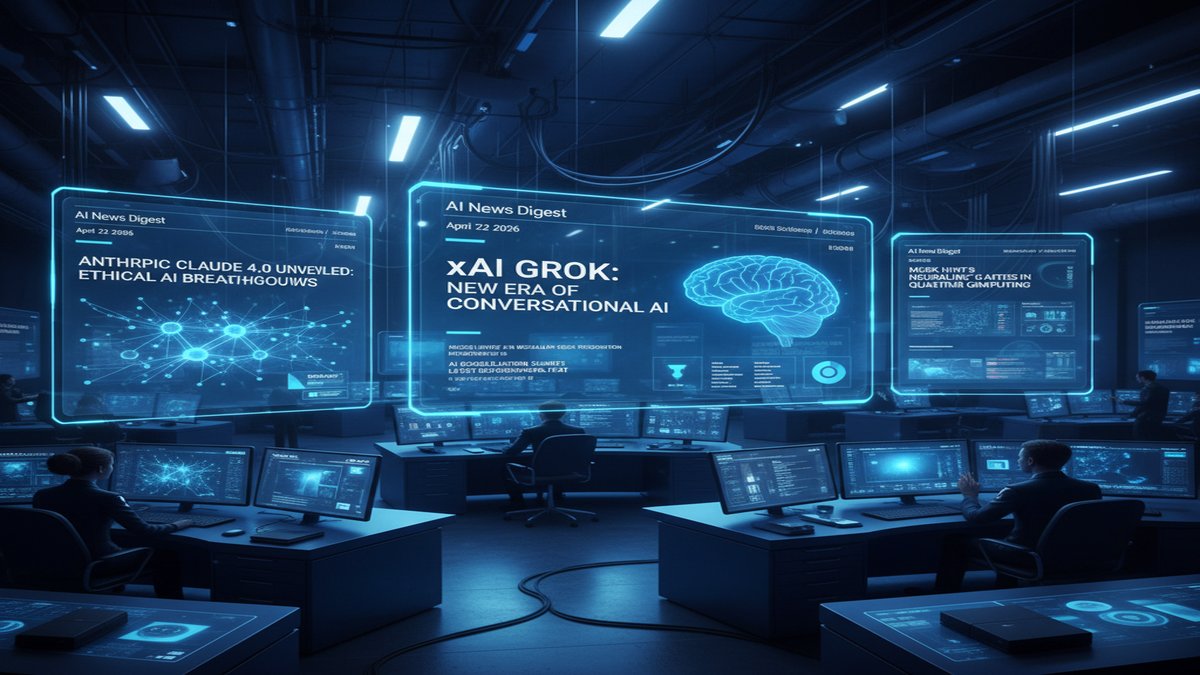
Today’s AI headlines are dominated by aggressive moves from key players: xAI announced its ambitious Grok 2.5, targeting multimodal superiority, while Anthropic made strides in democratizing access to its advanced Claude models. Concurrently, Apple signalled a significant acceleration in its on-device AI integration across its ecosystem.
xAI Unveils Ambitious Plans for Grok 2.5: Targeting Multimodal Superiority
Elon Musk’s xAI today outlined its audacious roadmap for Grok 2.5, declaring an intent to achieve multimodal superiority in the competitive large language model arena. While Grok 2.0 has recently made headlines for its enhanced reasoning capabilities and real-time information access, Grok 2.5 aims to integrate sophisticated understanding across text, images, audio, and video in an unprecedented manner.
A spokesperson for xAI indicated that Grok 2.5 is being engineered to not only comprehend but also to generate nuanced content across multiple modalities, far exceeding current benchmarks. “Our goal with Grok 2.5 is to create an AI that doesn’t just process information, but truly understands and interacts with the full richness of human communication,” the spokesperson stated. “This means going far beyond simple captioning or transcription, towards integrated reasoning within and across all sensory inputs.”
Key areas of focus for Grok 2.5 include:
-
Advanced Visual Comprehension:
The ability to analyze and interpret complex visual data, from intricate diagrams to subtle emotional cues in video, and integrate this into comprehensive text-based responses.
-
Sophisticated Audio Analysis:
Beyond speech recognition, Grok 2.5 aims for deep understanding of vocal tonality, environmental sounds, and musical structures, enabling richer interactive experiences.
-
Seamless Cross-Modal Generation:
The capability to generate cohesive narratives, code, or creative works that fluidly combine elements from different modalities based on user prompts.
The timeline for Grok 2.5’s full deployment remains aggressive, reflecting xAI’s rapid development philosophy. The announcement has sent ripples through the AI community, setting a new bar for multimodal ambition.
Anthropic Expands Claude Access with New API Tiers and Educational Initiatives
Following the positive feedback from its Claude 3.5 Opus early access program, Anthropic today announced significant expansions to its Claude model access. The company is rolling out new API tiers designed to cater to a broader range of users, from independent developers and startups to large enterprises, making its powerful conversational AI more widely available.
“Our mission is to build safe and beneficial AI, and part of that is ensuring robust access to our models for those who can contribute to their responsible development and deployment,” said Daniela Amodei, President of Anthropic. “The new API tiers, coupled with our educational initiatives, will help foster a larger community of developers working with Claude.”
Highlights of Anthropic’s expanded access include:
-
Tiered API Pricing:
New pricing structures designed to make Claude accessible for projects of varying scales, offering more flexibility and cost-efficiency.
-
Developer Resources and Documentation:
A substantial update to developer documentation, including more tutorials, code examples, and best practices for integrating Claude into diverse applications.
-
Academic and Research Grants:
Anthropic is launching a new grant program to support academic research into AI safety, ethics, and novel applications, providing researchers with subsidized access to Claude models.
This strategic move is expected to broaden Claude’s adoption and accelerate its integration into a wider array of applications, from customer service bots to advanced research assistants.
Apple Intensifies On-Device AI Push Across Ecosystem
Apple today reiterated its unwavering commitment to on-device AI, with several patent filings and internal reports surfacing that suggest a significant intensification of its efforts across its entire product ecosystem. The move underscores Apple’s long-standing philosophy of prioritizing user privacy and data security by performing as many AI computations as possible directly on the device, reducing reliance on cloud-based processing.
While no specific product announcements were made, the reports detail advancements in:
-
Neural Engine Capabilities:
Future iterations of Apple’s custom silicon are expected to feature significantly more powerful Neural Engine cores, capable of running larger and more complex AI models locally.
-
Personalized AI Assistants:
Improvements to Siri and other built-in AI features, moving towards more context-aware, proactive, and deeply personalized assistance that learns from individual user behaviour without sending sensitive data to the cloud.
-
Enhanced Privacy-Preserving Machine Learning:
Continued development in techniques like federated learning and differential privacy, enabling AI models to be trained and improved using decentralized data while safeguarding user anonymity.
Apple’s consistent focus on on-device AI is viewed as a strategic differentiator in an increasingly AI-driven world, appealing to users concerned about data ownership and privacy.
Google DeepMind Previews Next-Gen Robotics Foundation Model
In a forward-looking presentation during an internal summit, Google DeepMind researchers offered a tantalizing preview of their upcoming next-generation robotics foundation model. Still in its early stages, the model aims to achieve unprecedented generalization in robotic control, allowing single models to learn diverse tasks across a wide variety of robot morphologies and environments. This ambitious project could significantly accelerate the deployment of intelligent robots in unstructured real-world settings, a perennial challenge in robotics research.
This article was produced with the assistance of AI tools and reviewed by the AIStackDigest editorial team.