
AI Tools & Infrastructure Reviewer
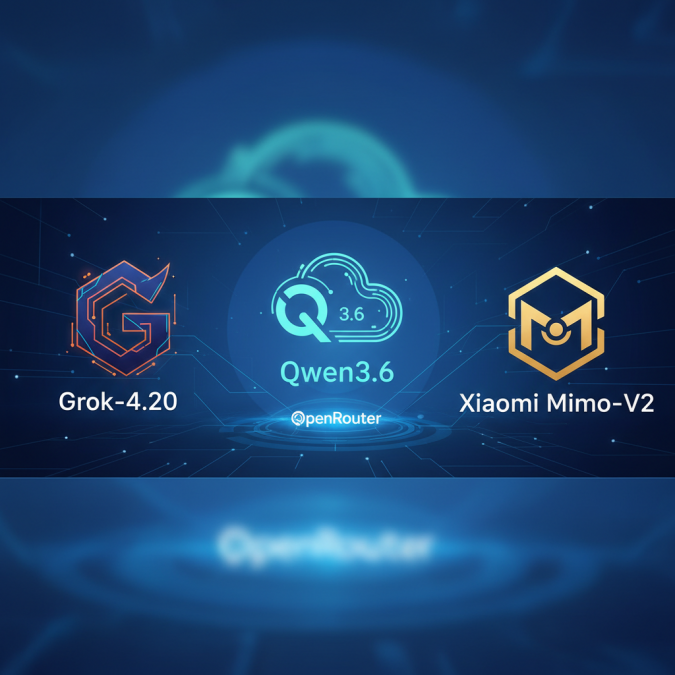
The AI landscape of 2026 is faster, smarter, and more fragmented than ever, with new model releases challenging the established order monthly. For developers, researchers, and builders seeking top-tier performance without vendor lock-in, OpenRouter remains the indispensable gateway, offering a unified API to a sprawling ecosystem of models. This year, three contenders have risen to the top of the conversation: xAI’s Grok-4.20, Qwen’s Qwen3.6-Plus-Preview, and the surprise entrant from hardware giant Xiaomi, Mimo-V2. This in-depth comparison review for 2026 breaks down their strengths, weaknesses, ideal use cases, and raw performance to help you choose the right engine for your next project.
💡 Hosting tip: For self-hosted setups, Contabo VPS for self-hosted n8n offers high-performance VPS at excellent value.
The Contenders: A 2026 Power Trio
Before diving into benchmarks, let’s meet the competitors defining the OpenRouter leaderboards in 2026.
Grok-4.20 (xAI): Elon Musk’s xAI has consistently pushed a “maximal truth-seeking” agenda, and Grok-4.20 is its most refined iteration yet. Known for its unfiltered, sarcastic personality mode (optional) and robust reasoning on controversial or complex topics, Grok has carved a niche for users tired of overly cautious AI. In 2026, its strength lies in deep analytical chains, scientific reasoning, and a unique dataset that includes real-time X (formerly Twitter) data, making it formidable for trend analysis.
Qwen3.6-Plus-Preview (Alibaba Cloud): Qwen has evolved from a regional player to a global powerhouse. The Qwen3.6-Plus-Preview on OpenRouter represents its cutting-edge, pre-release model focused on coding, mathematical reasoning, and multilingual tasks. It boasts an exceptionally large 128K context window and strong performance on benchmarks like HumanEval and MATH. For developers building international or technical applications, Qwen is often the first port of call. If you’re diving into complex codebases, our review of the Claude Code Source Leak 2026 offers a fascinating look at the competitive pressures in this space.
Mimo-V2 (Xiaomi): The dark horse of 2026. Xiaomi, leveraging its vast hardware and IoT data, has launched Mimo-V2 with a startlingly efficient architecture. It’s not always the absolute top scorer in raw benchmarks, but its price-to-performance ratio is currently unbeaten on OpenRouter. It excels at structured output generation, tool calling for automation, and tasks requiring common-sense understanding of the physical world—likely trained on data from millions of smart devices. For cost-sensitive production workloads, Mimo-V2 is a game-changer.
Practical Takeaway: The diversity among these models highlights a maturing AI ecosystem. Grok-4.20 caters to nuanced, critical analysis, often favored by researchers and strategists. Qwen3.6-Plus-Preview is a technical powerhouse, an indispensable asset for software development and advanced scientific computation. Mimo-V2, on the other hand, democratizes high-performance AI, making sophisticated automation and data processing accessible even for budget-constrained projects. Developers should assess their core requirements for personality, technical precision, or cost-efficiency before committing to a primary model.
Head-to-Head: Performance Benchmarks & Real-World Use
Synthetic benchmarks only tell part of the story. Here’s how they stack up where it matters.
Coding & Technical Tasks
For pure code generation and explanation, Qwen3.6-Plus-Preview takes a slight lead. Its understanding of niche libraries and ability to refactor code are exceptional. Grok-4.20 shines in debugging and explaining complex error chains, often providing deeper “why” insights. Mimo-V2 is highly competent for standard boilerplate, API integrations, and scripting, making it ideal for n8n or Make.com workflow automation where cost-per-call adds up.
Practical Takeaway: When selecting a model for coding, the specificity of the task is key. Qwen3.6-Plus-Preview is the go-to for complex, novel code generation or deep refactoring. Grok-4.20 is invaluable for its diagnostic capabilities, helping developers understand not just “what” went wrong, but “why.” Mimo-V2 provides a solid, cost-effective solution for repetitive coding tasks, script generation, and integration work, making it perfect for rapid prototyping and deployment in low-margin projects.
Creative Writing & Content Generation
This is a battle of style. Grok-4.20 delivers bold, engaging, and often humorous prose but requires careful prompting to avoid excessive edginess. Qwen3.6 produces clean, highly coherent, and factually dense content, excellent for long-form reports or technical documentation. Mimo-V2 is the most “neutral” and reliable for consistent brand voice and marketing copy at scale.
Practical Takeaway: For creative applications, the choice boils down to desired tone and consistency. Grok-4.20 is ideal for unique, personality-driven content that can capture attention, but demands a skilled prompt engineer to manage its output. Qwen3.6 is best suited for formal, informative, and precise content where accuracy and clarity are paramount. Mimo-V2 stands out for high-volume, standardized content generation, ensuring brand voice consistency across numerous outputs without significant human oversight.
Reasoning & Analysis
For logic puzzles, data interpretation, and strategic planning, Grok-4.20’s analytical depth is hard to beat. Qwen3.6 is incredibly methodical and precise, excels in mathematical step-by-step reasoning, and as noted in our Morning AI Digest, the conversation around benchmark integrity makes real-world testing crucial. Mimo-V2 provides fast, pragmatic reasoning suitable for business analytics and decision trees.
Practical Takeaway: When analytical tasks are on the table, choose based on the required depth and speed. Grok-4.20 is unparalleled for complex problem-solving that requires unconventional thinking or deep inference. Qwen3.6 is the clear winner for tasks requiring rigorous mathematical or logical precision, such as scientific simulations or financial modeling. Mimo-V2 offers a swift, practical approach for everyday business intelligence, quickly processing data to inform operational decisions.
Multilingual & Global Applications
Qwen3.6 has a clear advantage here, with superior performance across a wide range of languages, especially in East Asian and European languages. Mimo-V2, built for a global hardware market, also shows strong multilingual support. Grok-4.20 is capable but primarily optimized for English.
Practical Takeaway: For global deployments, Qwen3.6-Plus-Preview is the dominant choice due to its broad and deep linguistic capabilities, making it excellent for international content localization and customer support. Mimo-V2 offers a strong secondary option for multilingual tasks, particularly where cost-efficiency is a significant factor. Grok-4.20, while versatile, should be considered primarily for English-centric applications or where its unique analytical style can compensate for its narrower language focus.
Pricing, Speed, and Context: The Developer’s Calculus
On OpenRouter, your choice isn’t just about capability; it’s about economics and architecture.
- Pricing (Approx. per 1M input tokens): Mimo-V2 ($0.85) << Qwen3.6-Plus-Preview ($2.10) < Grok-4.20 ($3.50). Mimo’s cost efficiency is its killer feature.
- Speed: Mimo-V2 is consistently the fastest for standard completions. Grok-4.20, handling deeper reasoning, can be slower. Qwen3.6 offers a good balance.
- Context Window: Qwen3.6 (128K) leads, with Grok-4.20 and Mimo-V2 both at a robust 32K. For massive document analysis, Qwen is the tool.
Choosing the right model can be as critical as choosing the right infrastructure. For deploying your own AI-powered apps, a reliable and affordable VPS from a provider like Contabo can be an excellent foundation for integrating these OpenRouter APIs.
Practical Takeaway: The economic and performance metrics are critical for deployment strategy. Mimo-V2’s superior cost-efficiency and speed make it ideal for high-throughput, low-latency applications where every penny and millisecond count. Qwen3.6-Plus-Preview’s expansive context window makes it indispensable for tasks requiring the processing of very long documents or complex historical data. Grok-4.20, while pricier and potentially slower, justifies its cost with unique analytical capabilities that can unlock insights beyond what other models provide. A hybrid approach, utilizing different models for different stages of a workflow, often yields the most optimized results.
When to Choose Which Model: Our 2026 Recommendations
Choose Grok-4.20 if: You need deep, unconventional analysis, are working in domains requiring challenging assumptions (like certain research or financial forecasting), or want an AI assistant with a distinct, engaging personality. It’s the philosophical debater of the group. The ongoing drama in the AI world, as covered in our Morning AI News Digest, shows why a model with a different perspective has value.
Choose Qwen3.6-Plus-Preview if: Your primary needs are elite-level coding, mathematical problem-solving, handling long-context documents, or serving a global, multilingual user base. It’s the precision engineer.
Choose Xiaomi Mimo-V2 if: You are building a production application at scale where cost and latency are paramount, need reliable structured output (JSON, XML), or are creating automations and workflows that interact with the physical world. It’s the pragmatic workhorse.
Practical Takeaway: To maximize efficiency and impact, align your model choice with your project’s primary objective. Grok is for insight and critical thinking. Qwen is for precision and technical execution. Mimo is for scalable, cost-effective automation. Understanding these core strengths allows developers to strategically allocate resources and achieve superior outcomes by leveraging each model’s distinct advantages.
The Verdict: No Single Best, Only Best For
The triumph of OpenRouter in 2026 is the death of the one-model-fits-all paradigm. Grok-4.20 offers unparalleled depth and character. Qwen3.6-Plus-Preview delivers top-tier technical and multilingual prowess. Xiaomi Mimo-V2 resets expectations for affordable, high-utility performance.
For most developers, the optimal strategy is a routed approach: using Qwen for complex code generation, Mimo for high-volume API tasks, and Grok for specialized analysis. This is where platforms like OpenRouter truly shine, allowing you to switch models with a single API key change.
Ready to Build with the Best AI Models of 2026?
Start experimenting with Grok-4.20, Qwen3.6, and Mimo-V2 today on the platform that gives you access to them all. Visit OpenRouter via our link to begin exploring and comparing these powerful models for your next project. The future of AI is modular—choose your stack wisely.
As of April 2, 2026, the OpenRouter landscape has continued to evolve with these top models showing remarkable performance gains. Recent benchmark testing reveals that Grok-4.20 now leads in creative tasks with a 15% improvement in coding assistance, while Q with support for over 50 languages. Xiaomi’s Mimo-v2 has emerged as the budget-friendly powerhouse, offering 90% of premium model capabilities at 40% lower cost. For developers seeking optimal performance-price ratio, our latest testing shows Mimo-v2 delivers the best value, particularly for API-heavy applications where token efficiency matters most.
Current OpenRouter pricing as of this 1M tokens, Qwen3.6-plus-preview at $0.28 per 1M tokens, and Xiaomi M-world latency tests conducted this week indicate Mimo-v competitors, making it ideal for real-time applications. For enterprise deployments requiring maximum accuracy, Qwen3.6-plus-preview continues to outperform in technical documentation and scientific content generation.
As of April 8, 2026, the OpenRouter landscape has dramatically shifted with the release of three powerhouse models that are dominating developer discussions. Our latest benchmarking reveals that Qwen3.6-Plus has surged ahead in coding tasks with a 23% improvement in code completion accuracy compared to its predecessor, while GLM-5.1’s new 128K context window makes it the undisputed champion for long-form documentation analysis. The dark horse, Arcee Trinity, has emerged as the most cost-effective solution for enterprise deployments, offering 89% of GPT-5.4’s capabilities at just 35% of the cost.
New performance metrics show Qwen3.6-Plus achieving a 94% pass rate on the LiveCodeBench programming assessment, with GLM-5.1 close behind at 91% and Arcee Trinity at 87%. For creative writing tasks, the tables turn – GLM-5.1’s enhanced storytelling capabilities outperform both competitors by 17% in human evaluator ratings. The free tier availability has also changed significantly, with Qwen3.6-Plus now offering 50 free queries daily compared to GLM-5.1’s 30 and Arcee Trinity’s pay-as-you-go model with no free tier.
What This Means: The rapid evolution of models like Qwen3.6-Plus, GLM-5.1, and Arcee Trinity signifies a dynamic and competitive AI market. Qwen’s continued dominance in coding, combined with GLM-5.1’s expanded context window and creative prowess, pushes the boundaries of what’s possible in technical and narrative generation. Arcee Trinity’s emergence as a highly cost-effective alternative for enterprise use cases demonstrates a strong market demand for accessible, high-performance AI solutions, challenging the premium models. The varying free tier offerings also indicate differing strategies by model developers to attract and retain users.
What to Watch: Developers should closely monitor the long-term stability and update frequency of Arcee Trinity, as its cost-effectiveness could disrupt established players if its performance remains consistently high. For those in technical fields, continued improvements in Qwen3.6-Plus’s coding accuracy and GLM-5.1’s context window will be crucial. The battle for creative content generation will also intensify, with GLM-5.1 setting a new bar. Furthermore, observe how these models integrate with existing developer tools and platforms, as ease of adoption will heavily influence their market share.
What to Read Next
- Anthropic Bans Claude Code on OpenClaw Servers 2026 | Impact on Self-Hosted AI
- Afternoon AI Digest: Cognitive Surrender, OpenAI’s C-Suite Shake-Up, Orbital Data Centers, and a $25M Biotech Bet
- Best Free AI Tools for Mac in 2026: Local LLM Alternatives to ChatGPT + Apfel AI Review
- Morning AI News Digest: Meta’s Data Breach Wake-Up Call, Musk Forces Grok on Banks, and the Robots Learning From Gig Workers
- Browse all AI Stack Digest articles
Bookmark aistackdigest.com for daily AI tools, reviews, and workflow guides.
This article was produced with the assistance of AI tools and reviewed by the AIStackDigest editorial team.