

💡 Hosting tip: For self-hosted setups, Contabo VPS for self-hosted n8n offers high-performance VPS at excellent value.
Afternoon AI News Digest — Monday, March 30, 2026
- Theaters now — A new AI documentary puts Sam Altman, Dario Amodei, and Demis Hassabis on camera — and gets mixed reviews for pulling punches
- $0 — What Axiom Math’s Axplorer costs mathematicians to use, as DARPA-backed AI math tools go mainstream
- 100% — The strategic pivot underway at SES AI, which is abandoning Western battery manufacturing entirely in favor of AI-driven materials discovery
Good afternoon. This Monday’s digest ventures beyond the usual model releases and funding rounds to examine AI’s growing footprint in culture, mathematics, and industrial strategy. A new documentary wrestles with how we should feel about AI — and whether it’s possible to ask hard questions of the people building it. A startup is handing mathematicians a free AI tool powerful enough to crack century-old graph theory problems. And a battery company that survived MIT, Detroit, and Silicon Valley is now betting its future not on cells and electrolytes, but on AI-powered materials science. Let’s get into it.
These are three stories that rarely land in the same conversation — film criticism, pure mathematics, and industrial chemistry — yet they each illuminate something important about the moment we’re in: AI is no longer just a technology story. It’s a culture story, a science story, and an economics story all at once.

Image: AI-generated
1. The AI Documentary That Got the Interviews — But Missed the Moment
Filmmaker Adam Bhala Lough had one of the most enviable rolodexes in documentary filmmaking this year: access to Sam Altman (OpenAI), Dario Amodei (Anthropic), and Demis Hassabis (Google DeepMind). The result, The AI Doc: Or How I Became an Apocaloptimist, opened in theaters on March 27 — and WIRED’s review argues it squanders that access. According to critic Miles Klee, the film “ends up letting tech execs like Sam Altman off the hook” in its search for a reassuring middle ground between AI utopia and existential catastrophe.
The film’s title is telling: “apocaloptimist” is a neologism for someone who believes things could go very wrong but remains hopeful anyway. It’s a philosophically interesting position, but Klee suggests the documentary flattens it into something closer to corporate PR. The interviews are revealing in small ways — Altman discussing his therapy, Amodei’s careful parsing of risk — but the film never pushes into the harder questions about accountability, deployment decisions, or the gap between what AI labs say publicly and what their internal safety teams believe.
The contrast with an earlier Lough project is illuminating. For a different film, unable to secure an Altman interview, Lough commissioned a deepfake of the OpenAI CEO instead — a genuinely provocative choice that interrogated AI itself as a medium. That version of Lough seems to have been left behind. The AI Doc is more HBO profile than investigative documentary.
Why it matters: How culture processes AI will shape public policy as much as any congressional hearing. If the dominant artistic narrative about AI is one of soft-focus ambivalence — where the people building it are sympathetic, complicated geniuses rather than executives making consequential choices — it becomes harder to build the political will for meaningful regulation. Good AI journalism and good AI filmmaking ask the same question: who is accountable, and for what? This film, despite its access, doesn’t push hard enough on either.
📎 Read the full WIRED review: The Latest AI Documentary Asks: Just How Scared Should We Be?
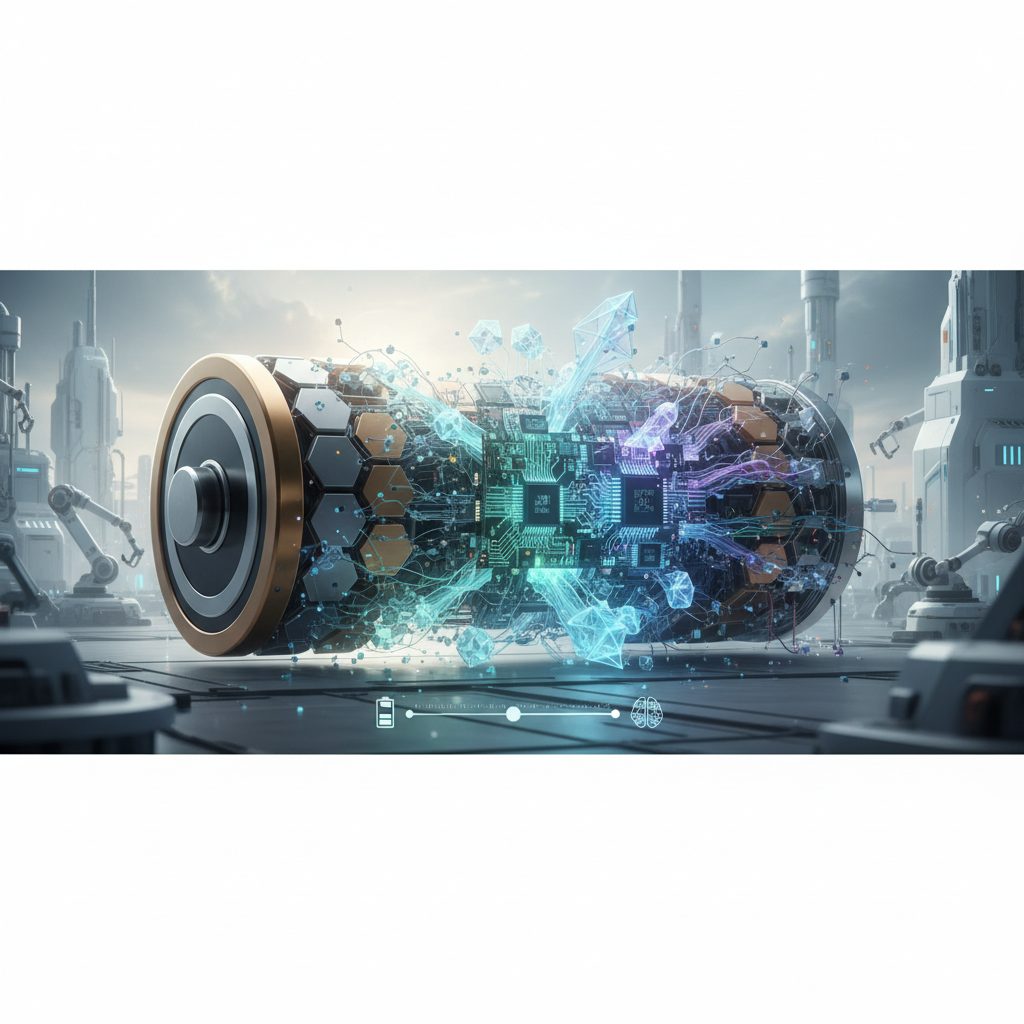
Image: AI-generated
2. From Batteries to Bits: Why SES AI Is Abandoning Western Manufacturing for AI
SES AI’s story reads like a compressed history of American industrial optimism and its limits. The company began as a MIT spinout called Solid Energy, developing solid-state lithium batteries for oil exploration equipment. By 2021, it had pivoted to EV batteries, partnered with GM, Hyundai, and Honda, and seemed positioned to ride the electric vehicle wave. Then the wave crashed. EV tax credits evaporated under the Trump administration in late 2025. Chinese battery manufacturers, backed by massive state subsidies, undercut Western competitors on price. The market that SES AI had built itself for simply ceased to exist on favorable terms.
CEO Qichao Hu’s diagnosis is blunt: “Almost every Western battery company has either died or is going to die. It’s kind of the reality.” Rather than fight a structural battle on unfavorable terrain, SES AI is now going all-in on something different: AI-powered battery materials discovery. The company’s platform uses machine learning to identify novel material combinations that could make batteries cheaper, more energy-dense, or easier to manufacture — and then licenses those discoveries to other companies, including the Chinese manufacturers that just outcompeted them on cells. It’s a pivot from maker to knowledge broker.
The strategic logic is sharp. Physical manufacturing at scale requires either cheap labor, cheap capital, or government subsidy — and Western companies increasingly lack all three for battery production. But IP-based businesses — software, algorithms, licensed processes — don’t have that geographic handicap. If SES AI can use AI to find materials faster than anyone else, it can sell that advantage to whoever is actually doing the manufacturing. The irony is that the same AI tools that are disrupting knowledge work may also be the only way for some Western industrial companies to survive the next decade of Chinese industrial competition.
Why it matters: SES AI is a canary in the coal mine for a broader question: as China dominates physical manufacturing of clean-energy hardware, can Western companies reinvent themselves as the intelligence layer — the AI-driven research and IP engine — that sits above it? This model has worked in semiconductors (ASML, ARM) and pharmaceuticals (CROs). Whether it translates to battery materials is genuinely unclear, but it’s a template more companies will try. Tools like OpenRouter are making multi-model AI research pipelines more accessible, which could accelerate exactly this kind of materials-science AI work at startups that can’t afford frontier model API contracts at scale.
📎 Read the full MIT Tech Review story: Why this battery company is pivoting to AI
3. Axiom Math Releases Free AI Tool Designed to Find Math No Human Has Thought Of
Most AI math tools do something impressive but ultimately conservative: they take known problems and find solutions. Axiom Math, a Palo Alto startup, is aiming at something harder. Its new free tool, Axplorer, is designed not to solve existing math problems but to discover entirely new patterns — the kind of structural insight that could, in theory, unlock approaches to problems that have resisted human mathematicians for decades or centuries.
Axplorer is a more accessible version of PatternBoost, a tool developed by François Charton (now a research scientist at Axiom) when he was at Meta. PatternBoost previously ran on a supercomputer; Axplorer runs on a Mac Pro. That’s a meaningful leap. PatternBoost was used to crack the Turán four-cycles problem, an important puzzle in graph theory that asks how to draw lines between as many points as possible without creating four-dot loops. Axiom says it has already used Axplorer to match or improve on best-known results for two additional major graph theory problems.
Charton is pointedly skeptical of LLM-based math — tools like GPT-5 that solve problems by pattern-matching against training data. “There are tons of problems that are open because nobody looked at them, and it’s easy to find a few gems you can solve,” he says. His focus is on the hard cases: problems that are famous precisely because brilliant people have hammered on them without success. For those, finding a solution requires a genuinely new idea — something LLMs, which are derivative by design, struggle to produce. Axplorer is built differently, focusing on pattern detection rather than answer generation.
The project is partly downstream of a DARPA initiative called expMath (Exponentiating Mathematics), launched in 2025, which explicitly funds the development and adoption of AI tools in professional mathematics. That government backing is a signal: the US defense establishment sees advanced math — which underlies cryptography, AI architecture, and network analysis — as a strategic frontier worth accelerating with AI tooling.
Why it matters: Mathematics is infrastructure. New math leads to new cryptographic protocols, new neural network architectures, and new algorithms for everything from logistics to drug design. If AI tools can genuinely accelerate mathematical discovery — not just solution-finding but pattern recognition in unexplored territory — the compounding effects would be enormous. Making those tools free and accessible (Axplorer is available at axiommath.ai at no cost) is a smart way to build community and gather feedback on which patterns prove fruitful. It’s also a bet that open access generates more mathematical progress than a walled-garden commercial product would.
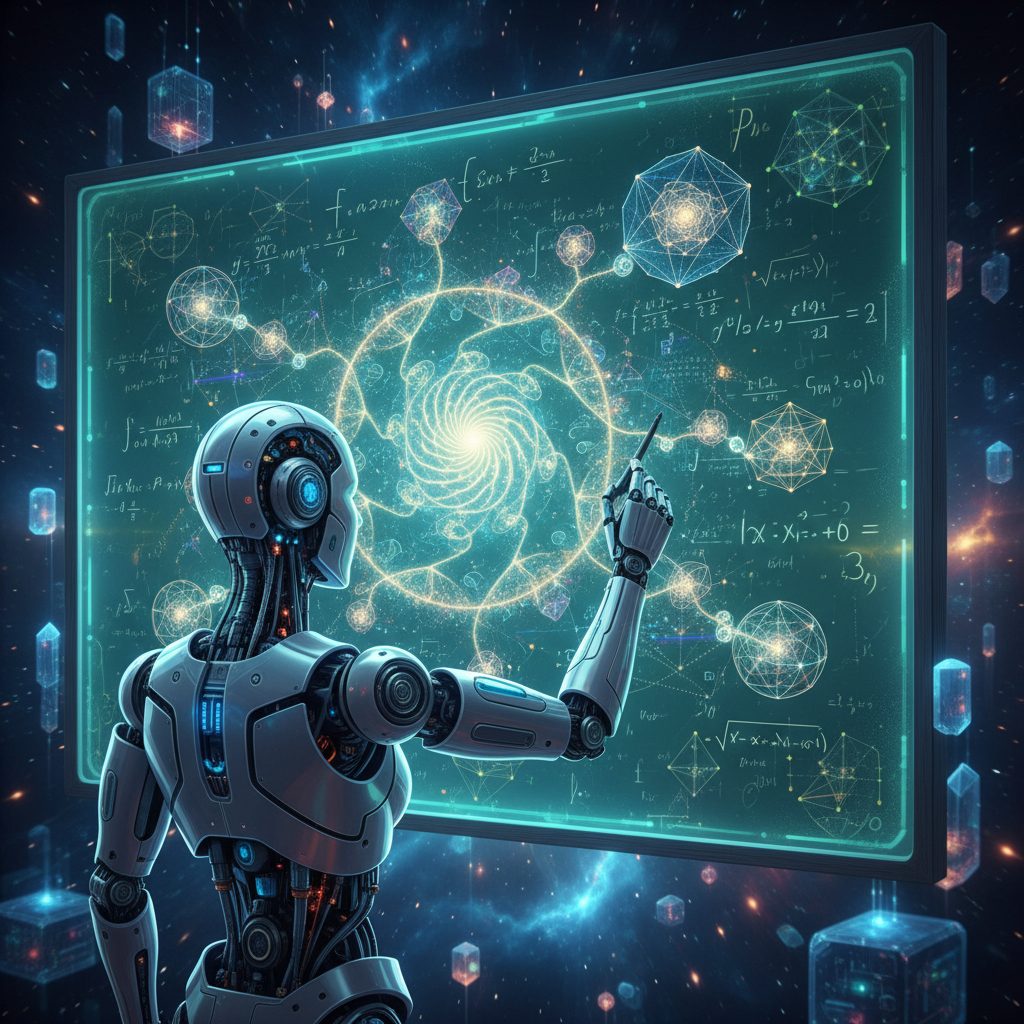
Image: AI-generated
4. A New AI Documentary and the Art of Asking Hard Questions
It’s worth pausing on something the documentary story and the Axiom story share: both involve the question of what AI can and can’t do when the stakes are highest. Lough’s film fails, in WIRED’s reading, because it gets close to the people making the most consequential decisions in tech history and then pulls its punches. Charton’s work succeeds, at least in early results, precisely because it doesn’t try to replicate what already exists — it hunts for structural novelties that no human has noticed yet.
That tension — between derivative competence and genuine discovery — runs through almost every serious discussion of AI right now. Large language models are extraordinarily good at synthesizing what exists. They are, as Charton puts it, “pretrained on all the data.” The interesting frontier is everything they haven’t been trained on: unexplored mathematical structures, genuinely novel scientific hypotheses, ethical frameworks for situations nobody has faced before. Building AI that operates at that frontier requires different architectures and different evaluation methods than benchmarking on existing problems.
The afternoon’s stories, taken together, suggest a useful frame: the AI tools that will matter most in the next decade won’t just be the ones that process information fastest. They’ll be the ones that find signal in unexplored territory — whether that’s new battery materials, new mathematical theorems, or new ways of asking questions of the people who are shaping the world. For developers building those kinds of tools, platforms like n8n are increasingly being used to wire together multi-step AI research pipelines — connecting model APIs, data sources, and custom logic without needing a full engineering team.
That’s your afternoon digest for Monday, March 30. Subscribe to catch the evening recap, or browse the archive for more context on the week’s biggest AI stories.
Image: AI-generated
The convergence of quantum machine learning and materials science represents one of 2026’s most promising frontiers, where AI algorithms can simulate atomic interactions at unprecedented scales. These systems are now predicting novel solid-state electrolytes and cathode materials that could double energy density while reducing reliance on scarce minerals like cobalt and lithium. Companies leveraging these AI-driven discoveries are positioned to dominate the next generation of sustainable energy storage technologies.
Recent breakthroughs in generative AI for molecular design allow researchers to explore billions of potential compounds in silico before synthesis. This computational acceleration is particularly crucial for developing grid-scale battery systems needed for renewable energy transition. As climate challenges intensify, the role of AI-powered materials discovery in creating efficient, abundant, and environmentally friendly energy solutions becomes increasingly vital for global sustainability goals.
This article was produced with the assistance of AI tools and reviewed by the AIStackDigest editorial team.