
A quieter Saturday evening in the AI news cycle — but don’t mistake quiet for uneventful. Today’s closing digest covers stories that operate on longer timescales than the typical product launch or funding announcement: Apple’s AI strategy as it enters its second half-century, an extraordinary biomedical breakthrough enabled by AI-driven bioreactor technology, the growing entanglement of AI research with geopolitics, and what the new wave of AI documentaries tells us about how the public is processing this technological moment. Plus: how many ads did ChatGPT serve in 500 questions? Quite a few, it turns out.
1. Apple at 50: The Next Fifty Years Will Be Won or Lost on AI
Apple turned 50 this week, and in a rare forward-looking moment, the notoriously tight-lipped company opened up to WIRED about its AI strategy. The key message from senior executives: Apple still plans to be selling iPhones in 50 more years — but the device form factor and the intelligence inside it will look radically different. Apple is betting that its edge in on-device AI (a result of its control over both hardware and software) will matter more as privacy concerns deepen and users grow wary of their data leaving their devices.

Image: AI-generated
It is a calculated wager. The rest of the industry races to centralize intelligence in massive cloud clusters, Apple is doubling down on what it calls “Apple Intelligence” — models that run locally, infer privately, and interact with your data without phoning home. The 50th anniversary interviews revealed something else too: Apple is deeply aware it has ground to make up. While rivals shipped agentic features, multimodal reasoning, and code assistants over the past two years, Apple’s consumer AI rollout has been cautious to the point of frustrating observers. The executives WIRED spoke to framed this not as slowness, but as care — the Apple brand, they argued, has always sold trust alongside technology. Shipping a hallucinating assistant that recommends the wrong medication or misreads a calendar invite would do lasting damage.
What to watch: WWDC 2026 is shaping up to be one of Apple’s most consequential developer conferences ever. Expect major announcements around on-device model capabilities, expanded Siri agentic features, and new APIs that let developers build directly on Apple Intelligence. Read the full WIRED feature: Apple Still Plans to Sell iPhones When It Turns 100.
2. The AI Bioreactor That Kept a Human Organ Alive Outside the Body
In one of the most striking science stories of the year, researchers at the Carlos Simón Foundation in Spain announced they had kept a donated human uterus alive outside the body for a full day — a world first. The machine at the center of the experiment is a rolling metal cabinet about a meter tall, threaded with plastic tubing that acts as artificial veins and arteries. Modified human blood circulates through the organ, monitored and regulated by AI-driven sensors that continuously adjust pressure, temperature, and blood chemistry.
The immediate goal is to use the system to study uterine disorders and the earliest stages of pregnancy, conditions that are currently almost impossible to observe in a living patient with adequate detail. The team hopes to extend organ viability long enough to witness a complete menstrual cycle in an ex-vivo environment. The longer-term implications — studying organ function, testing drugs, potentially developing ectogenesis technologies — are profound and deliberately left open-ended by the researchers.
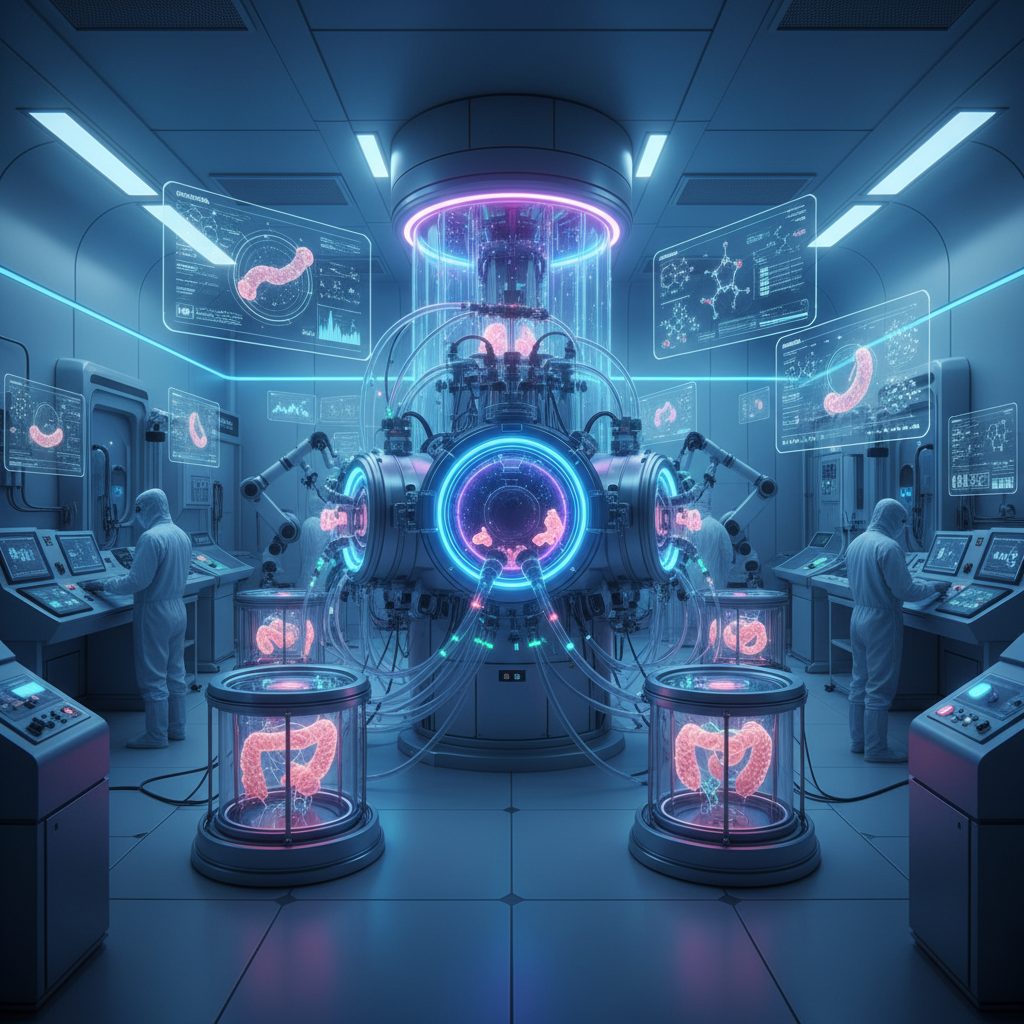
Image: AI-generated
The AI component here is not incidental. Keeping a complex biological organ alive outside its natural environment requires real-time monitoring at a granularity that human researchers simply cannot maintain manually. Machine learning models trained on biometric signals continuously tune the perfusion parameters — the same class of adaptive control algorithms increasingly used in robotic surgery and ICU patient monitoring. This is AI embedded in the infrastructure of science itself, quietly making experiments possible that weren’t possible before. The work has not yet been peer-reviewed, but the MIT Technology Review report provides strong technical detail. Full story: MIT Technology Review — A woman’s uterus has been kept alive outside the body for the first time.
Why it matters beyond the headline: This is a bellwether for AI in frontier science. Biomedical research is entering a phase where AI doesn’t just analyze existing data — it enables experiments that generate fundamentally new data. Drug discovery startups like those building on OpenRouter’s multi-model infrastructure are watching this space closely as the cost curves for biological AI experimentation start to resemble those of software.
3. NeurIPS, China, and the Fracturing of Global AI Research
The Conference on Neural Information Processing Systems — NeurIPS, the world’s most prestigious AI research venue — found itself at the centre of a geopolitical storm this week. Conference organisers announced new restrictions on international participants that Chinese researchers immediately read as discriminatory. The backlash was swift and loud, with prominent Chinese AI scientists threatening a boycott. Within days, the policy was reversed — but the damage to the relationship was done, and the incident crystallised something that has been building for years: global AI research is fracturing along national lines.
The US-China dimension is the most obvious fault line, but it is not the only one. Export controls on chips, visa restrictions on researchers, and now conference access policies are slowly formalising what had been an informal global research commons into something that looks more like Cold War-era scientific silos. Paul Triolo of DGA-Albright Stonebridge put it bluntly: “This is a potential watershed moment.” The NeurIPS reversal bought goodwill, but the underlying pressures have not gone anywhere. If anything, the incident showed how quickly the scientific community can be politicised by administrative decisions made without adequate consultation.
The paradox: Chinese AI research has become some of the most cited and influential in the world — DeepSeek, for instance, lit up the global research community earlier this year. Excluding Chinese researchers from Western conferences doesn’t slow Chinese AI development; it just reduces the cross-pollination of ideas that has historically benefited everyone. The question of how to maintain scientific openness under geopolitical pressure is one the community has no good answer to yet.
4. What ChatGPT’s Ads Look Like at Scale — 500 Questions Later
WIRED’s Reece Rogers spent a week asking ChatGPT 500 questions on the mobile app to document the ad rollout on its free tier. The findings are illuminating. Roughly one in five new conversation threads triggered an ad — displayed beneath the model’s response in a clearly labelled format. The most common advertisers leaned heavily toward software and productivity tools: project management platforms, subscription services, and — in a slightly recursive twist — other AI tools.
The ad relevance was mixed. Some placements felt contextually reasonable; others felt jarring in a way that search ads rarely do, because the conversational format creates a different expectation. When you type a question into a search bar, you expect commercial results alongside your answer. When you’re mid-conversation with an AI assistant about a personal problem, an insurance ad at the bottom of the response reads differently. OpenAI is threading a needle: it needs ad revenue to sustain its free tier at scale, but it risks eroding the user trust that makes ChatGPT more valuable than its competitors.
For developers building applications on top of AI APIs and looking to avoid ad-laden interfaces, direct API access remains the cleaner path. Platforms like OpenRouter offer unified API access across dozens of models — including OpenAI’s — without the consumer-tier monetisation overhead. As the ad rollout continues and spreads to more regions, expect this to become a clearer differentiator between consumer and developer-facing AI products.
5. The AI Documentary That Goes Too Easy on the CEOs
A new documentary — The AI Doc: Or How I Became an Apocaloptimist — hit screens this week, featuring sit-down interviews with AI’s most prominent figures, including Sam Altman. WIRED’s review is pointed: the film seeks a middle ground between AI panic and AI boosterism, lands closer to the latter, and ends up letting executives off the hook for hard questions. The documentary captures the genuine charisma and apparent good faith of people like Altman, but struggles to hold them accountable in any meaningful way.
This matters beyond film criticism. How the public understands AI — through documentaries, journalism, social media — shapes the regulatory and cultural environment in which AI companies operate. A documentary that treats AI executives with uncritical admiration is essentially advertising with better cinematography. The harder questions — about power concentration, about democratic accountability for transformative technology, about what happens when these systems fail at scale — don’t get resolved by a charming interview. They get resolved, or not, by policy.
The broader pattern: 2026 is seeing a surge in AI cultural products — books, films, podcasts — that reflect the public trying to process a transformation happening faster than institutions can track. The better ones ask uncomfortable questions. The weaker ones marvel at the technology without interrogating who controls it.
What to Watch Tomorrow
- Apple WWDC 2026 speculation heats up: Following this week’s 50th anniversary coverage, developer chatter about what Apple Intelligence features will ship at WWDC is intensifying. Watch for any pre-event leaks about expanded on-device model capabilities or new Siri agentic APIs.
- NeurIPS fallout: The policy reversal bought peace, but expect more commentary from AI researchers on both sides over the weekend about the state of US-China scientific collaboration. Academic voices — not just policy analysts — are starting to weigh in.
- Biomedical AI: The uterus bioreactor work from Spain hasn’t yet gone through peer review. Watch for pre-print publication or conference announcements that would bring it more formal scrutiny and open the methodological debate.
- AI drug discovery funding: Converge Bio’s recent M Series A is one of several AI-in-life-sciences deals closing this quarter. Monday’s market open could bring more announcements as the biotech-meets-AI funding wave continues.
- ChatGPT ads expansion: The US rollout is the test run. Expect OpenAI to announce wider geographic rollout of the free-tier ad programme in coming weeks, which will put the user experience questions raised this week to a much larger test.
That’s the Saturday evening wrap. A day that started with legal injunctions and ended with organ bioreactors — AI touches more of the world every day, and not always where you’d expect. See you tomorrow morning.
Image: AI-generated
What to Read Next
- Police AI Facial Recognition Wrongful Arrests 2026: A Crisis of Justice
- Morning AI News Digest — Tuesday, March 31, 2026
- Evening AI News Recap — Monday, March 30, 2026
- Afternoon AI News Digest — Monday, March 30, 2026
- Browse all AI Stack Digest articles
Bookmark aistackdigest.com for daily AI tools, reviews, and workflow guides.
This article was produced with the assistance of AI tools and reviewed by the AIStackDigest editorial team.